
Project Gutenberg Etext of A Journey in Other Worlds by J. J. Astor
 '
' Front cover
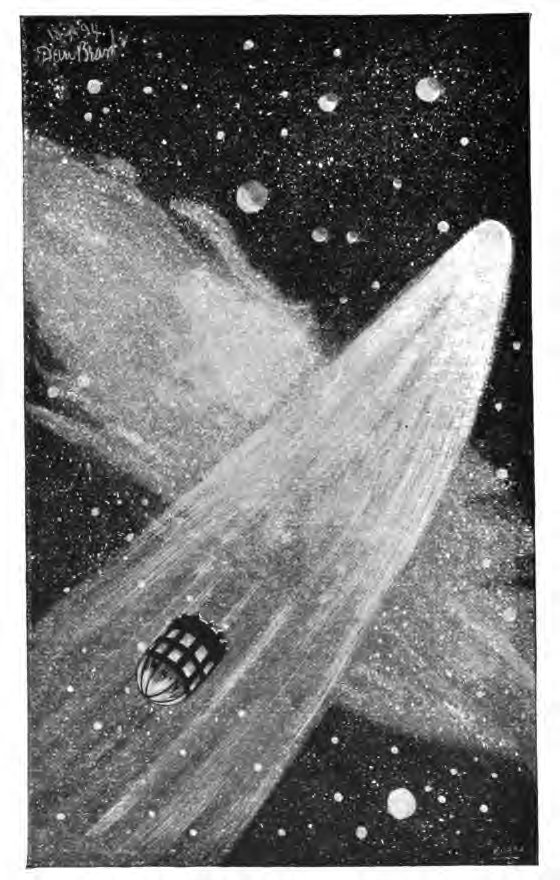
The Callisto and the Comet (Page 145)
A JOURNEY IN OTHER WORLDS
A ROMANCE OF THE FUTURE
BY JOHN JACOB ASTOR
with Ten Illustrations
PREFACE.
The protracted struggle between science and the classics appearsto be drawing to a close, with victory about to perch on thebanner of science, as a perusal of almost any university orcollege catalogue shows. While a limited knowledge of both Greekand Latin is important for the correct use of our own language,the amount till recently required, in my judgment, has beenabsurdly out of proportion to the intrinsic value of thesebranches, or perhaps more correctly roots, of study. Theclassics have been thoroughly and painfully threshed out, and itseems impossible that anything new can be unearthed. We mayequal the performances of the past, but there is no opportunityto surpass them or produce anything original. Even themuch-vaunted "mental training" argument is beginning to pall; forwould not anything equally difficult give as good developingresults, while by learning a live matter we kill two birds withone stone? There can be no question that there are many forcesand influences in Nature whose existence we as yet little morethan suspect. How much more interesting it would be if, insteadof reiterating our past achievements, the magazines andliterature of the period should devote their consideration towhat we do NOT know! It is only through investigation andresearch that inventions come; we may not find what we are insearch of, but may discover something of perhaps greater moment.It is probable that the principal glories of the future will befound in as yet but little trodden paths, and as Prof. Cortlandtjustly says at the close of his history, "Next to religion, wehave most to hope from science."
Contents.
BOOK I.
- - JUPITER.
- - ANTECEDENTAL
- - PRESIDENT BEARWARDEN'S SPEECH
- - PROF. CORTLANDT'S HISTORICAL SKETCH OF THE WORLD IN A.D. 2000
- - DR. CORTLANDT'S HISTORY CONTINUED
- - FAR-REACHING PLANS
- - HARD AT WORK
- - GOOD-BYE
BOOK II.
- - THE LAST OF THE EARTH
- - SPACE AND MARS
- - HEAVENLY BODIES
- - PREPARING TO ALIGHT
- - EXPLORATION AND EXCITEMENT
- - MASTODON AND WILL-O'-THE-WISP
- - AN UNSEEN HUNTER
- - SPORTSMEN'S REVERIES
- - THE HONEY OF DEATH
- - CHANGING LANDSCAPES
- - A JOVIAN NIAGARA
- - HILLS AND VALLEYS
- - NORTH-POLAR DISCOVERIES
- - THE SCENE SHIFTS
BOOK III.
- - SATURN
- - THE SPIRIT'S FIRST VISIT
- - DOUBTS AND PHILOSOPHY
- - A PROVIDENTIAL INTERVENTION
- - AYRAULT'S VISION
- - A GREAT VOID AND A GREAT LONGING
- - THE SPIRIT'S SECOND VISIT
- - CASSANDRA AND COSMOLOGY
- - DR. CORTLANDT SEES HIS GRAVE
- - AYRAULT
- - DREAMLAND TO SHADOWLAND
- - SHEOL
- - THE PRIEST'S SERMON
- - HIC ILLE JACET
- - MOTHER EARTH
LIST OF ILLUSTRATIONS,
INCLUDING NINE DRAWINGS BY MR. DAN. BEARD,
AND A DIAGRAM.
- The Callisto and the Comet
- The Callisto was going straight up
- The Signals from the Arctic Circle
- Diagram of the Comparative Sizes of the Planets
- The Ride on the Giant Tortoise
- A Battle Royal on Jupiter
- The Combat with the Dragons
- Ayrault's Vision
- They look into the Future
- The Return
Book I.
A JOURNEY IN OTHER WORLDS.
Chapter I.Contents
JUPITER.
Jupiter--the magnificent planet with a diameter of 86,500miles, having 119 times the surface and 1,300 times the volume ofthe earth--lay beneath them.
They had often seen it in the terrestrial sky, emitting itsstrong, steady ray, and had thought of that far-away planet,about which till recently so little had been known, and a burningdesire had possessed them to go to it and explore its mysteries.Now, thanks to APERGY, the force whose existence the ancientssuspected, but of which they knew so little, all things werepossible.
Ayrault manipulated the silk-covered glass handles, and theCallisto moved on slowly in comparison with its recent speed,and all remained glued to their telescopes as they peered throughthe rushing clouds, now forming and now dissolving before theireyes. What transports of delight, what ecstatic bliss, wastheirs! Men had discovered and mastered the secret of apergy,and now, "little lower than the angels," they could soar throughspace, leaving even planets and comets behind.
"Is it not strange," said Dr. Cortlandt, "that though it has beenknown for over a century that bodies charged with unlikeelectricities attract one another, and those charged with likerepel, no one thought of utilizing the counterpart ofgravitation? In the nineteenth century, savants and Indianjugglers performed experiments with their disciples and masses ofinert matter, by causing them to remain without visible supportat some distance from the ground; and while many of these, ofcourse, were quacks, some were on the right track, though theydid not push their research."
President Bearwarden and Ayrault assented. They were steeringfor an apparently hard part of the planet's surface, about adegree and a half north of its equator.
"Since Jupiter's axis is almost at right angles to the plane ofits orbit," said the doctor, "being inclined only about onedegree and a half, instead of twenty-three and a half, as was theearth's till nearly so recently, it will be possible for us tohave any climate we wish, from constantly warm at the equator toconstantly cool or cold as we approach the poles, without beingtroubled by extremes of winter and summer."
Until the Callisto entered the planet's atmosphere, its fivemoons appeared like silver shields against the black sky, but nowthings were looking more terrestrial, and they began to feel athome. Bearwarden put down his note-book, and Ayrault returned aphotograph to his pocket, while all three gazed at their newabode. Beneath them was a vast continent variegated by chains oflakes and rivers stretching away in all directions except towardthe equator, where lay a placid ocean as far as their telescopescould pierce. To the eastward were towering and massivemountains, and along the southern border of the continent smokingvolcanoes, while toward the west they saw forests, gently rollingplains, and table-lands that would have satisfied a poet or setan agriculturist's heart at rest. "How I should like to minethose hills for copper, or drain the swamps to the south!"exclaimed Col. Bearwarden. "The Lake Superior mines and thereclamation of the Florida Everglades would be nothing to this."
"Any inhabitants we may find here have so much land at theirdisposal that they will not need to drain swamps on account ofpressure of population for some time," put in the doctor.
"I hope we may find some four-legged inhabitants," said Ayrault,thinking of their explosive magazine rifles. "If Jupiter ispassing through its Jurassic or Mesozoic period, there must beany amount of some kind of game." Just then a quiver shook theCallisto, and glancing to the right they noticed one of thevolcanoes in violent eruption. Smoke filled the air in clouds,hot stones and then floods of lava poured from the crater, whileeven the walls of the hermetically sealed Callisto could notarrest the thunderous crashes that made the interior of the carresound.
"Had we not better move on?" said Bearwarden, and accordinglythey went toward the woods they had first seen. Finding a firmstrip of land between the forest and an arm of the sea, theygently grounded the Callisto, and not being altogether sure howthe atmosphere of their new abode would suit terrestrial lungs,or what its pressure to the square inch might be, they cautiouslyopened a port-hole a crack, retaining their hold upon it with itsscrew. Instantly there was a rush and a whistling sound as ofescaping steam, while in a few moments their barometer stood atthirty-six inches, whereupon they closed the opening.
"I fancy," said Dr. Cortlandt, "we had better wait now till webecome accustomed to this pressure. I do not believe it will gomuch higher, for the window made but little resistance when weshut it."
Finding they were not inconvenienced by a pressure but littlegreater than that of a deep coal-mine, they again opened theport, whereupon their barometer showed a further rise toforty-two, and then remained stationary. Finding also that thechemical composition of the air suited them, and that they had nodifficulty in breathing, the pressure being the same as thatsustained by a diver in fourteen feet of water, they opened adoor and emerged. They knew fairly well what to expect, and werenot disturbed by their new conditions. Though they hadapparently gained a good deal in weight as a result of theirethereal journey, this did not incommode them; for thoughJupiter's volume is thirteen hundred times that of the earth, onaccount of its lesser specific gravity, it has but three hundredtimes the mass--i. e., it would weigh but three hundred times asmuch. Further, although a cubic foot of water or anything elseweighs 2.5 as much as on earth, objects near the equator, onaccount of Jupiter's rapid rotation, weigh one fifth less thanthey do at the poles, by reason of the centrifugal force.Influenced by this fact, and also because they were 483,000,000miles from the sun, instead of 92,000,000 as on earth, they hadsteered for the northern limit of Jupiter's tropics. And, inaddition to this, they could easily apply the apergetic power inany degree to themselves when beyond the limits of the Callisto,and so be attracted to any extent, from twice the pull theyreceive from gravitation on earth to almost nothing.
Bearwarden and Ayrault shouldered their rifles, while Dr.Cortlandt took a repeating shot-gun with No. 4 shot, and, havingalso some hunting-knives and a sextant, all three set out in anorthwesterly direction. The ground was rather soft, and a warmvapor seemed to rise from it. To the east the sky was veiled bydense clouds of smoke from the towering volcanoes, while on theirleft the forest seemed to extend without limit. Clumps of hugeferns were scattered about, and the ground was covered withcurious tracks.
"Jupiter is evidently passing through a Carboniferous or Devonianperiod such as existed on earth, though, if consistent with itssize, it should be on a vastly larger scale," said the doctor."I never believed in the theory," he continued, "that the largerthe planet the smaller should be its inhabitants, and alwaysconsidered it a makeshift, put forward in the absence of definiteknowledge, the idea being apparently that the weight of verylarge creatures would be too great for their strength. Of thefact that mastodons and creatures far larger than any now livingon earth existed there, we have absolute proof, thoughgravitation must have been practically the same then as now."
Just here they came upon a number of huge bones, evidently theremains of some saurian, and many times the size of a growncrocodile. On passing a growth of most luxuriant vegetation,they saw a half-dozen sacklike objects, and drawing nearernoticed that the tops began to swell, and at the same time becamelighter in colour. Just as the doctor was about to investigateone of them with his duck-shot, the enormously inflated tops ofthe creatures collapsed with a loud report, and the entire groupsoared away. When about to alight, forty yards off, theydistended membranous folds in the manner of wings, which checkedtheir descent, and on touching the ground remained where theywere without rebound.
"We expected to find all kinds of reptiles and birds," exclaimedthe doctor. "But I do not know how we should class thosecreatures. They seem to have pneumatic feet and legs, for theirmotion was certainly not produced like that of frogs."
When the party came up with them the heads again began to swell.
"I will perforate the air-chamber of one," said Col. Bearwarden,withdrawing the explosive cartridge from the barrel of his rifleand substituting one with a solid ball. "This will doubtlessdisable one so that we can examine it."
Just as they were about to rise, he shot the largest through theneck. All but the wounded one, soared off, while Bearwarden,Ayrault, and Cortlandt approached to examine it more closely.
"You see," said Cortlandt, "this vertebrate--for that is asdefinitely as we can yet describe it--forces a great pressure ofair into its head and neck, which, by the action of valves, itmust allow to rush into its very rudimentary lower extremities,distending them with such violence that the body is shot upwardand forward. You may have noticed the tightly inflated portionunderneath as they left the ground."
While speaking he had moved rather near, when suddenly apartially concealed mouth opened, showing the unmistakable tongueand fangs of a serpent. It emitted a hissing sound, and thesmall eyes gleamed maliciously.
"Do you believe it is a poisonous species?" asked Ayrault.
"I suspect it is," replied the doctor; "for, though it isdoubtless able to leap with great accuracy upon its prey, we sawit took some time to recharge the upper air-chamber, so that,were it not armed with poison glands, it would fall an easyvictim to its more powerful and swifter contemporaries, and wouldsoon become extinct."
"As it will be unable to spring for some time," said Bearwarden,"we might as well save it the disappointment of trying," and,snapping the used shell from his rifle, he fired an explosiveball into the reptile, whereupon about half the body disappeared,while a sickening odour arose. Although the sun was still farabove the horizon, the rapidity with which it was descendingshowed that the short night of less than five hours would soon beupon them; and though short it might be very dark, for they werein the tropics, and the sun, going down perpendicularly, mustalso pass completely around the globe, instead of, as in northernlatitudes on earth in summer, approaching the horizon obliquely,and not going far below it. A slight and diffused sound hereseemed to rise from the ground all about them, for which theycould not account. Presently it became louder, and as the suntouched the horizon, it poured forth in prolonged strains. Thelarge trumpet-shaped lilies, reeds, and heliotropes seemed fairlyto throb as they raised their anthem to the sky and the settingsun, while the air grew dark with clouds of birds that graduallyalighted on the ground, until, as the chorus grew fainter andgradually ceased, they flew back to their nests. The threecompanions had stood astonished while this act was played. Thedoctor then spoke:
"This is the most marvellous development of Nature I have seen,for its wonderful divergence from, and yet analogy to, what takesplace on earth. You know our flowers offer honey, as it were, asbait to insects, that in eating or collecting it they may catchthe pollen on their legs and so carry it to other flowers,perhaps of the opposite sex. Here flowers evidently appeal tothe sense of hearing instead of taste, and make use of birds, ofwhich there are enormous numbers, instead of winged insects, ofwhich I have seen none, one being perhaps the natural result ofthe other. The flowers have become singers by long practice, orelse, those that were most musical having had the best chance toreproduce, we have a neat illustration of the 'survival of thefittest.' The sound is doubtless produced by a shrinking of thefibres as the sun withdraws its heat, in which case we may expectanother song at sunrise, when the same result will be effected bytheir expanding."
Searching for a camping-place in which to pass the coming hours,they saw lights flitting about like will-o'-the-wisps, butbrighter and intermittent.
"They seem to be as bright as sixteen-candle-power lamps, but thelight is yellower, and appears to emanate from a comparativelylarge surface, certainly nine or ten inches square," said thedoctor.
They soon gave up the chase, however, for the lights werecontinually moving and frequently went out. While groping in thegrowing darkness, they came upon a brown object about the size ofa small dog and close to the ground. It flew off with a humminginsect sound, and as it did so it showed the brilliantphosphorescent glow they had observed.
"That is a good-sized fire-fly," said Bearwarden. "Evidently theinsects here are on the same scale as everything else. They arelike the fire-flies in Cuba, which the Cubans are said to putinto a glass box and get light enough from to read by. Here theywould need only one, if it could be induced to give its lightcontinuously."
Having found an open space on high ground, they sat down, andBearwarden struck his repeater, which, for convenience, had beenarranged for Jupiter time, dividing the day into ten hours,beginning at noon, midnight being therefore five o'clock.
"Twenty minutes past four," said he, "which would correspond toabout a quarter to eleven on earth. As the sun rises athalf-past seven, it will be dark about three hours, for the timebetween dawn and daylight will, of course, be as short as that wehave just experienced between sunset and night."
"If we stay here long," said the doctor, "I suppose we shallbecome accustomed, like sailors, to taking our four, or in thiscase five, hours on duty, and five hours off."
"Or," added Ayrault, "we can sleep ten consecutive hours and takethe next ten for exploring and hunting, having the sun for onehalf the time and the moons for the other."
Bearwarden and Cortlandt now rolled themselves in their blanketsand were soon asleep, while Ayrault, whose turn it was to watchtill the moons rose--for they had not yet enough confidence intheir new domain to sleep in darkness simultaneously--leaned hisback against a rock and lighted his pipe. In the distance he sawthe torrents of fiery lava from the volcanoes reflected in thesky, and faintly heard their thunderous crashes, while thefire-flies twinkled unconcernedly in the hollow, and the nightwinds swayed the fernlike branches. Then he gazed at the earth,which, but little above the horizon, shone with a faint butsteady ray, and his mind's eye ran beyond his natural visionwhile he pictured to himself the girl of his heart, wishing thatby some communion of spirits he might convey his thoughts to her,and receive hers. It was now the first week of January on earth.He could almost see her house and the snow-clad trees in thepark, and knew that at that hour she was dressing for dinner, andhoped and believed that he was in her heart. While he thusmused, one moon after another rose, each at a different phase,till three were at once in the sky. Adjusting the electricprotection-wires that were to paralyze any creature thatattempted to come within the circle, and would arouse them byringing a bell, he knocked the ashes from his pipe, rolledhimself in a blanket, and was soon asleep beside his friends.
Chapter II.Contents
ANTECEDENTAL.
"Come in!" sounded a voice, as Dr. Cortlandt and Dick Ayraulttapped at the door of the President of the Terrestrial AxisStraightening Company's private office on the morning of the 21stof June, A. D. 2000. Col. Bearwarden sat at his capacious desk,the shadows passing over his face as April clouds flit across thesun. He was a handsome man, and young for the important post hefilled--being scarcely forty--a graduate of West Point, withgreat executive ability, and a wonderful engineer. "Sit down,chappies," said he; "we have still a half hour before I begin toread the report I am to make to the stockholders andrepresentatives of all the governments, which is now ready. Iknow YOU smoke," passing a box of Havanas to the professor.
Prof. Cortlandt, LL. D., United States Government expert,appointed to examine the company's calculations, was about fifty,with a high forehead, greyish hair, and quick, grey eyes, ageologist and astronomer, and altogether as able a man, in hisown way, as Col. Bearwarden in his. Richard Ayrault, a largestockholder and one of the honorary vice-presidents in thecompany, was about thirty, a university man, by nature ascientist, and engaged to one of the prettiest society girls, whowas then a student at Vassar, in the beautiful town ofPoughkeepsie.
"Knowing the way you carry things in your mind, and thedifficulty of rattling you," said Cortlandt, "we have dropped inon our way to hear the speech that I would not miss for afortune. Let us know if we bother you."
"Impossible, dear boy," replied the president genially. "Since Isurvived your official investigations, I think I deserve some ofyour attention informally."
"Here are my final examinations," said Cortlandt, handingBearwarden a roll of papers. "I have been over all your figures,and testify to their accuracy in the appendix I have added."
So they sat and chatted about the enterprise that interestedCortlandt and Ayrault almost as much as Bearwarden himself. Asthe clock struck eleven, the president of the company put on hishat, and, saying au revoir to his friends, crossed the street tothe Opera House, in which he was to read a report that would becopied in all the great journals and heard over thousands ofmiles of wire in every part of the globe. When he arrived, thevast building was already filled with a distinguished company,representing the greatest intelligence, wealth, and powers of theworld. Bearwarden went in by the stage entrance, exchanginggreetings as he did so with officers of the company and directorswho had come to hear him. Cortlandt and Ayrault entered by theregular door, the former going to the Government representatives'box, the latter to join his fiancee, Sylvia Preston, who wasthere with her mother. Bearwarden had a roll of manuscript athand, but so well did he know his speech that he scarcely glancedat it. After being introduced by the chairman of the meeting,and seeing that his audience was all attention, he began, holdinghimself erect, his clear, powerful voice making every part of thebuilding ring.
Chapter III.Contents
PRESIDENT BEARWARDEN'S SPEECH.
"To the Bondholders and Stockholders of the Terrestrial AxisStraightening Company and Representatives of Earthly Governments.
"GENTLEMEN: You know that the objects of this company are, tostraighten the axis of the earth, to combine the extreme heat ofsummer with the intense cold of winter and produce a uniformtemperature for each degree of latitude the year round. Atpresent the earth's axis--that is, the line passing through itscentre and the two poles--is inclined to the ecliptic abouttwenty-three and a half degrees. Our summer is produced by thenorthern hemisphere's leaning at that angle towards the sun, andour winter by its turning that much from it. In one case thesun's rays are caused to shine more perpendicularly, and in theother more obliquely. This wabbling, like that of a top, is thesole cause of the seasons; since, owing to the eccentricity ofour orbit, the earth is actually fifteen hundred thousand milesnearer the sun during our winter, in the northern hemisphere,than in summer. That there is no limit to a planet'sinclination, and that inclination is not essential, we haveastronomical proof. Venus's axis is inclined to the plane of herorbit seventy-five degrees, so that the arctic circle comeswithin fifteen degrees of the equator, and the tropics alsoextend to latitude seventy-five degrees, or within fifteendegrees of the poles, producing great extremes of heat and cold.
"Venus is made still more difficult of habitation by the factthat she rotates on her axis in the same time that she revolvesabout the sun, in the same way that the moon does about theearth, so that one side must be perpetually frozen while theother is parched.
"In Uranus we see the axis tilted still further, so that thearctic circle descends to the equator. The most varied climatemust therefore prevail during its year, whose length exceedseighty-one of ours.
"The axis of Mars is inclined about twenty-eight and two thirdsdegrees to the plane of its orbit; consequently its seasons mustbe very similar to ours, the extremes of heat and cold beingsomewhat greater.
"In Jupiter we have an illustration of a planet whose axis isalmost at right angles to the plane of its orbit, being inclinedbut about a degree and a half. The hypothetical inhabitants ofthis majestic planet must therefore have perpetual summer at theequator, eternal winter at the poles, and in the temperateregions everlasting spring. On account of the straightness ofthe axis, however, even the polar inhabitants--if there areany--are not oppressed by a six months' night, for all exceptthose at the VERY pole have a sunrise and a sunset every tenhours--the exact day being nine hours, fifty five minutes, andtwenty-eight seconds. The warmth of the tropics is also temperedby the high winds that must result from the rapid whirl on itsaxis, every object at the equator being carried around by this atthe rate of 27,600 miles an hour, or over three thousand milesfarther than the earth's equator moves in twenty-four hours.
"The inclination of the axis of our own planet has alsofrequently considerably exceeded that of Mars, and again has beenbut little greater than Jupiter's at least, this is by all oddsthe most reasonable explanation of the numerous Glacial periodsthrough which our globe has passed, and of the recurring mildspells, probably lasting thousands of years, in which elephants,mastodons, and other semi-tropical vertebrates roamed in Siberia,some of which died so recently that their flesh, preserved by thecold, has been devoured by the dogs of modern explorers.
"It is not to be supposed that the inclining of the axes ofJupiter, Venus, the Earth, and the other planets, is now fixed;in some cases it is known to be changing. As long ago as 1890,Major-Gen. A. W. Drayson, of the British Army, showed, in a workentitled Untrodden Ground in Astronomy and Geology, that, as aresult of the second rotation of the earth, the inclination ofits axis was changing, it having been 23° 28' 23" on January 1,1750, 23° 27' 55.3" on January 1, 1800, and 23° 27' 30.9" onJanuary 1, 1850; and by calculation one hundred and ten years agoshowed that in 1900 (one hundred years ago) it would be 23° 27'08.8". This natural straightening is, of course, going on, andwe are merely about to anticipate it. When this improvement wasmooted, all agreed that the EXTREMES of heat and cold could wellbe spared. 'Balance those of summer against those of winter bypartially straightening the axis; reduce the inclination fromtwenty-three degrees, thirty minutes, to about fifteen degrees,but let us stop there,' many said. Before we had gone far,however, we found it would be best to make the work complete.This will reclaim and make productive the vast areas of Siberiaand the northern part of this continent, and will do much for theantarctic regions; but there will still be change in temperature;a wind blowing towards the equator will always be colder than oneblowing from it, while the slight eccentricity of the orbit willsupply enough change to awaken recollections of seasons in oureternal spring.
"The way to accomplish this is to increase the weight of the poleleaving the sun, by increasing the amount of material there forthe sun to attract, and to lighten the pole approaching orturning towards the sun, by removing some heavy substance fromit, and putting it preferably at the opposite pole. Thisshifting of ballast is most easily accomplished, as you willreadily perceive, by confining and removing water, which iseasily moved and has a considerable weight. How we purpose toapply these aqueous brakes to check the wabbling of the earth, bymeans of the attraction of the sun, you will now see.
"From Commander Fillmore, of the Arctic Shade and the Committeeon Bulkheads and Dams, I have just received the following bycable telephone: 'The Arctic Ocean is now in condition to bepumped out in summer and to have its average depth increased onehundred feet by the dams in winter. We have already fiftymillion square yards of windmill turbine surface in position andready to move. The cables bringing us currents from the dynamosat Niagara Falls are connected with our motors, and those fromthe tidal dynamos at the Bay of Fundy will be in contact whenthis reaches you, at which moment the pumps will begin. Inseveral of the landlocked gulfs and bays our system of confiningis so complete, that the surface of the water can be raised twohundred feet above sea-level. The polar bears will soon have touse artificial ice. Perhaps the cheers now ringing without mayreach you over the telephone.'"
The audience became greatly interested, and when the end of thetelephone was applied to a microphone the room fairly rang withexultant cheers, and those looking through a kintograph (visualtelegraph) terminating in a camera obscura on the shores ofBaffin Bay were able to see engineers and workmen waving andthrowing up their caps and falling into one another's arms inecstasies of delight. When the excitement subsided, thepresident continued:
"Chairman Wetmore, of the Committee on Excavations andEmbankments in Wilkesland and the Antarctic Continent, reports:'Two hundred and fifty thousand square miles are now hollowed outand enclosed sufficiently to hold water to an average depth offour hundred feet. Every summer, when the basin is allowed todrain, we can, if necessary, extend our reservoir, and shall havethe best season of the year for doing work until the earth haspermanent spring. Though we have comparatively little water ortidal power, the earth's crust is so thin at this latitude, onaccount of the flattening, that by sinking our tubular boilersand pipes to a depth of a few thousand feet we have secured soterrific a volume of superheated steam that, in connection withour wind turbines, we shall have no difficulty in raising half acubic mile of water a minute to our enclosure, which is butlittle above sea-level, and into which, till the pressureincreases, we can fan or blow the water, so that it can be fullthree weeks after our longest day, or, since the presentunimproved arrangement gives the indigenes but one day and nighta year, I will add the 21st day of December.
"'We shall be able to find use for much of the potential energyof the water in the reservoir when we allow it to escape in June,in melting some of the accumulated polar ice-cap, therebydecreasing still further the weight of this pole, in lighting andwarming ourselves until we get the sun's light and heat, inextending the excavations, and in charging the storage batteriesof the ships at this end of the line. Everything will be readywhen you signal "Raise water."'"
"Let me add parenthetically," said Bearwarden, "that this meansof obtaining power by steam boilers sunk to a great depth is muchto be commended; for, though the amount of heat we can withdrawis too small to have much effect, the farther towards the centreour globe can be cooled the deeper will the water of the oceansbe able to penetrate--since it is its conversion into steam thatprevents the water from working its way in farther--and the moredry land we shall have."
"You see," the president continued, "the storage capacity at thesouth pole is not quite as great as at the north, because it ismore difficult to excavate a basin than to close the exits of onethat already exists, which is what we have done in the arctic.The work is also not so nearly complete, since it will not benecessary to use the southern reservoir for storing weight forsix months, or until the south pole, which is now at its maximumdeclination from the sun, is turned towards it and begins to moveaway; then, by increasing the amount of matter there, and at thesame time lightening the north pole, and reversing the processevery six months, we decrease the speed at which the departingpole leaves the sun and at which the approaching pole advances.The north pole, we see, will be a somewhat more powerful leverthan the south for working the globe to a straight position, butwe may be sure that the latter, in connection with the former,will be able to hold up its end."[The building here fairly shook with applause, so that, had thearctic workers used the microphone, they might have heard in theenthusiastic uproar a good counterpart of their own period.]
"I only regret," the president continued, "that when we beganthis work the most marvellous force yet discovered--apergy--wasnot sufficiently understood to be utilized, for it would haveeased our labours to the point of almost eliminating them. Butwe have this consolation: it was in connection with our work thatits applicability was discovered, so that had we and all otherspostponed our great undertaking on the pretext of waiting for anew force, apergy might have continued to lie dormant forcenturies. With this force, obtained by simply blending negativeand positive electricity with electricity of the third element orstate, and charging a body sufficiently with this fluid,gravitation is nullified or partly reversed, and the earth repelsthe body with the same or greater power than that with which itstill attracts or attracted it, so that it may be suspended orcaused to move away into space. Sic itur ad astra, we may say.With this force and everlasting spring before us, what may we notachieve? We may some day be able to visit the planets, thoughmany may say that, since the axes of most of those we haveconsidered are more inclined than ours, they would rather stayhere. 'Blessed are they that shall inherit the earth,'" he wenton, turning a four-foot globe with its axis set vertically and atright angles to a yellow globe labelled "Sun"; and again waxingeloquent, he added: "We are the instruments destined to bringabout the accomplishment of that prophecy, for never in thehistory of the world has man reared so splendid a monument to hisown genius as he will in straightening the axis of the planet.
"No one need henceforth be troubled by sudden change, and everyman can have perpetually the climate he desires. Northern Europewill again luxuriate in a climate that favoured the elephantsthat roamed in northern Asia and Switzerland. To produce theseanimals and the food they need, it is not necessary to have greatheat, but merely to prevent great cold, half the summer's sunbeing absorbed in melting the winter's accumulation of ice.
"When the axis has reached a point at which it inclines but abouttwelve degrees, it will become necessary to fill the antarcticreservoir in June and the Arctic Ocean in December, in order tocheck the straightening, since otherwise it might get beyond theperpendicular and swing the other way. When this motion iscompletely arrested, I suggest that we blow up the Aleutian Islesand enlarge Bering Strait, so as to allow what corresponds to theAtlantic Gulf Stream in the Pacific to enter the ArcticArchipelago, which I have calculated will raise the averagetemperature of that entire region about thirty degrees, therebystill further increasing the amount of available land.
"Ocean currents, being the result of the prevailing winds, whichwill be more regular than at present, can be counted upon tocontinue practically as they are. It may not be plain to you whythe trade winds do not blow towards the equator due south andnorth, since the equator has much the same effect on air that astove has in the centre of a room, causing an ascending currenttowards the ceiling, which moves off in straight lines in alldirections on reaching it, its place being taken by cold currentsmoving in opposite directions along the floor. Picture toyourselves the ascending currents at the equator moving off tothe poles from which they came. As they move north they arecontinually coming to parts of the globe having smaller circlesof latitude than those they have left, and therefore not movedforward as rapidly by the earth's daily rotation as the latitudesnearer the equator. The winds consequently run ahead of thesurface, and so move east of north--the earth turning towards theeast--while the heavier colder surface currents, rushing towardsthe equator to take the place of the ascending column, comingfrom regions where the surface whirls comparatively slowly tothose where it is rotating faster, are continually left behind,and so move southwest; while south of the equator a correspondingmotion results. Though this is not the most exact explanation,it may serve to make the action clear. I will add, that if anyone prefers a colder or a warmer climate than that of the placein which he lives, he need only go north or south for an hour;or, if he prefers his own latitude, he can rise a few thousandfeet in the air, or descend to one of the worked-out coal-mineswhich are now used as sanitariums, and secure his object by aslight change of altitude. Let us speed the departure of rackingchanges and extremes of climate, and prepare to welcome what webelieve prevails in paradise--namely, everlasting spring."
Appended to the address was the report of the GovernmentExamining Committee, which ran: "We have critically examined theTerrestrial Axis Straightening Company's figures andcalculations, also its statements involving natural philosophy,physics, and astronomy, all of which we find correct, and herebyapprove.
[Signed]
"For the Committee:"HENRY CHELMSFORD CORTLANDT,
"Chairman."
The Board of Directors having ratified the acts of its officers,and passed congratulatory resolutions, the meeting adjourned sinedie.
Chapter IV.Contents
PROF. CORTLANDT'S HISTORICAL SKETCH OF THE WORLD
IN A. D. 2000.
Prof. Cortlandt, preparing a history of the times at thebeginning of the great terrestrial and astronomical change, wroteas follows: "This period--A.D. 2000--is by far the mostwonderful the world has as yet seen. The advance in scientificknowledge and attainment within the memory, of the presentgeneration has been so stupendous that it completely overshadowsall that has preceded. All times in history and all periods ofthe world have been remarkable for some distinctive orcharacteristic trait. The feature of the period of Louis XIV wasthe splendour of the court and the centralization of power inParis. The year 1789 marked the decline of the power of courtsand the evolution of government by the people. So, by the spreadof republican ideas and the great advance in science, educationhas become universal, for women as well as for men, and this ismore than ever a mechanical age.
"With increased knowledge we are constantly coming to realize howlittle we really know, and are also continually findingmanifestations of forces that at first seem like exceptions toestablished laws. This is, of course, brought about by themodifying influence of some other natural law, though many ofthese we have not yet discovered.
"Electricity in its varied forms does all work, having supersededanimal and manual labour in everything, and man has only todirect. The greatest ingenuity next to finding new uses for thisalmost omnipotent fluid has been displayed in inducing the forcesof Nature, and even the sun, to produce it. Before describingthe features of this perfection of civilization, let us reviewthe steps by which society and the political world reached theirpresent state.
"At the close of the Franco-Prussian War, in 1871, ContinentalEurope entered upon the condition of an armed camp, which lastedfor nearly half a century. The primary cause of this was themutual dislike and jealousy of France and Germany, each of whichstrove to have a larger and better equipped national defence thanthe other. There were also many other causes, as the ambition ofthe Russian Czar, supported by his country's vast thoughimperfectly developed resources and practically unlimited supplyof men, one phase of which was the constant ferment in the BalkanPeninsula, and another Russia's schemes for extension in Asia;another was the general desire for colonies in Africa, in whichone Continental power pretty effectually blocked another, and thelatent distrust inside the Triple Alliance. England, meanwhile,preserved a wise and profitable neutrality.
"These tremendous sacrifices for armaments, both on land andwater, had far-reaching results, and, as we see it now, wereclouds with silver linings. The demand for hardened steelprojectiles, nickel-steel plates, and light and almostunbreakable machinery, was a great incentive to improvement inmetallurgy while the necessity for compact and safely carriedammunition greatly stimulated chemical research, and led to thediscovery of explosives whose powers no obstacle can resist, andincidentally to other more useful things.
"Further mechanical and scientific progress, however, such asflying machines provided with these high explosives, andasphyxiating bombs containing compressed gas that could be firedfrom guns or dropped from the air, intervened. The former wouldhave laid every city in the dust, and the latter might havealmost exterminated the race. These discoveries providentiallyprevented hostilities, so that the 'Great War,' so long expected,never came, and the rival nations had their pains for nothing,or, rather, for others than themselves.
"Let us now examine the political and ethnological results.Hundreds of thousands, of the flower of Continental Europe werekilled by overwork and short rations, and millions of desirableand often--unfortunately for us--undesirable people were drivento emigration, nearly all of whom came to English-speakingterritory, greatly increasing our productiveness and power. As,we have seen, the jealousy of the Continental powers for oneanother effectually prevented their extending their influence orprotectorates to other continents, which jealousy wasconsiderably aided by the small but destructive wars that didtake place. High taxes also made it more difficult for themoneyed men to invest in colonizing or development companies,which are so often the forerunners of absorption; while theUnited States, with her coal--of which the Mediterranean stateshave scarcely any--other resources, and low taxes, which, thoughnecessary, can be nothing but an evil, has been able to expandnaturally as no other nation ever has before.
"This has given the English-speakers, especially the UnitedStates, a free hand, rendering enforcement of the Monroe doctrineeasy, and started English a long way towards becoming theuniversal language, while all formerly unoccupied land is nowowned by those speaking it.
"At the close of our civil war, in 1865, we had but 3,000,000square miles, and a population of 34,000,000. The countrystaggered beneath a colossal debt of over $4,000,000,000, had anexpensive but essentially perishable navy, and there was anominous feeling between the sections. The purchase of Alaska in1867, by which we added over half a million square miles to ourterritory, marked the resumption of the forward march of theUnited States. Twenty-five years later, at the presidentialcampaign of 1892, the debt had been reduced to $900,000,000,deducting the sinking fund, and the charge for pensions had aboutreached its maximum and soon began to decrease, though no oneobjected to any amount of reward for bona fide soldiers who hadhelped to save the country. The country's wealth had alsoenormously increased, while the population had grown to65,000,000. Our ancestors had, completed or in building, a navyof which no nation need be ashamed; and, though occasionallymarred by hard times, there was general prosperity.
"Gradually the different States of Canada--or provinces, as theywere then called--came to realize that their future would be fargrander and more glorious in union with the United States thanseparated from it; and also that their sympathy was far strongerfor their nearest neighbours than for any one else. One by onethese Northern States made known their desire for consolidationwith the Union, retaining complete control of their localaffairs, as have the older States. They were gladly welcomed byour Government and people, and possible rivals became the best offriends. Preceding and also following this, the States ofMexico, Central America, and parts of South America, tiring ofthe incessant revolutions and difficulties among themselves,which had pretty constantly looked upon us as a big brother onaccount of our maintenance of the Monroe doctrine, began toagitate for annexation, knowing they would retain control oftheir local affairs. In this they were vigorously supported bythe American residents and property-holders, who knew that theirpossessions would double in value the day the United StatesConstitution was signed.
"Thus, in the first place, by the encouragement of our people,and latterly, apparently, by its own volition, the Union hasincreased enormously in power, till it now embraces 10,000,000square miles, and has a free and enlightened population of300,000,000. Though the Union established by Washington and hiscontemporaries has attained such tremendous proportions, itsgrowth is by no means finished; and as a result of modernimprovements, it is less of a journey now to go from Alaska tothe Orinoco than it was for the Father of his Country to travelfrom New York or Philadelphia to the site of the city named inhis honour.
"Adequate and really rapid transportation facilities have donemuch to bind the different parts of the country together, and torub off the edges of local prejudice. Though we always favourpeace, no nation would think of opposing the expressed wishes ofthe United States, and our moral power for good is tremendous.The name Japhet means enlargement, and the prophecy seems aboutto be literally fulfilled by these his descendants. The bankruptsuffering of so many European Continental powers had also otherresults. It enabled the socialists--who have never been able tosee beyond themselves--to force their governments into sellingtheir colonies in the Eastern hemisphere to England, and theirislands in the Western to us, in order to realize upon them.With the addition of Canada to the United States and its loss tothe British Empire, the land possessions of the two powers becameabout equal, our Union being a trifle the larger. All danger ofwar being removed by the Canadian change, a healthful andfriendly competition took its place, the nations competing intheir growth on different hemispheres. England easily addedlarge areas in Asia and Africa, while the United States grew aswe have seen. The race is still, in a sense, neck-and-neck, andthe English-speakers together possess nearly half the globe. Theworld's recent rate of progress would have been impossiblewithout this approximation to a universal language. The causesthat checkmated the Continental powers have ceased to exist.Many millions of men whose principal thought had been to destroyother members of the race became producers, but it was then toolate, for the heavy armaments had done their work.
"Let us now glance at the times as they are, and see how thebusiness of life is transacted. Manhattan Island has somethingover 2,500,000 inhabitants, and is surrounded by a belt ofpopulation, several miles wide, of 12,000,000 more, of which itis the focus, so that the entire city contains more than14,500,000 souls. The several hundred square miles of land andwater forming greater New York are perfectly united by numerousbridges, tunnels, and electric ferries, while the city's greatnatural advantages have been enhanced and beautified by everyingenious device. No main avenue in the newer sections is lessthan two hundred feet wide, containing shade and fruit trees, abridle-path, broad sidewalks, and open spaces for carriages andbicycles. Several fine diagonal streets and breathing-squareshave also been provided in the older sections, and the existingparks have been supplemented by intermediate ones, all beingconnected by parkways to form continuous chains.
"The hollow masts of our ships--to glance at another phase enpassant--carry windmills instead of sails, through which the windperforms the work, of storing a great part of the energy requiredto run them at sea, while they are discharging or loading cargoin port; and it can, of course, work to better advantage whilethey are stationary than when they are running before it. Theseturbines are made entirely of light metal, and fold when not inuse, so that only the frames are visible. Sometimes these alsofold and are housed, or wholly disappear within the mast.Steam-boilers are also placed at the foci of huge concavemirrors, often a hundred feet in diameter, the required heatbeing supplied by the sun, without smoke, instead of by bulky anddirty coal. This discovery gave commercial value to Sahara andother tropical deserts, which are now desirable for mill-sitesand for generating power, on account of the directness with whichthey receive the sun's rays and their freedom from clouds. Mileafter mile Africa has been won for the uses of civilization, tillgreat stretches that were considered impassible are as productiveas gardens. Our condensers, which compress, cool, and rarefyair, enabling travellers to obtain water and even ice from theatmosphere, are great aids in desert exploration, removingabsolutely the principal distress of the ancient caravan. Theerstwhile 'Dark Continent' has a larger white population now thanNorth America had a hundred years ago, and has this advantage forthe future, that it contains 11,600,000 square miles, while NorthAmerica has less than 9,000,000. Every part of the globe willsoon sustain about as large and prosperous a population as theamount of energy it receives from the sun and other sources willwarrant; public debts and the efficiency of the governments beingthe variable elements.
"The rabbits in Australia, and the far more objectionablepoisonous snakes in South America and India, have beenexterminated by the capture of a few dozen of the creatures inthe infested districts, their inoculation with the virus similarto the murus tiphi, tuberculosis or any other contagious-germcomplaint to which the species treated was particularlysusceptible, and the release of these individuals when thedisease was seen to be taking hold. The rabbits and serpentsreleased at once returned to their old haunts, carrying theplague far and wide. The unfortunate rabbits were greatlycommiserated even by the medicos that wielded the death-dealingsyringe; but, fortunately for themselves, they died easily. Thereptiles, perhaps on account of the wider distribution of thenerve centres, had more lingering but not painful deaths, often,while in articulo mortis, leaving the holes with which theyseemed to connect their discomfort, and making a final strugglealong the ground, only to die more quickly as a result of theirexertions. We have applied this also to the potato-bug, locust,and other insect pests, no victim being too small for theubiquitous, subtle germ, which, properly cultivated and utilized,has become one of man's best friends.
"We have microbe tests that show us as unmistakably whether thegerms of any particular disease--like malaria, typhoid, orscarlet fever--are present in the air, as litmus-paper showsalkalinity of a solution. We also inoculate as a preventiveagainst these and almost all other germ diseases, with the samesuccess that we vaccinate for smallpox.
"The medicinal properties of all articles of food are so wellunderstood also, that most cures are brought about simply bydieting. This, reminds me of the mistakes perpetrated on afriend of mine who called in Dr. Grave-Powders, one of theold-school physicians, to be treated for insomnia and dyspepsia.This old numskull restricted his diet, gave him huge doses ofmedicine, and decided most learnedly that he was daily growingworse. Concluding that he had but a short time to live, myfriend threw away the nauseating medicines, ate whatever he had anatural desire for, and was soon as well as ever--the obviousmoral of which is, that we can get whatever treatment we needmost beneficially from our food. Our physicians are most seriousand thoughtful men. They never claim to be infallible, but studyscientifically to increase their knowledge and improve themethods of treatment. As a result of this, fresh air, regularexercise for both sexes, with better conditions, and thepreservation of the lives of children that formerly died bythousands from preventable causes, the physique, especially ofwomen, is wonderfully improved, and the average longevity isalready over sixty.
"Our social structure, to be brief, is based on science, or theconservation of energy, as the Greek philosophers predicted. Itwas known to them that a certain amount of power would produceonly a certain amount of work--that is, the weight of a clock indescending or a spring in uncoiling returns theoretically theamount of work expended in raising or coiling it, and in nopossible way can it do more. In practice, on account offriction, etc., we know it does less. This law, beinginvariable, of course limits us, as it did Archimedes andPythagoras; we have simply utilized sources of power that theirclumsy workmen allowed to escape. Of the four principalsources--food, fuel, wind, and tide--including harnessedwaterfalls, the last two do by far the most work. Much of theelectrical energy in every thunderstorm is also captured andcondensed in our capacious storage batteries, as natural hygeiain the form of rain was and is still caught in our countrycisterns. Every exposed place is crowned by a cluster of hugewindmills that lift water to some pond or reservoir placed ashigh as possible. Every stiff breeze, therefore, raises millionsof tons of water which operate hydraulic turbines as required.Incidentally these storage reservoirs, by increasing the surfaceexposed to evaporation and the consequent rainfall, have a verybeneficial effect on the dry regions in the interior of thecontinent, and in some cases have almost superseded irrigation.The windmill and dynamo thus utilize bleak mountain-tops that,till their discovery, seemed to be but indifferent successes inDame Nature's domain. The electricity generated by these, inconnection with that obtained by waterfalls, tidal dynamos,thunderstorms, chemical action, and slow-movingquadruple-expansion steam engines, provides the power required torun our electric ships and water-spiders, railways, andstationary and portable motors, for heating the cables laid alongthe bottom of our canals to prevent their freezing in winter, andfor almost every conceivable purpose. Sometimes a man has awindmill on his roof for light and heat; then, the harder thewintry blasts may blow the brighter and warmer becomes the house,the current passing through a storage battery to make it moresteady. The operation of our ordinary electric railways is verysimple: the current is taken from an overhead, side, orunderneath wire, directly through the air, without theintervention of a trolley, and the fast cars, for they are nolonger run in trains, make five miles a minute. The entireweight of each car being used for its own traction, it can ascendvery steep grades, and can attain high speed or stop veryquickly.
"Another form is the magnetic railway, on which the cars arewedge-shaped at both ends, and moved by huge magnets weighingfour thousand tons each, placed fifty miles apart. On passing amagnet, the nature of the electricity charging a car isautomatically changed from positive to negative, or vice versa,to that of the magnet just passed, so that it repels while thenext attracts. The successive magnets are charged oppositely,the sections being divided halfway between by insulators, thenature of the electricity in each section being governed by thecharge in the magnet. To prevent one kind of electricity fromuniting with and neutralizing that in the next section by passingthrough the car at the moment of transit, there is a "deadstretch" of fifty yards with rails not charged at all between thesections. This change in the nature of the electricity isrepeated automatically every fifty miles, and obviates thenecessity of revolving machinery, the rails aiding communication."Magnetism being practically as instantaneous as gravitation, theonly limitations to speed are the electrical pressure at themagnets, the resistance of the air, and the danger of the wheelsbursting from centrifugal force. The first can seemingly beincreased without limit; the atmospheric resistance is about tobe reduced by running the cars hermetically sealed through apartial vacuum in a steel and toughened glass tube; while thethird has been removed indefinitely by the use of galvanizedaluminum, which bears about the same relation to ordinaryaluminum that steel does to iron, and which has twice the tensilestrength and but one third the weight of steel. In some casesthe rails are made turned in, so that it would be impossible fora car to leave the track without the road-bed's being totallydemolished; but in most cases this is found to be unnecessary,for no through line has a curve on its vast stretches with aradius of less than half a mile. Rails, one hundred and sixtypounds to the yard, are set in grooved steel ties, which in turnare held by a concrete road-bed consisting of broken stone andcement, making spreading rails and loose ballast impossible. Alarge increase in capital was necessary for these improvements,the elimination of curves being the most laborious part,requiring bridges, cuttings, and embankments that dwarf thePyramids and would have made the ancient Pharaohs open theireyes; but with the low rate of interest on bonds, the slight costof power, and great increase in business, the venture was asuccess, and we are now in sight of further advances that willenable a traveller in a high latitude moving west to keep pacewith the sun, and, should he wish it, to have unending day."
Chapter V.Contents
DR. CORTLANDT'S HISTORY CONTINUED.
"In marine transportation we have two methods, one for freightand another for passengers. The old-fashioned deeply immersedship has not changed radically from the steam and sailing vesselsof the last century, except that electricity has superseded allother motive powers. Steamers gradually passed through the fivehundred-, six hundred-, and seven hundred-foot-long class, withother dimensions in proportion, till their length exceeded onethousand feet. These were very fast ships, crossing the Atlanticin four and a half days, and were almost as steady as houses, ineven the roughest weather.
"Ships at this period of their development had also passedthrough the twin and triple screw stage to the quadruple, allfour together developing one hundred and forty thousand indicatedhorse-power, and being driven by steam. This, of course,involved sacrificing the best part of the ship to her engines,and a very heavy idle investment while in port. Storagebatteries, with plates composed of lead or iron, constantlyincreasing in size, had reached a fair state of development bythe close of the nineteenth century.
"During the second decade of the twentieth century the engineersdecided to try the plan of running half of a transatlanticliner's screws by electricity generated by the engines fordriving the others while the ship was in port, this having been asuccess already on a smaller scale. For a time this plan gavegreat satisfaction, since it diminished the amount of coal to becarried and the consequent change of displacement at sea, andenabled the ship to be worked with a smaller number of men. Thebatteries could also, of course, be distributed along the entirelength, and placed where space was least valuable.
"The construction of such huge vessels called for muchgovernmental river and harbour dredging, and a ship drawingthirty-five feet can now enter New York at any state of the tide.For ocean bars, the old system of taking the material out to seaand discharging it still survives, though a jet of water fromforce-pumps directed against the obstruction is also oftenemployed with quick results. For river work we have discovered abetter method. All the mud is run back, sometimes over a milefrom the river bank, where it is used as a fertilizer, by meansof wire railways strung from poles. These wire cables combine inthemselves the functions of trolley wire and steel rail, andcarry the suspended cars, which empty themselves and returnaround the loop for another load. Often the removed materialentirely fills small, saucer-shaped valleys or low places, inwhich case it cannot wash back. This improvement has ended thenecessity of building jetties.
"The next improvement in sea travelling was the 'marine spider.'As the name shows, this is built on the principle of an insect.It is well known that a body can be carried over the water muchfaster than through it. With this in mind, builders at firstconstructed light framework decks on large water-tight wheels ordrums, having paddles on their circumferences to provide a holdon the water. These they caused to revolve by means of machineryon the deck, but soon found that the resistance offered to thebarrel wheels themselves was too great. They therefore made themmore like centipeds with large, bell-shaped feet, connected witha superstructural deck by ankle-jointed pipes, through which,when necessary, a pressure of air can be forced down upon theenclosed surface of water. Ordinarily, however, they go at greatspeed without this, the weight of the water displaced by the bellfeet being as great as that resting upon them. Thus they swingalong like a pacing horse, except that there are four rows offeet instead of two, each foot being taken out of the water as itis swung forward, the first and fourth and second and third rowsbeing worked together. Although, on account of their size, whichcovers several acres, they can go in any water, they give thebest results on Mediterraneans and lakes that are free from oceanrollers, and, under favourable conditions, make better speed thanthe nineteenth-century express trains, and, of course, goingstraight as the crow flies, and without stopping, they reach adestination in considerably shorter time.
"Some passengers and express packages still cross the Atlantic on'spiders,' but most of these light cargoes go in a far pleasanterand more rapid way. The deep-displacement vessels, for heavyfreight, make little better speed than was made by the same classa hundred years ago. But they are also run entirely byelectricity, largely supplied by wind, and by the tide turningtheir motors, which become dynamos while at anchor in any stream.They therefore need no bulky boilers, engines, sails, orcoal-bunkers, and consequently can carry unprecedentedly largecargoes with comparatively small crews. The officers on thebridge and the men in the crow's nest--the way to which is by aladder INSIDE the mast, to protect the climber from theweather--are about all that is needed; while disablement is madepractically impossible, by having four screws, each with its ownset of automatically lubricating motors.
"This change, like other labour-saving appliances, at firstresulted in laying off a good many men, the least satisfactorybeing the first to go; but the increase in business was so greatthat the intelligent men were soon reemployed as officers athigher rates of pay and more interesting work than before, whilethey as consumers were benefited as much as any one else by thedecreased cost of production and transportation.
"With a view to facilitating interchange still further, ourGovernment has gradually completed the double coast-line thatNature gave us in part. This was done by connecting islandsseparated from shore by navigable water, and leaving openings foringress and exit but a few hundred yards wide. The breakwatersrequired to do this were built with cribbing of incorrodiblemetal, affixed to deeply driven metallic piles, and filled withstones along coasts where they were found in abundance or excess.This, while clearing many fields and improving them forcultivation, provided just the needed material; since irregularstones bind together firmly, and, while also insoluble, combineconsiderable bulk with weight. South of Hatteras, where stonesare scarce, the sand dredged from parts of the channel was filledinto the crib, the surface of which has a concave metallic cover,a trough of still water being often the best barrier against thepassage of waves. This double coast-line has been a greatbenefit, and propelled vessels of moderate draught can range insmooth water, carrying very full loads, from Labrador to theOrinoco. The exits are, of course, protected by a line ofcribbing a few hundred feet to seaward.
"The rocks have been removed from all channels about New York andother commercial centres, while the shallow places have beendredged to a uniform depth. This diminishes the dangers ofnavigation and considerably decreases the speed with which thetides rush through. Where the obstructions consisted of reefssurrounded by deep water, their removal with explosives was easy,the shattered fragments being allowed to sink to the bottom andremain there beneath the danger line.
"Many other great works have also been completed. The canals atNicaragua have been in operation many years, it having been foundbest to have several sizes of locks, and to use the large onesonly for the passage of large vessels. The improved Erie andChamplain Canals also enable ships four hundred feet long toreach New York from the Great Lakes via the Hudson River.
"For flying, we have an aeroplane that came in when we devised asuitable motor power. This is obtained from very lightpaper-cell batteries that combine some qualities of the primaryand secondary type, since they must first be charged from adynamo, after which they can supply full currents for one hundredhours--enough to take them around the globe--while partlyconsuming the elements in the cells. The power is appliedthrough turbine screws, half of which are capable of propellingthe flat deck in its inclined position at sufficient speed toprevent its falling. The moving parts have ball bearings andfriction rollers, lubrication being secured automatically, whenrequired, by a supply of vaseline that melts if any part becomeshot. All the framing is of thin but very durable galvanizedaluminum, which has superseded steel for every purpose in whichweight is not an advantage, as in the permanent way on railways.The air ships, whose length varies from fifty to five hundredfeet, have rudders for giving a vertical or a horizontal motion,and several strengthening keels that prevent leeway when turning.They are entirely on the principle of birds, maintainingthemselves mechanically, and differing thus from the unwieldyballoon. Starting as if on a circular railway, against the wind,they rise to a considerable height, and then, shutting off thebatteries, coast down the aerial slope at a rate that sometimestouches five hundred miles an hour. When near the ground thehelmsman directs the prow upward, and, again turning on fullcurrent, rushes up the slope at a speed that far exceeds theeagle's, each drop of two miles serving to take the machinetwenty or thirty; though, if the pilot does not wish to soar, orif there is a fair wind at a given height, he can remain in thatstratum of the atmosphere by moving horizontally. He can alsomaintain his elevation when moving very slowly, and though theheadway be entirely stopped, the descent is gradual on account ofthe aeroplane's great spread, the batteries and motors beingsecured to the under side of the deck.
"The motors are so light that they develop two horse power forevery pound of their weight; while, to keep the frames thin, thenecessary power is obtained by terrific speed of the movingparts, as though a steam engine, to avoid great pressure in itscylinders, had a long stroke and ran at great piston speed,which, however, is no disadvantage to the rotary motion of theelectric motor, there being no reciprocating cranks, etc., thatmust be started and stopped at each revolution.
"To obviate the necessity of gearing to reduce the number ofrevolutions to those possible for a large screw, this member ismade very small, and allowed to revolve three thousand times aminute, so that the requisite power is obtained with greatsimplicity of mechanism, which further decreases friction. Theshafts, and even the wires connecting the batteries with themotors, are made large and hollow. Though the primary batterypure and simple, as the result of great recent advances inchemistry, seems to be again coming up, the best aeroplanebatteries are still of the combination-storage type. These havebeen so perfected that eight ounces of battery yield one horsepower for six hours, so that two pounds of battery will supply ahorse power for twenty-four hours; a small fifty-horse-poweraeroplane being therefore able to fly four days with a batteryweight of but four hundred pounds.
"Limestone and clarified acid are the principal parts of thesebatteries. It was known long ago that there was about as muchimprisoned solar energy in limestone as in coal, but it was onlyrecently that we discovered this way of releasing and using it.
"Common salt plays an important part in many of our chemicalreactions. By combining it with limestone, and treating thiswith acid jelly, we also get good results on raising to theboiling-point.
"However enjoyable the manly sport of yachting is on water, howvastly more interesting and fascinating it is for a man to have ayacht in which he can fly to Europe in one day, and with whichthe exploration of tropical Africa or the regions about the polesis mere child's play, while giving him so magnificent abird's-eye view! Many seemingly insoluble problems are solved bythe advent of these birds. Having as their halo the enforcementof peace, they have in truth taken us a long step towards heaven,and to the co-operation and higher civilization that followed weshall owe much of the success of the great experiment on MotherEarth now about to be tried.
"Another change that came in with a rush upon the discovery of abattery with insignificant weight, compact form, and greatcapacity, was the substitution of electricity for animal powerfor the movement of all vehicles. This, of necessity brought ingood roads, the results obtainable on such being so much greaterthan on bad ones that a universal demand for them arose. Thiswas in a sense cumulative, since the better the streets and roadsbecame, the greater the inducement to have an electric carriage.The work of opening up the country far and near, by straighteningand improving existing roads, and laying out new ones thatcombine the solidity of the Appian Way with the smoothness ofmodern asphalt, was largely done by convicts, working under thedirection of State and Government engineers. Every Statecontained a horde of these unprofitable boarders, who, as theyformerly worked, interfered with honest labour, and when idle gotinto trouble. City streets had been paved by the municipality;country roads attended to by the farmers, usually veryunscientifically. Here was a field in which convict labour wouldnot compete, and an important work could be done. When once thiswas made the law, every year showed improvement, while theconvicts had useful and healthful occupation.
"The electric phaetons, as those for high speed are called, havethree and four wheels, and weigh, including battery and motor,five hundred to four thousand pounds. With hollow but immenselystrong galvanically treated aluminum frames and pneumatic orcushion tires, they run at thirty-five and forty miles an hour oncountry roads, and attain a speed over forty on city streets, andcan maintain this rate without recharging for several days. Theycan therefore roam over the roads of the entire hemisphere, fromthe fertile valley of the Peace and grey shores of Hudson Bay, tobeautiful Lake Nicaragua, the River Plate, and Patagonia,improving man by bringing him close to Nature, while they combinethe sensations of coasting with the interest of seeing thecountry well.
"To recharge the batteries, which can be done in almost everytown and village, two copper pins attached to insulated copperwires are shoved into smooth-bored holes. These drop out ofthemselves by fusing a small lead ribbon, owing to the increasedresistance, when the acid in the batteries begins to 'boil,'though there is, of course, but little heat in this, the functionof charging being merely to bring about the condition in whichpart of the limestone can be consumed, the batteries themselves,when in constant use, requiring to be renewed about once a month.A handle at the box seat turns on any part of the attainablecurrent, for either going ahead or reversing, there being six oreight degrees of speed for both directions, while the steering isdone with a small wheel.
"Light but powerful batteries and motors have also been fitted onbicycles, which can act either as auxiliaries for hill-climbingor in case of head wind, or they can propel the machinealtogether.
"Gradually the width of the streets became insufficient for thetraffic, although the elimination of horses and the consequentincrease in speed greatly augmented their carrying capacity,until recently a new system came in. The whole width of theavenues and streets in the business parts of the city, includingthe former sidewalks, is given up to wheel traffic, an iron ridgeextending along the exact centre to compel vehicles to keep tothe right. Strips of nickel painted white, and showing a brightphosphorescence at night, are let into the metal pavement flushwith the surface, and run parallel to this ridge at distances often to fifteen feet, dividing each half of the avenue into fouror five sections, their width increasing as they approach themiddle. All trucks or drays moving at less than seven miles anhour are obliged to keep in the section nearest the buildingline, those running between seven and fifteen in the next,fifteen to twenty-five in the third, twenty-five to thirty-fivein the fourth, and everything faster than that in the sectionnext the ridge, unless the avenue or street is wide enough forfurther subdivisions. If it is wide enough for only four orless, the fastest vehicles must keep next the middle, and limittheir speed to the rate allowed in that section, which is markedat every crossing in white letters sufficiently large for himthat runs to read. It is therefore only in the widethoroughfares that very high speed can be attained. In additionto the crank that corresponds to a throttle, there is a gauge onevery vehicle, which shows its exact speed in miles per hour, bygearing operated by the revolutions of the wheels.
"The policemen on duty also have instantaneous kodaks mounted ontripods, which show the position of any carriage at half- andquarter-second intervals, by which it is easy to ascertain theexact speed, should the officers be unable to judge it by theeye; so there is no danger of a vehicle's speed exceeding thatallowed in the section in which it happens to be; neither can aslow one remain on the fast lines.
"Of course, to make such high speed for ordinary carriagespossible, a perfect pavement became a sine qua non. We havesecured this by the half-inch sheet of steel spread over acarefully laid surface of asphalt, with but little bevel; andthough this might be slippery for horses' feet, it neverseriously affects our wheels. There being nothing harder thanthe rubber ties of comparatively light drays upon it--for theheavy traffic is carried by electric railways under ground--itwill practically never wear out.
"With the application of steel to the entire surface, car-tracksbecame unnecessary, ordinary wheels answering as well as thosewith flanges, so that no new tracks were laid, and finally thecar companies tore up the existing ones, selling them in manyinstances to the municipalities as old iron. Our streets alsoneed but little cleaning; neither is the surface continuallyindented, as the old cobble-stones and Belgian blocks were, bythe pounding of the horses' feet, so that the substitution ofelectricity for animal power has done much to solve the problemof attractive streets.
"Scarcely a ton of coal comes to Manhattan Island or its vicinityin a year. Very little of it leaves the mines, at the mouths ofwhich it is converted into electricity and sent to the points ofconsumption by wire, where it is employed for all uses to whichfuel was put, and many others. Consequently there is no smoke,and the streets are not encumbered with coal-carts; the entirewidth being given up to carriages, etc. The ground floors in thebusiness parts are used for large warehouses, trucks running into load and unload. Pedestrians therefore have sidewalks levelwith the second story, consisting of glass floors let intoaluminum frames, while all street crossings are made on bridges.Private houses have a front door opening on the sidewalk, andanother on the ground level, so that ladies paying visits orleaving cards can do so in carriages. In business streets thesecond story is used for shops. In place of steel covering,country roads have a thick coating of cement and asphalt over afoundation of crushed stone, giving a capital surface, and have awidth of thirty-three feet (two rods) in thinly settleddistricts, to sixty-six feet (four rods) where the population isgreater. All are planted with shade and fruit trees, while thewide driveways have one or two broad sidewalks. The same rule ofmaking the slow-moving vehicles keep near the outside prevails,though the rate of increase in speed on approaching the middle ismore rapid than in cities, and there is usually no dividingridge. On reaching the top of a long and steep hill, if we donot wish to coast, we convert the motors into dynamos, whilerunning at full speed, and so change the kinetic energy of thedescent into potential in our batteries. This twentieth-centurystage-coaching is one of the delights to which we are heirs,though horses are still used by those that prefer them.
"We have been much aided in our material progress by the facilitywith which we obtain the metals. It was observed, some time ago,that when artesian and oil wells had reached a considerabledepth, what appeared to be drops of lead and antimony came upwith the stream. It finally occurred to a well-borer that if hecould make his drill hard enough and get it down far enough,keeping it cool by solidified carbonic acid during theproceeding, he would reach a point at which most of the metalswould be viscous, if not actually molten, and on being freed fromthe pressure of the crust they would expand, and reach thesurface in a stream. This experiment he performed near the hotgeysers in Yellowstone Park, and what was his delight, onreaching a depth scarcely half a mile beyond his usualstopping-place, to be rewarded by a stream of metal that heralded itsapproach by a loud explosion and a great rush of superheatedsteam! It ran for a month, completely filling the bed of asmall, dried-up river, and when it did stop there were tenmillion tons in sight. This proved the feasibility of thescheme, and, though many subsequent attempts were lesssuccessful, we have learned by experience where it is best todrill, and can now obtain almost any metal we wish.
"'Magnetic eyes' are of great use to miners and Civil engineers.These instruments are something like the mariner's compass, withthe sensitiveness enormously increased by galvanic currents. The'eye,' as it were, sees what substances are underground, and atwhat distances. It also shows how many people are in anadjoining room--through the magnetic properties of the iron intheir blood--whether they are moving, and in what directions andat what speed they go. In connection with the phonograph andconcealed by draperies, it is useful to detectives, who, througha registering attachment, can obtain a record of everything saidand done.
"Our political system remains with but little change. Each Statehas still two United States Senators, though the populationrepresented by each representative has been greatly increased, sothat the Senate has grown numerically much more than the House.It is the duty of each member of Congress to understand theconditions existing in every other member's State or district,and the country's interest always precedes that of party. Wehave a comprehensive examination system in the civil service, andevery officeholder, except members of the Cabinet, retains hisoffice while efficiently performing his duty, without regard topolitics. The President can also be re-elected any number oftimes. The Cabinet members, as formerly, usually remain inoffice while he does, and appear regularly in Congress to defendtheir measures.
"The really rapid transit lines in New York are underground, andhave six tracks, two being used for freight. At all stations thelocal tracks rise several feet towards the street and slope offin both directions, while the express tracks do this only atstations at which the faster trains stop. This gives thepassengers a shorter distance to descend or rise in theelevators, and the ascent before the stations aids the brakes instopping, while the drop helps the motors to start the trainsquickly in getting away.
"Photography has also made great strides, and there is now nodifficulty in reproducing exactly the colours of the objecttaken.
"Telephones have been so improved that one person can speak inhis natural voice with another in any part of the globe, the wirethat enables him to hear also showing him the face of the speakerthough he be at the antipodes. All telephone wires beingunderground and kept by themselves, they are not interfered withby any high-tension electric-light or power wires, thunderstorms,or anything else.
"Rain-making is another subject removed from the uncertainties,and has become an absolute science. We produce clouds byexplosions in the atmosphere's heights and by surface air forcedby blowers through large pipes up the side of a mountain ornatural elevation and there discharged through an opening in thetop of a tower built on the highest part. The aëriduct isincased in a poor heat-conductor, so that the air retains itswarmth until discharged, when it is cooled by expansion and thesurrounding cold air. Condensation takes place and soon servesto start a rain.
"Yet, until the earth's axis is straightened, we must be more orless dependent on the eccentricities of the weather, withextremes of heat and cold, droughts and floods, which last are ofcourse largely the result of several months' moisture held on theground in the form of snow, the congestion being relievedsuddenly by the warm spring rains.
"Medicine and surgery have kept pace with otherimprovements--inoculation and antiseptics, as already seen,rendering most of the germ diseases and formerly dreadedepidemics impotent; while through the potency of electricalaffinity we form wholesome food-products rapidly, instead ofhaving to wait for their production by Nature's slow processes.
"The metric system, now universal, superseded the old-fashionedarbitrary standards, so prolific of mistakes and confusion, abouta century ago.
"English, as we have seen, is already the language of 600,000,000people, and the number is constantly increasing through itsadoption by the numerous races of India, where, even before theclose of the last century, it was about as important as Latinduring the greatness of Rome, and by the fact that the Spanishand Portuguese elements in Mexico and Central and South Americashow a constant tendency to die out, much as the population ofSpain fell from 30,000,000 to 17,000,000 during the nineteenthcentury. As this goes on, in the Western hemisphere, the placesleft vacant are gradually filled by the more progressiveAnglo-Saxons, so that it looks as if the study of ethnology inthe future would be very simple.
"The people with cultivation and leisure, whose number isincreasing relatively to the population at each generation, spendmuch more of their year in the country than formerly, where theyhave large and well-cultivated country seats, parts of which arealso preserved for game. This growing custom on the part ofsociety, in addition to being of great advantage to theout-of-town districts, has done much to save the forests andpreserve some forms of game that would otherwise, like thebuffalo, have become extinct.
"In astronomy we have also made tremendous strides. Theold-fashioned double-convex lens used in telescopes became soheavy as its size grew, that it bent perceptibly from its ownweight, when pointed at the zenith, distorting the vision; whilewhen it was used upon a star near the horizon, though the glasson edge kept its shape, there was too much atmosphere between itand the observed object for successful study. Our recenttelescopes have, therefore, concave plate-glass mirrors, twentymetres in diameter, like those used for converging the sun's raysin solar engines, but with curves more mathematically exact,which collect an immense amount of light and focus it on asensitive plate or on the eye of the observer, whose back isturned to the object he is studying. An electrical field alsoplays an important part, the electricity being as great an aid tolight as in the telephone it is to sound. With these placedgenerally on high mountain peaks, beyond the reach of clouds, wehave enormously increased the number of visible stars, thoughthere are still probably boundless regions that we cannot see.These telescopes have several hundred times the power of thelargest lenses of the nineteenth century, and apparently bringMars and Jupiter, when in opposition, within one thousand and tenthousand miles, respectively, so that we study their physicalgeography and topography; and we have good maps of Jupiter, andeven of Saturn, notwithstanding their distance and atmosphericenvelopes, and we are able to see the disks of third-magnitudestars.
"It seems as if, when we wish any particular discovery orinvention, in whatever field, we had but to turn our efforts inits direction to obtain our desire. We seem, in fact, to haveawakened in the scenes of the Arabian Nights; yet the mysteriousgenius which we control, and which dims Aladdin's lamp, is thegift of no fairy godmother sustained by the haze of dreams, butshines as the child of science with fadeless and growingsplendour, and may yet bring us and our little planet much closerto God.
"We should indeed be happy, living as we do at this apex ofattained civilization, with the boundless possibilities of thefuture unfolding before us, on the horizon of which we may fairlybe said to stand.
"We are freed from the rattling granite pavement of only acentury ago, which made the occupant of an omnibus feel like afly inside of a drum; from the domination of our local politicsby ignorant foreigners; and from country roads that either filledthe eyes, lungs, and hair of the unfortunates travelling uponthem with dust, or, resembling ploughed and fertilized fields,saturated and plastered them with mud. These miseries, togetherwith sea-sickness in ocean travelling, are forever passed, and wefeel that 'Excelsior!' is indeed our motto. Our new andincreasing sources of power have so stimulated production andmanufacturing that poverty or want is scarcely known; while thedevelopment of the popular demand, as a result of the suppliedneed, is so great that there is no visible limit to thediversification of industry or the possibilities of the arts.
"It may seem strange to some that apparently so disproportionatea number of inventions have been made in the last century. Thereare several reasons. Since every discovery or advance inknowledge increases our chance of obtaining more, it becomescumulative, and our progress is in geometric instead ofarithmetical ratio. Public interest and general appreciation ofthe value of time have also effectively assisted progress. Atthe beginning of each year the President, the Governors of theStates, and the Mayors of cities publish a prospectus of thegreat improvements needed, contemplated, and under way withintheir jurisdiction--it may be planning a new boulevard, a newpark, or an improved system of sewers; and at the year's end theyissue a resume of everything completed, and the progress ineverything else; and though there is usually a great differencebetween the results hoped for and those attained, the effect isgood. The newspapers publish at length the recommendations ofthe Executives, and also the results obtained, and keep up publicinterest in all important matters.
"Free to delve in the allurement and fascination of science,emancipated man goes on subduing Nature, as his Maker said heshould, and turning her giant forces to his service in hisconstant struggle to rise and become more like Him who gave thecommandments and showed him how he should go.
"Notwithstanding our strides in material progress, we are notentirely content. As the requirements of the animal become fullysupplied, we feel a need for something else. Some say this islike a child that cries for the moon, but others believe it theawakening and craving of our souls. The historian narrates butthe signs of the times, and strives to efface himself; yet thereis clearly a void, becoming yearly more apparent, whichmaterialism cannot fill. Is it some new subtle force for whichwe sigh, or would we commune with spirits? There is, so far aswe can see, no limit to our journey, and I will add, in closing,that, with the exception of religion, we have most to hope fromscience."
Chapter VI.Contents
FAR-REACHING PLANS.
Knowing that the rectification of the earth's axis wassatisfactorily begun, and that each year would show an increasingimprovement in climate, many of the delegates, after hearingBearwarden's speech, set out for their homes. Those from thevalley of the Amazon and the eastern coast of South Americaboarded a lightning express that rushed them to Key West at therate of three hundred miles an hour. The railroad had sixtracks, two for through passengers, two for locals, and two forfreight. There they took a "water-spider," six hundred feet longby three hundred in width, the deck of which was one hundred feetabove the surface, which carried them over the water at the rateof a mile a minute, around the eastern end of Cuba, throughWindward Passage, and so to the South American mainland, wherethey continued their journey by rail.
The Siberian and Russian delegates, who, of course, felt a keeninterest in the company's proceedings, took a magneticdouble-ender car to Bering Strait. It was eighteen feet high,one hundred and fifty feet long, and had two stories. The upper,with a toughened glass dome running the entire length, descendedto within three feet of the floor, and afforded an unobstructedview of the rushing scenery. The rails on which it ran were tenfeet apart, the wheels being beyond the sides, like those of acarriage, and fitted with ball bearings to ridged axles. Thecar's flexibility allowed it to follow slight irregularities inthe track, while the free, independent wheels gave it a greatadvantage in rounding curves over cars with wheels and axle inone casting, in which one must slip while traversing a greater orsmaller arc than the other, except when the slope of the treadand the centrifugal force happen to correspond exactly. The factof having its supports outside instead of underneath, whileincreasing its stability, also enabled the lower floor to comemuch nearer the ground, while still the wheels were large.Arriving in just twenty hours, they ran across on an electricferry-boat, capable of carrying several dozen cars, to East Cape,Siberia, and then, by running as far north as possible, had ashort cut to Europe.
The Patagonians went by the all-rail Intercontinental Line,without change of cars, making the run of ten thousand miles inforty hours. The Australians entered a flying machine, and weresoon out of sight; while the Central Americans and members fromother States of the Union returned for the most part in theirmechanical phaetons.
"A prospective improvement in travelling," said Bearwarden, as heand his friends watched the crowd disperse, "will be when we canrise beyond the limits of the atmosphere, wait till the earthrevolves beneath us, and descend in twelve hours on the otherside."
"True," said Cortlandt, "but then we can travel westward only,and shall have to make a complete circuit when we wish to goeast."
A few days later there was a knock at President Bearwarden'sdoor, while he was seated at his desk looking over some papersand other matters. Taking his foot from a partly opened deskdrawer where it had been resting, he placed it upon the handle ofa handsome brass-mounted bellows, which proved to bearticulating, for, as he pressed, it called lustily, "Come in!"The door opened, and in walked Secretary of State Stillman,Secretary of the Navy Deepwaters, who was himself an old sailor,Dr. Cortlandt, Ayrault, Vice-President Dumby, of the T. A. S.Co., and two of the company's directors.
"Good-morning," said Bearwarden, as he shook hands with hisvisitors. "Charmed to see you."
"That's a great invention," said Secretary Stillman, examiningthe bellows. "We must get Congress to make an appropriation forits introduction in the department buildings in Washington. Youhave no idea how it dries my throat to be all the time shouting,'Come in!'"
"Do you know, Bearwarden," said Secretary Deepwaters, "I'm afraidwhen we have this millennium of climate every one will be so wellsatisfied that our friend here (pointing to Secretary Stillmanwith his thumb) will have nothing to do."
"I have sometimes thought some of the excitement will be gone,and the struggle of the 'survival of the fittest' will becomeless problematical," said Bearwarden.
"The earth seems destined to have a calm old age," saidCortlandt, "unless we can look to the Cabinet to prevent it."
"This world will soon be a dull place. I wish we could leave itfor a change," said Ayrault. "I don't mean forever, of course,but just as people have grown tired of remaining like plants inthe places in which they grew. Alan has been a caterpillar foruntold ages; can he not become the butterfly?"
"Since we have found out how to straighten the axis," saidDeepwaters, "might we not go one better, and improve the orbit aswell?--increase the difference between aphelion and perihelion,and give those that still like a changing climate a chance, whileincidentally we should see more of the world--I mean the solarsystem--and, by enlarging the parallax, be able to measure thedistance of a greater number of fixed stars. Put your helm harddown and shout 'Hard-a-lee!' You see, there is nothing simpler.You keep her off now, and six months hence you let her luff."
"That's an idea!" said Bearwarden. "Our orbit could be enoughlike that of a comet to cross the orbits of both Venus and Mars;and the climatic extremes would not be inconvenient. The wholeearth being simultaneously warmed or cooled, there would be noequinoctials or storms resulting from changes on one part of thesurface from intense heat to intense cold; every part would havea twelve-hour day and night, and none would be turned towards orfrom the sun for six months at a time; for, however eccentric theorbit, we should keep the axis absolutely straight. Atperihelion there would simply be increased evaporation and cloudsnear the equator, which would shield those regions from the sun,only to disappear again as the earth receded.
"The only trouble," said Cortlandt, "is that we should have nofulcrum. Straightening the axis is simple enough, for we havethe attraction of the sun with which to work, and we have but toincrease it at one end while decreasing it at the other, andchange this as the poles change their inclination towards thesun, to bring it about. If a comet with a sufficiently largehead would but come along and retard us, or opportunely give us apull, or if we could increase the attraction of the other planetsfor us, or decrease it at times, it might be done. If the force,the control of which was discovered too late to help usstraighten the axis, could be applied on a sufficiently largescale; if apergy----"
"I have it!" exclaimed Ayrault, jumping up. "Apergy will do it.We can build an airtight projectile, hermetically seal ourselveswithin, and charge it in such a way that it will be repelled bythe magnetism of the earth, and it will be forced from it withequal or greater violence than that with which it is ordinarilyattracted. I believe the earth has but the same relation tospace that the individual molecule has to any solid, liquid, orgaseous matter we know; and that, just as molecules strive to flyapart on the application of heat, this earth will repel thatprojectile when electricity, which we are coming to look upon asanother form of heat, is properly applied. It must be so, and itis the manifest destiny of the race to improve it. Man is aspirit cursed with a mortal body, which glues him to the earth,and his yearning to rise, which is innate, is, I believe, only apart of his probation and trial."
"Show us how it can be done," shouted his listeners in chorus.
"Apergy is and must be able to do it," Ayrault continued."Throughout Nature we find a system of compensation. Thecentripetal force is offset by the centrifugal; and when,according to the fable, the crystal complained of its hard lot inbeing unable to move, while the eagle could soar through theupper air and see all the glories of the world, the bird replied,'My life is but for a moment, while you, set in the rock, willlive forever, and will see the last sunrise that flashes upon theearth.'
"We know that Christ, while walking on the waves, did not sink,and that he and Elijah were carried up into heaven. What becameof their material bodies we cannot tell, but they were certainlysuperior to the force of gravitation. We have no reason tobelieve that in miracles any natural law was broken, or even setaside, but simply that some other law, whose workings we do notunderstand, became operative and modified the law that otherwisewould have had things its own way. In apergy we undoubtedly havethe counterpart of gravitation, which must exist, or Nature'ssystem of compensation is broken. May we not believe that inChrist's transfiguration on the mount, and in the appearance ofMoses and Elias with him--doubtless in the flesh, since otherwisemortal eyes could not have seen them--apergy came into play andupheld them; that otherwise, and if no other modification hadintervened, they would have fallen to the ground; and that apergywas, in other words, the working principle of those miracles?"
"May we not also believe," added Cortlandt, "that in thetransfiguration Christ's companions took the substance of theirmaterial bodies--the oxygen, hydrogen, nitrogen, and carbon--fromthe air and the moisture it contained; for, though spiritualbodies, be their activity magnetic or any other, could of coursepass the absolute cold and void of space without being affected,no mortal body could; and that in the same manner Elijah's bodydissolved into air without the usual intervention ofdecomposition; for we know that, though matter can easily changeits form, it can never be destroyed."
All assented to this, and Ayrault continued: "If apergy canannul gravitation, I do not see why it should not do more, for toannul it the repulsion of the earth that it produces must be asgreat as its attraction, unless we suppose gravitation for thetime being to be suspended; but whether it is or not, does notaffect the result in this case, for, after the apergeticrepulsion is brought to the degree at which a body does not fall,any increase in the current's strength will cause it to rise, andin the case of electro-magnets we know that the attraction orrepulsion has practically no limit. This will be of greatadvantage to us," he continued, "for if a projectile could moveaway from the earth with no more rapid acceleration than thatwith which it approaches, it would take too long to reach thenearest planet, but the maximum repulsion being at the start byreason of its proximity to the earth--for apergy, being thecounterpart of gravitation, is subject to Newton's and Kepler'slaws--the acceleration of a body apergetically charged will begreatest at first. Two inclined planes may have the same fall,but a ball will reach the bottom of one that is steepest near thetop in less time than on any other, because the maximumacceleration is at the start. We are all tired of being stuck tothis cosmical speck, with its monotonous ocean, leaden sky, andsingle moon that is useless more than half the time, while itssize is so microscopic compared with the universe that we cantraverse its great circle in four days. Its possibilities areexhausted; and just as Greece became too small for thecivilization of the Greeks, and as reproduction is growth beyondthe individual, so it seems to me that the future glory of thehuman race lies in exploring at least the solar system, withoutwaiting to become shades."
"Should you propose to go to Mars or Venus?" asked Cortlandt.
"No," replied Ayrault, "we know all about Mars; it is but oneseventh the size of the earth, and as the axis is inclined morethan ours, it would be a less comfortable globe than this; while,as our president here told us in his T. A. S. Company's report,the axis of Venus is inclined to such a degree that it would bealmost uninhabitable for us. It would be as if colonists triedto settle Greenland, or had come to North America during itsGlacial period. Neither Venus nor Mars would be a good placenow."
"Where should you propose to go?" asked Stillman.
"To Jupiter, and, if possible, after that to Saturn," repliedAyrault; "the former's mean distance from the sun is 480,000,000miles; but, as our president showed us, its axis is so nearlystraight that I think, with its internal warmth, there will benothing to fear from cold. Though, on account of the planet'svast size, objects on its surface weigh more than twice as muchas here, if I am able to reach it by means of apergy, the sameforce will enable me to regulate my weight. Will any one go withme?"
"Splendid!" said Bearwarden. "If Mr. Dumby, our vice-president,will temporarily assume my office, nothing will give me greaterpleasure."
"So will I go, if there is room for me," said Cortlandt. "I willat once resign my place as Government expert, and consider it thegrandest event of my life."
"If I were not afraid of leaving Stillman here to his owndevices, I'd ask for a berth as well," said Deepwaters.
"I am afraid," said Stillman, "if you take any more, you will beovercrowded."
"Modesty forbids his saying," said Deepwaters, "that it wouldn'tdo for the country to have all its eggs in one basket."
"Are you not afraid you will find the surface hot, or evenmolten?" asked Vice-President Dumby. "With its eighty-sixthousand five hundred mile diameter, the amount of originalinternal heat must have been terrific."
"No," said Cortlandt, "it cannot be molten, or even in the leastdegree luminous, for, if it were, its satellites would be visiblewhen they enter its shadow, whereas they entirely disappear."
"I do not believe Jupiter's surface is even perceptibly warm,"said Bearwarden. "We know that Algol, known to the ancients asthe 'Demon Star,' and several other variable stars, areaccompanied by a dark companion, with which they revolve about acommon centre, and which periodically obscures part of theirlight. Now, some of these non-luminaries are nearly as large asour sun, and, of course, many hundred times the size of Jupiter.If these bodies have lost enough heat to be invisible, Jupiter'ssurface at least must be nearly cold."
"In the phosphorescence of seawater," said Cortlandt, "and inother instances in Nature, we find light without heat, and we maysoon be able to produce it in the arts by oxidizing coal withoutthe intervention of the steam engine; but we never find anyconsiderable heat without light."
"I am convinced," said Bearwarden, "that we shall find Jupiterhabitable for intelligent beings who have been developed on amore advanced sphere than itself, though I do not believe it hasprogressed far enough in its evolution to produce them. I expectto find it in its Palaeozoic or Mesozoic period, while over ahundred years ago the English astronomer, Chambers, thought thaton Saturn there was good reason for suspecting the presence ofsnow."
"What sort of spaceship do you propose to have?" asked thevice-president.
"As you have to pass through but little air," said Deepwaters, "Ishould suggest a short-stroke cylinder of large diameter, with aflat base and dome roof, composed of aluminum, or, still better,of glucinum or beryllium as it is sometimes called, which istwice as good a conductor of electricity as aluminum, four timesas strong, and is the lightest of all known metals, having aspecific gravity of only two, which last property will be ofgreat use to you, for of course the more weight you have topropel the more apergetic repulsion you will have to develop."
"I will get some drawing-paper I left outside in my trap," saidAyrault, "when with your ideas we may arrive at somethingdefinite," saying which, he left the room.
"He seems very cynical in his ideas of life and the world ingeneral," said Secretary Stillman, "for a man of his age, and onethat is engaged."
"You see," replied Bearwarden, "his fiancee is not yet a senior,being in the class of two thousand and one at Vassar, and socannot marry him for a year. Not till next June can this sweetgirl graduate come forth with her mortar-board and sheepskin toenlighten the world and make him happy. That is, I suspect, onereason why he proposed this trip."
Chapter VII.Contents
HARD AT WORK.
In a few moments Ayrault returned with pencils, a pair ofcompasses, and paper.
"Let us see, in the first place," said Deepwaters, "how long thejourney will take. Since a stone falls 16.09 feet the firstsecond, and 64+ feet the next, it is easy to calculate at whatrate your speed would increase with the repulsion twice that ofthe ordinary traction. But I think this would be too slow. Itwill be best to treble or quadruple the apergetic charge, whichcan easily be done, in which case your speed will exceed themuzzle-velocity of a projectile from a long-range gun, in a fewseconds. As the earth's repulsion decreases, the attraction ofmars and Jupiter will increase, and, there being no resistance,your gait will become more and more rapid till it is necessary toreverse the charge to avoid being dashed to pieces or beingconsumed like a falling star by the friction in passing throughJupiter's atmosphere. You can be on the safe side by checkingyour speed in advance. You must, of course, be careful to avoidcollisions with meteors and asteroids but if you do, they will beof use to you, for by attracting or repelling them you can changeyour course to suit yourself, and also theirs in inverse ratio totheir masses. Jupiter's moons will be like head and stern linesin enabling you to choose the part of the surface on which youwish to land. With apergy it is as essential to have some heavybody on which to work, within range, as to have water about aship's propellers. Whether, when apergy is developed,gravitation is temporarily annulled, or reversed like the lateattraction of a magnet when the current is changed, or whether itis merely overpowered, in which case your motion will be theresultant of the two, is an unsettled and not very importantpoint; for, though we know but little more of the nature ofelectricity than was known a hundred years ago, this does notprevent our producing and using it."
"Jupiter, when in opposition," he continued, "is about380,000,000 miles from us, and it takes light, which travels atthe rate of 190,000 miles a second, just thirty-four minutes toreach the earth from Jupiter. If we suppose the average speed ofyour ship to be one-five-hundredth as great, it will take youjust eleven days, nineteen hours and twenty minutes to make thejourney. You will have a fine view of Mars and the asteroids,and when 1,169,000 miles from Jupiter, will cross the orbit ofCallisto, the fifth moon in distance from the giant planet. Thatwill be your best point to steer by."
"I think," said Ayrault, "as that will be the first member ofJupiter's system we pass, and as it will guide us into port, itwould be a good name for our ship, and you must christen her ifwe have her launched."
"No, no," said Deepwaters, "Miss Preston must do that; but wecertainly should have a launch, for you might have to land in thewater, and you must be sure the ship is tight."
"Talking of tight ships," said Bearwarden, passing a decanter ofclaret to Stillman, "may remind us that it is time to splice the'main brace.' There's a bottle of whisky and some water justbehind you," he added to Deepwaters, "while three minutes after Iring this bell," he said, pressing a button and jerking a handlemarked '8,' "the champagne cocktails will be on the desk."
"I see you know his ways," said Stillman to Bearwarden, droopinghis eyes in Deepwaters's direction.
"Oh, yes, I've been here before," replied Deepwaters. "You see,we navy men have to hustle now-a-days, and can't pass our time ina high-backed chair, talking platitudes."
At this moment there was a slight rumbling, and eight champagnecocktails, with the froth still on, and straws on a separateplate, shot in and landed on a corner of the desk.
"Help yourselves, gentlemen," said Bearwarden, placing them on atable; "I hope we shall find them cold."
"Do you know," said Deepwaters to Ayrault, while rapidly makinghis cocktail disappear, "the Callisto's cost with its outfit willbe very great, especially if you use glucinum, which, though theideal metal for the purpose, comes pretty high? I suggest thatyou apply to Congress for an appropriation. This experimentcomes under the 'Promotion of Science Act,' and any bill for itwould certainly pass."
"No, indeed," replied Ayrault; "the Callisto trip will be aprivilege and glory I would not miss, and building her will be apart of it. I shall put in everything conducive to success, butwill come to the Government only for advice."
"I will send a letter to all our ambassadors and consuls," saidStillman, "to telegraph the department anything they may know orlearn that will be of use in adjusting the batteries, controllingthe machine, or anything else, and will turn over to you in asuccinct form all information that may be relevant, for withoutsuch sorting you would be overwhelmed."
"And I," said Deepwaters, "will order the commanders of ourvessels to give you a farewell salute at starting, and to pickyou up in case you fail. When you have demonstrated thesuitability of apergy," he continued, "and the habitability ofJupiter and Saturn--,which, with their five and eight moons,respectively, and rings thrown in, must both be vastly superiorto our little second-rate globe--we will see what can be donetowards changing our orbit, and if we cannot swing a littlenearer to our new world or worlds. Then we'll lower, or ratherraise, the boats in the shape of numerous Callistos, and have alanding-party ready at each opposition, while a man or two can beplaced in charge of each projectile to bring it back in ballast.Thus we may soon have regular interplanetary lines."
"As every place seems to have been settled from some other," saidCortlandt, "I do not see why, with increased scientificfacilities, history should not repeat itself, and this be thepoint from which to colonize the solar system; for, for thepresent at least, it would seem that we could not get beyondthat."
"As it will be quite an undertaking to change the orbit," saidDeepwaters, "we shall have time meanwhile to absorb or run outall inferior races, so that we shall not make the mistake ofextending the Tower of Babel."
"He is putting on his war-paint," said Stillman, "and will soonwant a planet to himself."
"I see no necessity for even changing the orbit," saidBearwarden, "except for the benefit of those that remain. Ifthis attempt succeeds, it can doubtless be repeated. An increasein eccentricity would merely shorten the journey, if aphelionalways coincided with opposition, which it would not."
"Let us know how you are getting on," said Deepwaters to Ayrault,"and be sure you have the Callisto properly christened. Steplively there, landlubbers!" he called to Stillman; "I have anappointment at Washington at one, and it is now twenty minutespast twelve. We can lunch on the way."
Ayrault immediately advertised for bids for the construction of aglucinum cylinder twenty-five feet in diameter, fifteen feet highat the sides, with a domed roof, bringing up the total height totwenty-one feet, and with a small gutter about it to catch therain on Jupiter or any other planet they might visit. The sides,roof, and floor were to consist of two sheets, each one third ofan inch thick and six inches apart, the space between to befilled with mineral wool, as a protection against the intensecold of space. There were also to be several keels and supportsunderneath, on which the car should rest. Large, toughenedplate-glass windows were to be let into the roof and sides, andsmaller ones in the floor, all to be furnished with thick shadesand curtains. Ayrault also decided to have it divided into twostories, with ceilings six and a half to seven and a half feethigh, respectively, with a sort of crow's nest or observatory atthe top; the floors to be lattice-work, like those in theengine-room of a steamer, so that when the carpets were rolled upthey should not greatly obstruct the view. The wide, flat baseand the low centre of gravity would, he saw, be of use inwithstanding the high winds that he knew often prevailed onJupiter.
As soon as possible he awarded the contract, and then enteringhis smart electric trap, steered for Vassar University along whatwas the old post-road--though its builders would not haverecognized it with its asphalt surface, straightened curves, andeasy grades--to ask his idol to christen the Callisto when itshould be finished.
Starting from the upper end of Central Park, he stopped to buyher a bunch of violets, and then ran to Poughkeepsie in twohours.
Sylvia Preston was a lovely girl, with blue eyes, brown hair, andperfect figure, clear white skin, and just twenty. She wasdelighted to see him, and said she would love to christen theCallisto or do anything else that he wished. "But I am so sorryyou are going away," she went on. "I hate to lose you for solong, and we shall not even be able to write."
"Why couldn't we be married now," he asked, "and go to Jupiterfor our honeymoon?"
"I'm afraid, dear," she answered, "you would be sorry a few yearshence if I didn't take my degree; and, besides, as you have askedthose other men, there wouldn't be room for me."
"We could have made other arrangements," he replied, "had I beenable to persuade you to go."
"Won't you dine with us at Delmonico's this evening, and go tothe play?" she asked. "Papa has taken a box."
"Of course I will," he said, brightening up. "What are you goingto wear?"
"Oh, I suppose something light and cool, for it's so hot," sheanswered.
"I'll go now, so as to be ready," he said, getting up and goingtowards the door to which Sylvia followed him.
A man in livery stood at the step of the phaeton. Ayrault got inand turned on the current, and his man climbed up behind.
On turning into the main road Ayrault was about to increase hisspeed, when Sylvia, who had taken a short cut appeared at thewayside carrying her hat in one hand and her gloves in the other.
"I couldn't let you go all by yourself," she said. "The fact is,I wanted to be with you."
"You are the sweetest thing that ever lived, and I'll love youall my days," he said, getting down and helping Sylvia to theseat beside him. "What a nuisance this fellow behind is!" hecontinued--referring to the groom--"for, though he is a Russian,and speaks but little English, it is unpleasant to feel he isthere."
"You'll have to write your sweet nothings, instead of sayingthem," Sylvia replied.
"For you to leave around for other girls to see," answeredAyrault with a smile.
"I don't know what your other girls do," she returned, "but withme you are safe."
Ayrault fairly made his phaeton spin, going up the grades like ashot and down like a bird. On reaching New York, he left Sylviaat her house, then ran his machine to a florist's, where heordered some lilies and roses, and then steered his way to hisclub, where he dressed for dinner. Shortly before the time herepaired to Delmonico's--which name had become historical, thoughthe founders themselves were long dead--and sat guard at a tabletill Sylvia, wearing his flowers and looking more beautiful thanany of them, arrived with her mother and father, and Bearwarden,whom they knew very well.
"How are the exams getting on, Miss Preston?" Bearwarden asked.
"Pretty well," she replied, with a smile. "We had Englishliterature yesterday, and natural history the day before. Nextweek we have chemistry and philosophy."
"What are you taking in natural history?" asked Bearwarden, withinterest.
"Oh, principally physical geography, geology, and meteorology,"she replied. "I think them entrancing."
"It must be a consolation," said Ayrault, "when your best hat isspoiled by rain, to know the reason why. Your average," hecontinued, addressing Sylvia, "was ninety in the semi-annuals,and I haven't a doubt that the finals will maintain your recordfor the year."
"Don't be too sure," she replied. "I have been loafing awfully,and had to engage a 'grind' as a coach."
After dinner they went to the play, where they saw a presentationof Society at the Close of the Twentieth Century, which Sylviaand Ayrault enjoyed immensely.
A few days after the Delmonico dinner, while Bearwarden,Cortlandt, and Ayrault sat together discussing their plans, theservant announced Ayrault's family physician, Dr. TubercleGerminy, who had been requested to call.
"Delighted to see you, doctor," said Ayrault, shaking hands."You know Col. Bearwarden, our President, and Dr. Cortlandt--anLL. D., however, and not a medico."
"I have had the pleasure," replied Dr. Germiny, shaking handswith both.
"As you may be aware, doctor," said Ayrault, when they wereseated, "we are about to take a short trip to Jupiter, and, iftime allows, to Saturn. We have come to you, as one familiarwith every known germ, for a few precautionary suggestions andadvice concerning our medicine-chest."
"Indeed!" replied Dr. Germiny, "a thorough knowledge ofbacteriology is the groundwork of therapeutics. It ispractically admitted that every ailment, with the exception ofmechanical injuries, is the direct result of a specific germ; andeven in accidents and simple fractures, no matter what may be thenature of the bruise, a micro-organism soon announces itspresence, so that if not the parent, it is the inseparablecompanion, in fact the shadow, of disease. Now, though not thefirst cause in this instance, it has been indubitably proved,that much of the effect, the fever and pain, are produced andcontinued by the active, omnipresent, sleepless sperm. Eitherkill the micrococcus or heal the wound, and you are free fromboth. It being, therefore, granted that the ills of life are inthe air, we have but to find the peculiar nature of the case inhand, its habits, tastes, and constitution, in order to destroyit. Impoverish the soil on which it thrives, before its arrival,if you can foresee the nature of the inoculation to which youwill be exposed, by a dilute solution of itself, and supply itonly with what it particularly dislikes. For an alreadyestablished tubercle requiring rapid action of the blood, such asmay well exist among the birds and vertebrates of Jupiter andSaturn, I suggest a hypodermic rattlesnake injection, whilehydrocyanic acid and tarantula saliva may also come in well. Thecombinations that so long destroyed us have already become ourpanacea."
"I see you have these poisons at your fingers' ends," saidAyrault, "and we shall feel the utmost confidence in the remediesand directions you prescribe."
They found that, in addition to their medicine-chest, they wouldhave to make room for the following articles, and also many more:six shot-guns (three double-barrel 12-bores, three magazine10-bores,) three rifles, three revolvers; a large supply ofammunition (explosive and solid balls), hunting-knives,fishing-tackle, compass, sextant, geometrical instruments, cannedfood for forty days, appliance for renewing air, clothing, rubberboots, apergetic apparatus, protection-wires, aneroid barometer,and kodaks.
Chapter VIII.Contents
GOOD-BYE.
At last the preparations were completed, and it was arranged thatthe Callisto should begin its journey at eleven o'clock A. M.,December 21st--the northern hemisphere's shortest day.
Though six months' operations could hardly be expected to haveproduced much change in the inclination of the earth's axis, theautumn held on wonderfully, and December was pronounced verymild. Fully a million people were in and about Van CortlandtPark hours before the time announced for the start, and thosenear looked inquiringly at the trim little air-ship, that, havingdone well on the trial trip, rested on her longitudinal andtransverse keels, with a battery of chemicals alongside, to makesure of a full power supply.
The President and his Cabinet--including, of course, the shininglights of the State and Navy Departments--came from Washington.These, together with Mr. and Mrs. Preston, and a number of peoplewith passes, occupied seats arranged at the sides of theplatform; while sightseers and scientists assembled from everypart of the world.
"There's a ship for you!" said Secretary Stillman to theSecretary of the Navy. "She'll not have to be dry-docked forbarnacles, neither will the least breeze make the passengerssick.""That's all you landlubbers think of," replied Deepwaters. "Iremember one of the kings over in Europe said to me, as heintroduced me to the queen: 'Your Secretary of State is a greatman, but why does he always part his hair in the middle?'
"'So that it shall not turn his head,' I replied.
"'But with so gallant and handsome an officer as you to leanupon,' he answered, 'I should think he could look down on all theworld.' Whereupon I asked him what he'd take to drink."
"Your apology is accepted," replied Secretary Stillman.
Cortlandt also came from Washington, where, as chief of theGovernment's Expert Examiners Board, he had temporary quarters.Bearwarden sailed over the spectators' heads in one of theTerrestrial Axis Straightening Company's flying machines, whileAyrault, to avoid the crowd, had come to the Callisto early, andwas showing the interior arrangements to Sylvia, who hadaccompanied him. She was somewhat piqued because at the lastmoment he had not absolutely insisted on carrying her off, oroffered, if necessary, to displace his presidential andDoctor-of-Laws friends in order to make room.
"You will have an ideal trip," she said, looking over someastronomical star-charts and photographic maps of Jupiter andSaturn that lay on the table, with a pair of compasses, "and Ihope you won't lose your way."
"I shall need no compass to find my way back," replied Ayrault,"if I ever succeed in leaving this planet; neither willstar-charts be necessary, for you will be a magnet stronger thanany compass, and, compared with my star, all others are dim."
"You should write a book," said Sylvia, "and put some of thosethings in it." She was wearing a bunch of forget-me-nots andviolets that she had cut from a small flower-garden of pottedplants Ayrault had sent her, which she had placed in her father'sconservatory.
At this moment the small chime clock set in the Callisto'swood-work rang out quarter to eleven. As the sounds died away,Sylvia became very pale, and began to regret in her womanly waythat she had allowed her hero to attempt this experiment.
"Oh," she said, clinging to his arm, "it was very wrong of me tolet you begin this. I was so dazzled by the splendour of yourscheme when I heard it, and so anxious that you should have theglory of being the first to surpass Columbus, that I did notrealize the full meaning. I thought, also, you seemed ratherready to leave me," she added gently, "and so said little; you donot know how it almost breaks my heart now that I am about tolose you. It was quixotic to let you undertake this journey."
"An undertaker would have given me his kind offices for one evenlonger, had I remained here," replied Ayrault. "I cannot live inthis humdrum world without you. The most sustained excitementcannot even palliate what seems to me like unrequited love."
"O Dick!" she exclaimed, giving him a reproachful glance, "youmustn't say that. You know you have often told me my reason forstaying and taking my degree was good. My lot will be very muchharder than yours, for you will forget me in the excitement ofdiscovery and adventure; but I--what can I do in the midst of allthe old associations?"
"Never mind, sweetheart," he said, kissing her hand, "I haveseemed on the verge of despair all the time."
Seeing that their separation must shortly begin, Ayrault tried toassume a cheerful look; but as Sylvia turned her eyes away theywere suspiciously moist.
Just one minute before the starting-time Ayrault took Sylvia backto her mother, and, after pressing her hand and having one lastlong look into her--or, as he considered them, HIS--deep-seaeyes, he returned to the Callisto, and was standing at the footof the telescopic aluminum ladder when his friends arrived. Asall baggage and impedimenta had been sent aboard and properlystowed the day before, the travellers had not to do but climb toand enter by the second-story window. It distressed Bearwardenthat the north pole's exact declination on the 21st day ofDecember, when the axis was most inclined, could not be figuredout by the hour at which they were to start, so as to show whatchange, if any, had already been brought about, but theastronomers were working industriously, and promised that, if itwere finished by midnight, they would telegraph the result intospace by flash-light code.
Raising his hat to his fiancee and his prospectiveparents-in-law, Ayrault followed them up. To draw in and foldthe ladder was but the work of a moment. As the clocks in theneighbouring steeples began to strike eleven, Ayrault touched theswitch that would correspond to the throttle of an engine, andthe motors began to work at rapidly increasing speed. Slowly theCallisto left her resting-place as a Galatea might her pedestal,only, instead of coming down, she rose still higher.
A large American flag hanging from the window, which, as theystarted, fluttered as in a southern zephyr, soon began to flap asin a stiff breeze as the car's speed increased. With a finalwave, at which a battery of twenty-one field-pieces made the airring with a salute, and the multitude raised a mighty cheer, theydrew it in and closed the window, sealing it hermetically inorder to keep in the air that, had an opening remained, wouldsoon have become rarefied.
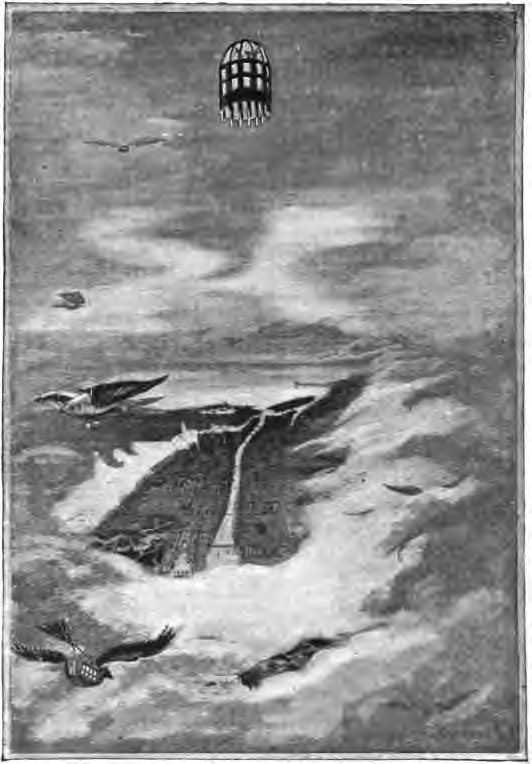
The Callisto was going straight up.
Sylvia had waved her handkerchief with the utmost enthusiasm, inspite of the sadness at her heart. But she now had other use forit in trying to hide her tears. The Callisto was still goingstraight up, with a speed already as great as a cannon ball's,and was almost out of sight. The multitude then began todisperse, and Sylvia returned to her home.
Let us now follow the Callisto. The earth and Jupiter not beingexactly in opposition, as they would be if the sun, the earth,and Jupiter were in line, with the earth between the two, butrather as shown in the diagram, the Callisto's journey wasconsiderably more than 380,000,000 miles, the mean oppositiondistance. As they wished to start by daylight--i. e., from theside of the earth turned towards the sun--they could not steerimmediately for Jupiter, but were obliged to go a few hundredmiles in the direction of the sun, then change their course tosomething like a tangent to the earth, and get their final rightdirection in swinging near the moon, since they must becomparatively near some material object to bring apergy intoplay.
The maximum power being turned on, the projectile shot from theearth with tremendous and rapidly increasing speed, by theshortest course--i. e., a straight line--so that for the presentit was not necessary to steer. Until beyond the limits of theatmosphere they kept the greatest apergetic repulsion focused onthe upper part of their cylinder, so that its point went first,and they encountered least possible resistance. Looking throughthe floor windows, therefore, the travellers had a most superbview. The air being clear, the eastern border of North Americaand the Atlantic were outlined as on a map, the blue of the oceanand brownish colour of the land, with white snow-patches on theelevations, being very marked. The Hudson and the Sound appearedas clearly defined blue ribbons, and between and around the twothey could see New York. They also saw the ocean dotted formiles with points in which they recognized the marine spiders andcruisers of the North Atlantic squadron, and the ships on thehome station, which they knew were watching them through theirglasses.
"I see," said Cortlandt, "that Deepwaters has been as good as hisword, and has his ships on the watch to rescue us in case wefail."
"Yes," replied Bearwarden, "he is the right sort. When he gavethat promise I knew his men would be there."
They soon perceived that they had reached the void of space, for,though the sun blazed with a splendour they had never beforeseen, the firmament was intensely black, and the stars shone asat midnight. Here they began to change their course to a curvebeginning with a spiral, by charging the Callisto apergetically,and directing the current towards the moon, to act as an aid tothe lunar attraction, while still allowing the earth to repel,and their motion gradually became the resultant of the twoforces, the change from a straight line being so gradual,however, that for some minutes they scarcely perceived it. Thecoronal streamers about the sun, such as are visible on earthduring a total eclipse, shone with a halo against theultra-Cimmerian background, bursting forth to a height of twentyor thirty thousand miles above the surface in vast cyclonicstorms, producing so rapid a motion that a column of incandescentgas may move ten thousand miles in less than ten minutes.Whether these great streaks were in part electrical phenomenasimilar to the aurora borealis, or entirely of intensely heatedmaterial thrown up by explosions within the sun's mass, theycould not tell even from their point of vantage.
"I believe," said Cortlandt, pointing to the streamers, "thatthey are masses of gas thrown beyond the sun's atmosphere, whichexpand enormously when the pressure to which they are subjectedin the sun is removed--for only in space freed from resistancecould they move at such velocities, and that their brilliancy isincreased by great electrical disturbance. If they were entirelythe play of electrical forces, their change of place would bepractically instantaneous, which, however rapid their movement,is not the case."
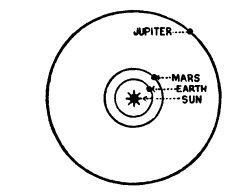
Book II.
Chapter I.Contents
THE LAST OF THE EARTH.
Finding that they were rapidly swinging towards their propercourse, and that the earth in its journey about the sun wouldmove out of their way, they divided their power between repellingthe body they had left and increasing the attraction of the moon,and then set about getting their house in order.
Bearwarden, having the largest appetite, was elected cook, theothers sagely divining that labour so largely for himself wouldbe no trial. Their small but business-like-looking electricrange was therefore soon in full blast, with Bearwarden incommand. It had enough current to provide heat for cooking forfour hundred hours, which was an ample margin, and it had thisadvantage, that, no matter how much it was used, it could notexhaust the air as any other form of heat would.
There were also a number of sixteen-candle-power incandescentlamps, so that when passing through the shadow of a planet, or atnight after their arrival on Jupiter, their car would be brightlyilluminated. They had also a good search-light for examining thedark side of a satellite, or exploring the spaces in Saturn'srings. Having lunched sumptuously on canned chicken soup, beefa la jardiniere, and pheasant that had been sent them by some oftheir admirers that morning, they put the bones and the glass canthat had contained the soup into the double-doored partition orvestibule, placing a large sheet of cardboard to act as a wadbetween the scraps and the outside door. By pressing a buttonthey unfastened the outside door, and the articles to be disposedof were shot off by the expansion of the air between thecardboard disk and the inside door; after which the outside doorwas drawn back to its place by a current sent through a magnet,but little power being required to reclose it with no resistingatmospheric pressure. As the electricity ran along a wirepassing through a hermetically sealed opening in the floor, therewas no way by which more air than that in the vestibule couldescape; and as the somewhat flat space between the doorscontained less than one cubic foot, the air-pressure inside theCallisto could not be materially lessened by a few openings.
"By filling the vestibule as full as possible," said Bearwarden,"and so displacing most of its air, we shall be able to open theoutside door oftener without danger of rarefaction."
The things they had discharged flew off with considerable speedand were soon out of sight; but it was not necessary for them tomove fast, provided they moved at all, for, the resistance beingnil, they would be sure to go beyond the range of vision,provided enough time was allowed, even if the Callisto's speedwas not being increased by apergy, in which case articles outsideand not affected would be quickly left behind.
The earth, which at first had filled nearly half their sky, wasrapidly growing smaller. Being almost between themselves and thesun, it looked like a crescent moon; and when it was only abouttwenty times the size of the moon they calculated they must havecome nearly two hundred thousand miles. The moon was now on whata sailor would call the starboard bow--i. e., to the right andahead. Being a little more than three quarters full, and onlyabout fifty thousand miles off, it presented a splendid sight,brilliant as polished silver, and about twenty-five times aslarge as they had ever before seen it with the unaided eye.
It was just ten hours since they had started, and at that moment9 A. M. in New York; but, though it was night there, the Callistowas bathed in a flood of sunlight such as never shines on earth.The only night they would have was on the side of the Callistoturned away from the sun, unless they passed through some shadow,which they intended to avoid on account of the danger ofcolliding with a meteor in the dark. The moon and the Callistowere moving on converging lines, the curve on which they hadentered having swung them to the side nearest the earth; but theysaw that their own tremendous and increasing speed would carrythem in front of the moon in its nearly circular orbit. Wishingto change the direction of their flight by the moon's attraction,they shut off the power driving them from the earth, whereuponthe Callisto turned its heavy base towards the moon. They werealready moving at such speed that their momentum alone wouldcarry them hundreds of thousands of miles into space, and werethen almost abreast of the earth's satellite, which was but a fewthousand miles away. The spectacle was magnificent. As theylooked at it through their field glasses or with the unaided eye,the great cracks and craters showed with the utmost clearness,sweeping past them almost as the landscape flies past a railwaytrain. There was something awe-inspiring in the vast antiquityof that furrowed lunar surface, by far the oldest thing thatmortal eye can see, since, while observing the ceaselesspolitical or geological changes on earth, the face of this deadsatellite, on account of the absence of air and water andconsequent erosion, has remained unchanged for bygone ages, as itdoubtless will for many more.
They closely watched the Callisto's course. At first it did notseem to deflect from a straight line, and they stood ready toturn on the apergetic force again, when the car very slowly beganto show the effect of the moon's near pull; but not till they hadso far passed it that the dark side was towards them were theyheading straight for Jupiter. Then they again turned on fullpower and got a send-off shove on the moon and earth combined,which increased their speed so rapidly that they felt they couldsoon shut off the current altogether and save their supply.
"We must be ready to watch the signals from the arctic circle,"said Bearwarden. "At midnight, if the calculations are finished,the result will be flashed by the searchlight." It was then tenminutes to twelve, and the earth was already over four hundredthousand miles away. Focusing their glasses upon the region nearthe north pole, which, being turned from the sun, was towardsthem and in darkness, they waited.
"In this blaze of sunlight," said Cortlandt, "I am afraid we cansee nothing."
Fortunately, at this moment the Callisto entered the moon'stapering shadow.
"This," said Ayrault, "is good luck. We could of course havegone into the shadow; but to change our course would have delayedus, and we might have lost part of the chance of increasing ourspeed."
"There will be no danger from meteors or sub-satellites here,"said Bearwarden, "for anything revolving about the moon at thisdistance would be caught by the earth."
The sun had apparently set behind the moon, and they wereeclipsed. The stars shone with the utmost splendour against thedead-black sky, and the earth appeared as a large crescent, stillconsiderably larger than the satellite to which they wereaccustomed. Exactly at midnight a faint phosphorescent light,like that of a glow-worm, appeared in the region of Greenland onthe planet they had left. It gradually increased its strengthtill it shone like a long white beam projected from a lighthouse,and in this they beheld the work of the greatest search-lightever made by man, receiving for a few moments all the electricitygenerated by the available dynamos at Niagara and the Bay ofFundy, the steam engines, and other sources of power in thenorthern hemisphere. The beam lasted with growing intensity forone minute; it then spelled out with clean-cut intervals,according to the Cable Code: "23° no' 6". The southernhemisphere pumps are now raising and storing water at full blast.We have already begun to lower the Arctic Ocean."
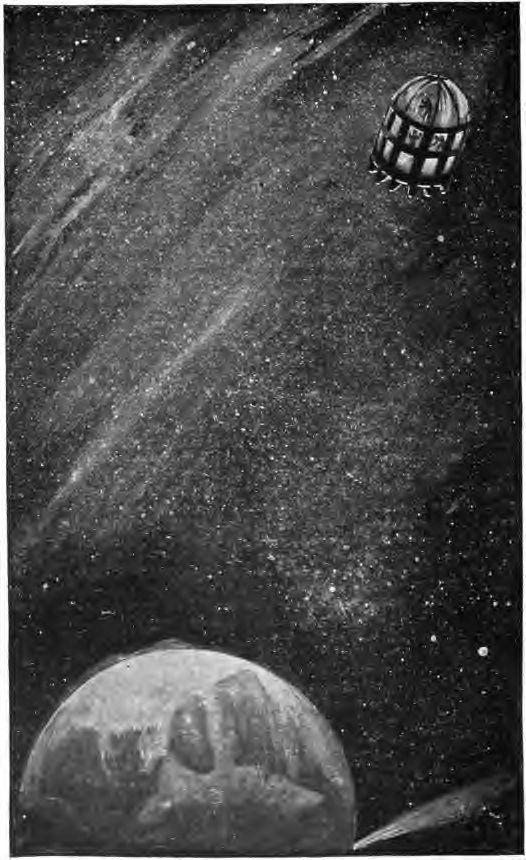
The signals from the Arctic Circle.
"Victory!" shouted Bearwarden, in an ecstasy of delight. "Nearlyhalf a degree in six months, with but one pole working. If wecan add at this rate each time to the speed of straighteningalready acquired, we can reverse our engines in five years, andin five more the earth will be at rest and right."
"Look!" said Ayrault, "they are sending something else." Theflashes came in rapid succession, reaching far into space. Withtheir glasses fixed upon them, they made out these sentences:"Our telescopes, in whatever part of the earth was turned towardsyou, have followed you since you started, and did not lose sightof you till you entered the moon's shadow. On your presentcourse you will be in darkness till 12.16, when we shall see youagain."
On receiving this last earthly message, the travellers sprang totheir searchlight, and, using its full power, telegraphed backthe following: "Many thanks to you for good news about earth,and to Secretary Deepwaters for lending us the navy. Result ofwork most glorious. Remember us to everybody. Shadow's edgeapproaching."
This was read by the men in the great observatories, whoevidently telephoned to the arctic Signal Light immediately, forit flashed back: "Got your message perfectly. Wish you greatestluck. The T. A. S. Co. has decked the Callisto's pedestal withflowers, and has ordered a tablet set up on the site tocommemorate your celestial journey."
At that moment the shadow swept by, and they were in the fullblaze of cloudless day. The change was so great that for amoment they were obliged to close their eyes. The polished sidesof the Callisto shone so brightly that they knew they were easilyseen. The power temporarily diverted in sending them the messagethen returned to the work of draining the Arctic Ocean, which, asthe north pole was now returning to the sun, was the thing to do,and the travellers resumed their study of the heavenly bodies.
Chapter II.Contents
SPACE AND MARS.
Never before had the travellers observed the stars and planetsunder such favourable conditions. No air or clouds intervened,and as the Callisto did not revolve on its axis there was nonecessity for changing the direction of the glasses. After anhour of this interesting work, however, as it was already late atthe longitude they had left on earth, and as they knew they hadmany days in space before them, they prepared to go to bed. Whenready, they had only to pull down the shades; for, as apergy wasnot applied to them, but only to the Callisto, they still lookedupon the floor as down, and closed the heavy curtains to havenight or darkness. They found that the side of the Callistoturned constantly towards the sun was becoming very warm, thedouble-toughened glass windows making it like a greenhouse; butthey consoled themselves with the thought that the sun's power onthem was hourly becoming less, and they felt sure the doublewalls and thick upholstery would protect them almost anywherewithin the solar system from the intense cold of space.
"We could easily have arranged," said Ayrault, "for night and dayon alternate sides of the Callisto by having strips of metalarranged spirally on the outside as on the end of an arrow.These would have started us turning as slowly as we like, sincewe passed through the atmosphere at a comparatively low rate ofspeed."
"I am afraid," said Cortlandt, "the motion, however slow, wouldhave made us dizzy. It would be confusing to see the heavensturning about us, and it would interfere with using the glasses."
The base and one side of the Callisto had constant sunshine,while the other side and the dome were in the blackest night.This dome, on account of its shape, sky windows, and thecompleteness with which it could be isolated, was an idealobservatory, and there was seldom a time during their wakinghours for the rest of the journey when it was not occupied byone, two, or all the observers.
"There is something marvellous," said Cortlandt, "about thecondition of space. Its absolute cold is appalling, apparentlybecause there is nothing to absorb heat; yet we find the base ofthis material projectile uncomfortably warm, though, should weexpose a thermometer in the shade in front, we know it would showa temperature of three hundred to four hundred degrees belowzero--were the instrument capable of recording it."
Artificial darkness having been obtained, the travellers weresoon asleep, Bearwarden's dreams being regaled with thoughts ofhis company's triumph; Ayrault's, naturally, with visions ofSylvia; while Cortlandt frequently started up, thinking he hadalready made some great astronomical discovery.
About 9 A. M., according to seventy-fifth meridian time, theexplorers awoke feeling greatly refreshed. The tank in which theliquefied oxygen was kept automatically gave off its gas soevenly that the air remained normal, while the lime contained incups absorbed the carbon dioxide as fast as they exhaled it.They had darkened those windows through which the sun wasactually pouring, for, on account of the emptiness of thesurrounding ether and consequent absence of diffusion of light,nothing but the inky blackness of space and the bright starslooked in at the rest. On raising the shades they got an idea oftheir speed. A small crescent, smaller than the familiar moon,accompanied by one still tinier, was all that could be seen ofthe earth and its satellite.
"We must," said Bearwarden, "be moving at the rate of nearly amillion miles an hour, from the way we have travelled."
"We must be doing fully a million," replied Cortlandt, "for bythis time we are pretty well in motion, having got a tremendousstart when so near the moon, with it and the earth in line."
By steering straight for Jupiter, instead of for the place itwould occupy ten days later, they knew they would swing past, forthe giant planet, being in rapid motion, would advance; but theydid not object to this, since it would give them a chance toexamine their new world in case they wished to do so beforealighting; while, if they preferred to land at once, they couldeasily change their course by means of the moons, the fourth,from which their car was named, being the one that they knewwould be of most use. Their tremendous speed showed them theyshould have time for exploration on their arrival, and that theywould reach their destination sooner than they had expected. Theapergetic force being applied, as we have seen, only to theCallisto, just as power in starting is exerted on a carriage orrailway car and only through it to the passengers, Ayrault andhis companions had no unusual sensation except loss of weight,for, when they were so far from the earth, its attraction wasvery slight, and no other planet was near enough to take itsplace. After breakfast, wishing to reach the dome, and realizingthat it would be unnecessary to climb, each in turn gave a slightspring and was obliged to put up his hands to avoid striking theroof. In the cool quiet of the dark dome it was difficult tobelieve that only twenty feet away the sun was shining with suchintensity upon the metal base as to make it too hot on the insideto touch without gloves.
The first thing that attracted their attention was the size andbrilliance of Mars. Although this red planet was over fortymillion miles from the earth when they started, they calculatedthat it was less than thirty million miles from them now, or fivemillions nearer than it had ever been to them before. Thisreduction in distance, and the clearness of the void throughwhich they saw it, made it a splendid sight, its disk showingclearly. From hour to hour its size and brightness increased,till towards evening it looked like a small, full moon, the sunshining squarely upon it. They calculated that on the coursethey were moving they should pass about nine hundred thousandmiles to the right or behind it, since it was moving towardstheir left. They were interested to see what effect the mass ofMars would have on the Callisto, and saw here a chance of stillfurther increasing their speed. Notwithstanding its tremendousrate, they expected to see the Callisto swerve from its straightline and move towards Mars, whose orbital speed of nine hundredmiles a minute they thought would take it out of the Callisto'sway, so that no actual collision would occur even if theirair-ship were left to her own devices.
Towards evening they noticed through their glasses that severalapparently island peaks in the southern hemisphere, which wasturned towards them, became white, from which they concluded thata snow-storm was in progress. The south polar region was alsomarkedly glaciated, though the icecap was not as extensive aseither of those at the poles of the earth.
"As the Martian winters must be fully as severe as ours," saidCortlandt, "on account of their length, the planet's distancefrom the sun, and the twenty-seven and a half degrees inclinationof its axis, we can account for the smallness of its ice-capsonly by the fact that its oceans cover but one fourth of itssurface instead of three quarters, as on the earth, and there isconsequently a smaller evaporation and rain and snow-fall."
They were too much interested to think of sleeping that night,and so, after dining comfortably returned to their observatory.When within four million miles of Mars the Callisto began toswerve perceptibly, its curve, as when near the moon beginningwith a spiral. They swung on unconcernedly, however, knowingthey could check their approach at any time. Soon Mars appearedto have a diameter ten times as great as that of the moon, andpromised shortly to occupy almost one side of their sky."We must be on the lookout for the satellites," said Cortlandt;"a collision with either would be worse than a wreck on a desertisland."
They therefore turned their glasses in the direction of thesatellites.
"Until Prof. Hall, at Washington, discovered the two satellitesin 1877," he continued, "Mars was supposed to be without moons.The outer one, Deimos, is but six miles in diameter, and revolvesabout its primary in thirty hours and eighteen minutes, at adistance of fourteen thousand six hundred miles. As it takes butlittle longer to complete a revolution than Mars does to rotateon its axis, it remains in the Martial sky one hundred andthirty-two hours between rising and setting, passing through allthe phases from new moon to full and back again four times; thatis, it swings four times around Mars before going below thehorizon. It is one of the smallest bodies discovered with atelescope. The inner one, Phobos, is considerably larger, havinga diameter of about twenty miles. It is but twenty-seven hundredmiles from Mars's surface, and completes its revolution in sevenhours and thirty-eight minutes, which is shorter than any otherknown period, Jupiter's nearest moon being the next, with elevenhours and fifty-nine minutes. It thus revolves in less than athird of the time Mars takes to rotate, and must consequentlyrise in the west and set in the east, as it is continuallyrunning ahead of the surface of the planet, though the sun andall the other stars rise and set on Mars in the same way as onthe earth."
When about fifteen thousand miles from Mars, they sighted Deimosdirectly ahead, and saw that they should pass on its left--i. e.,behind--for it was moving across them. The sun poured directlyupon it, making it appear full and showing all its features.There were small unevennesses on the surface, apparently seventyor a hundred feet high, which were the nearest approach tomountains, and they ran in ridges or chains. There were alsounmistakable signs of volcanic action, the craters being largecompared with the size of the planet, but shallow. They saw nosigns of water, and the blackness of the shadows convinced themthere was no air. They secured two instantaneous photographs ofthe little satellite as the Callisto swept by, and resumed theirinspection of Mars. They noticed red and brownish patches on thepeaks that had that morning turned white, from which theyconcluded that the snow had begun to melt under the warm springsun. This strengthened the belief they had already formed, thaton account of its twenty-seven and a half degrees inclination thechanges in temperature on Mars must be great and sudden. Sointerested were they with this, that they did not at first see alarge and bright body moving rapidly on a course that convergedwith theirs.
"We must be ready to repel boarders," said Bearwarden, observingit for the first time and fixing his glass upon it. "That mustbe Phobos."
Not ten miles off they beheld Mars's inner moon, and though theirown speed caused them to overtake and rush by it like awhirlwind, the satellite's rapid motion in its orbit, in a coursetemporarily almost parallel with theirs, served to give them achance the better to examine it. Here the mountain ranges wereconsiderably more conspicuous than on Deimos, and there wereboulders and loose stones upon their slopes, which looked as ifthere might at some time have been frost and water on itssurface; but it was all dry now, neither was there any air. Theevidences of volcanic action were also plainly visible, while anoticeable flattening at the poles showed that the little bodyhad once rotated rapidly on its axis, though whether it did sostill they had not time to ascertain. When abreast of it theywere less than two miles distant, and they secured severalinstantaneous impressions, which they put aside to develop later.As the radius of Phobos's circle was far shorter than that of theparabolic curve they were making, it began to draw away, and wasrapidly left behind. Applying the full apergetic force to Marsand the larger moon, they shot away like an arrow, having hadtheir speed increased by the planet's attraction whileapproaching it, and subsequently by repulsion.
"Either of those," said Bearwarden, looking back at the littlesatellites, "would be a nice yacht for a man to explore space on.He would also, of course, need a sun to warm him, if he wished togo beyond this system, but that would not have to be a largeaffair--in fact, it might be smaller than the planet, and couldrevolve about it like a moon."
"Though a sun of that size," replied Cortlandt, "might retain itsheat for the time you wished to use it, the planet part would benothing like as comfortable as what we have here, for it would bevery difficult to get enough air-pressure to breathe on so smalla body, since, with its slight gravitation-pull, to securefifteen pounds to the square inch, or anything like it, theatmosphere would have to extend thousands of miles into space, sothat on a cloudy day you would be in darkness. It would bebetter, therefore, to have such a sun as you describe andaccompany it in a yacht or private car like this, well stockedwith oxygen and provisions. When passing through meteoric swarmsor masses of solid matter, collision with which is the mostserious risk we run, the car could follow behind its sun insteadof revolving around it, and be kept from falling into it bypartially reversing the attraction. As the gravitation of sosmall a sun would be slight, counteracting it for even aconsiderable time would take but little from the batteries."
"There are known to be several unclaimed masses," added Ayrault,"with diameters of a few hundred yards, revolving about the earthinside the orbit of the moon. If in some way two of these couldbe brought into sufficiently violent collision, they would becomeluminous and answer very well; the increase in bulk as a resultof the consolidation, and the subsequent heat, about serving tobring them to the required size. Whenever this sun showed spotsand indications of cooling, it could be made to collide with thesolid head of some comet, or small asteroid, till its temperaturewas again right; while if, as a result of these accretions, itbecame unwieldy, it could be caused to rotate with sufficientrapidity on its axis to split, and we should have two sunsinstead of one."
"Bravo!" said Bearwarden. "There is no limit to what can bedone. The idea of our present trip would have seemed morechimerical to people a hundred years ago than this new schemeappears now."
Thus they sat and talked, or studied maps and star-charts, orthe stars themselves, while the hours quickly passed and theyshot through space. They had now a straight stretch of overthree hundred million miles, and had to cross the orbits ofinnumerable asteroids on the way. The apparent size of the sunhad by this time considerably decreased, and the interior of theCallisto was no longer uncomfortably warm. They divided the dayinto twenty-four hours from force of habit, and drew the shadestightly during what they considered night, while Bearwardendistinguished himself as a cook.
Chapter III.Contents
HEAVENLY BODIES.
The following day, while in their observatory, they saw somethingnot many miles ahead. They watched it for hours, and in fact allday, but notwithstanding their tremendous speed they came butlittle nearer.
"They say a stern chase is a long one," said Bearwarden; "but thatbeats anything I have ever seen."
After a while, however, they found they WERE nearer, the timetaken having been in part due to the deceptive distance, whichwas greater than they supposed.
"A comet!" exclaimed Cortlandt excitedly. "We shall really beable to examine it near."
"It's going in our direction," said Ayrault, "and at almostexactly our speed."
While the sun shone full upon it they brought their camera intoplay, and again succeeded in photographing a heavenly body atclose range. The nucleus or head was of course turned towardsthe sun; while the tail, which they could see faintly, precededit, as the comet was receding towards the cold and dark depths ofspace. The head was only a few miles in diameter, for it was asmall comet, and was composed of grains and masses of stone andmeteoric iron. Many of the grains were no larger than peas ormustard-seeds; no mass was more than four feet in diameter, andall of them had very irregular shapes. The space between theparticles was never less than one hundred times their masses.
"We can move about within it," said Ayrault, as the Callistoentered the aggregation of particles, and moved slowly forwardamong them.
The windows in the dome, being made of toughened glass, setsomewhat slantingly so as to deflect anything touching them, andhaving, moreover, the pressure of the inside air to sustain them,were fairly safe, while the windows in the sides and base werebut little exposed. Whenever a large mass seemed dangerouslynear the glass, they applied an apergetic shock to it and sent itkiting among its fellows. At these times the Callisto recoiledslightly also, the resulting motion in either being in inverseratio to its weight. There was constant and incessant movementamong the individual fragments, but it was not rotary. Nothingseemed to be revolving about anything else; all were moving,apparently swinging back and forth, but no collisions took place.When the separate particles got more than a certain distanceapart they reapproached one another, but when seemingly withinabout one hundred diameters of each other they swung off in someother direction. The motion was like that of innumerableharp-strings, which may approach but never strike one another.After a time the Callisto seemed to become endowed with the sameproperty that the fragments possessed; for it and they repelledone another, on a near approach, after which nothing came verynear.
Much of the material was like slag from a furnace, havingevidently been partly fused. Whether this heat was the result ofcollision or of its near approach to the sun at perihelion, theycould not tell, though the latter explanation seemed most simpleand probable. When at about the centre of the nucleus they werein semi-darkness--not twilight, for any ray that succeeded inpenetrating was dazzlingly brilliant, and the shadows, their ownincluded, were inky black. As they approached the farther sideand the sunlight decreased, they found that a diffused luminositypervaded everything. It was sufficiently bright to enable themto see the dark side of the meteoric masses, and, on emergingfrom the nucleus in total darkness, they found the shadowstretching thousands of miles before them into space.
"I now understand," said Bearwarden, "why stars of the sixth andseventh magnitude can be seen through thousands of miles of acomet's tail. It is simply because there is nothing in it. Thereason ANY stars are obscured is because the light in the tail,however faint, is brighter than they, and that light is all thatthe caudal appendage consists of, though what produces it Iconfess I am unable to explain. I also see why the tail alwaysstretches away from the sun, because near by it is overwhelmed bythe more powerful light; in fact, I suspect it is principally inthe comet's shadow that the tail is visible. It is strange thatno one ever thought of that before, or that any one feared theearth's passing through the tail of a comet. It is obvious to menow that if there were any material substance, any gas, howeverrarefied, in this hairlike* accompaniment, it would immediatelyfall to the comparatively heavy head,and surround that as a centre."* Comet means literally a hair.
"How, then," asked Cortlandt, "do you account for the spacesbetween those stones? However slight gravitation might bebetween some of the grains, if it existed at all, or wasunopposed by some other force, with sufficient time--and theyhave eternity--every comet would come together like a planet intoone solid mass. Perhaps some similar force maintains gases inthe distended tail, though I know of no such, or even anyanalogous manifestation on earth. If the law on which we havebeen brought up, that 'every atom in the universe attracts everyother atom,' were without exceptions or modifications, that cometcould not continue to exist in its present form. Until we getsome additional illustration, however, we shall be short of datawith which to formulate any iconoclastic hypothesis. The sourceof the light, I must admit, also puzzles me greatly. There iscertainly no heat to which we can attribute it."
Having gone beyond the fragments, they applied a strong repulsioncharge to the comet, creating thereby a perfect whirlpool amongits particles, and quickly left it. Half an hour later theyagain shut off the current, as the Callisto's speed wassufficient.
For some time they had been in the belt of asteroids, but as yetthey had seen none near. The morning following their experiencewith the comet, however, they went to their observatory afterbreakfast as usual, and, on pointing their glasses forward,espied a comparatively large body before them, a little to theirright.
"That must be Pallas," said Cortlandt, scrutinizing it closely."It was discovered by Olbers, in 1802, and was the secondasteroid found, Ceres having been the first, in 1801. It has adiameter of about three hundred miles, being one of the largestof these small planets. The most wonderful thing about it is theinclination of its orbit--thirty-five degrees--to the plane ofthe ecliptic; which means that at each revolution in its orbit,it swings that much above and below the imaginary plane cuttingthe sun at its equator, from which the earth and other largerplanets vary but little. This no doubt is due to the nearapproach and disturbing attraction of some large comet, or elseit was flung above or below the ordinary plane in the catastrophethat we think befell the large planet that doubtless formerlyexisted where we now find this swarm. You can see that its pathmakes a considerable angle to the plane of the ecliptic, and thatit is now about crossing the line."
It soon presented the phase of a half moon, but the waviness ofthe straight line, as in the case of Venus and Mercury, showedthat the size of the mountains must be tremendous compared withthe mass of the body, some of them being obviously fifteen mileshigh. The intense blackness of the shadows, as on the moon,convinced them there was no trace of atmosphere.
"There being no air," said Cortlandt, "it is safe to assume thereis no water, which helps to account for the great inequalities onthe body's surface, since the mountains will seem higher whensurrounded by dry ocean-bottom than they would if water camehalfway up their sides. Undoubtedly, however, the main cause oftheir height is the slight effect of gravitation on an asteroid,and the fact that the shrinking of the interior, and consequentfolding of the crust in ridges, may have continued for a timeafter there was no longer water on the surface to cut them down.
"The temperature and condition of a body," continued Cortlandt,"seem to depend entirely on its size. In the sun we have anincandescent, gaseous star, though its spots and the colour ofits rays show that it is becoming aged, or, to be more accurate,advanced in its evolutionary development. Then comes a greatjump, for Jupiter has but about one fourteen-hundredth of themass of the sun, and we expect to find on it a firm crust, andthat the planet itself is at about the fourth or fifth period ofdevelopment, described by Moses as days. Saturn is doubtlesssomewhat more advanced. The earth we know has been habitablemany hundreds of thousands or millions of years, though threefourths of its surface is still covered by water. In Mars we seea further step, three fourths of its surface being land. InMercury, could we study it better, or in the larger satellites ofJupiter or Saturn, we might find a stepping-stone from Mars tothe moon, perhaps with no water, but still having air, and beinghabitable in all other respects. In our own satellite we see aworld that has died, though its death from an astronomical pointof view is comparatively recent, while this little Pallas hasbeen dead longer, being probably chilled through and through.From this I conclude that all bodies in the solar system had onegenesis, and were part of the same nebulous mass. But this doesnot include the other systems and nebulae; for, compared withthem, our sun, as we have seen, is itself advanced and smallbeside such stars as Sirius having diameters of twelve millionmiles."
As they left Pallas between themselves and the sun, it became acrescent and finally disappeared.
Two days later they sighted another asteroid exactly ahead. Theyexamined it closely, and concluded it must be Hilda, put down inthe astronomies as No. 153, and having almost the greatest meandistance of any of these small bodies from the sun.
When they were so near that the disk was plainly visible to theunaided eye, Hilda passed between them and Jupiter, eclipsing it.To their surprise, the light was not instantly shut off, as whenthe moon occults a star, but there was evident refraction.
"By George!" said Bearwarden, "here is an asteroid that HAS anatmosphere."
There was no mistaking it. They soon discovered a small ice-capat one pole, and then made out oceans and continents, withmountains, forests, rivers, and green fields. The sight lastedbut a few moments before they swept by, but they secured severalphotographs, and carried a vivid impression in their minds.Hilda appeared to be about two hundred miles in diameter.
"How do you account for that living world," Bearwarden askedCortlandt, "on your theory of size and longevity?"
"There are two explanations," replied Cortlandt, "if the theory,as I still believe, is correct. Hilda has either been brought tothis system from some other less matured, in the train of acomet, and been captured by the immense power of Jupiter, whichmight account for the eccentricity of its orbit, or some accidenthas happened to rejuvenate it here. A collision with anotherminor planet moving in an orbit that crossed its own, or with thehead of a large comet, would have reconverted it into a star,perhaps after it had long been cold. A comet may first have sochanged the course of one of two small bodies as to make themcollide. This seems to me the most plausible theory. Over ahundred years ago the English astronomer, Chambers, wrote ofhaving found traces of atmosphere in some of these minor planets,but it was generally thought he was mistaken. One reason we knowso little about this great swarm of minor planets is, that tillrecently none of them showed a disk to the telescope. Inasmuchas only their light was visible, they were indistinguishable fromstars, except by their slow motion. A hundred years ago onlythree hundred and fifty had been discovered; our photographicstar-charts have since then shown the number recorded to exceedone thousand."
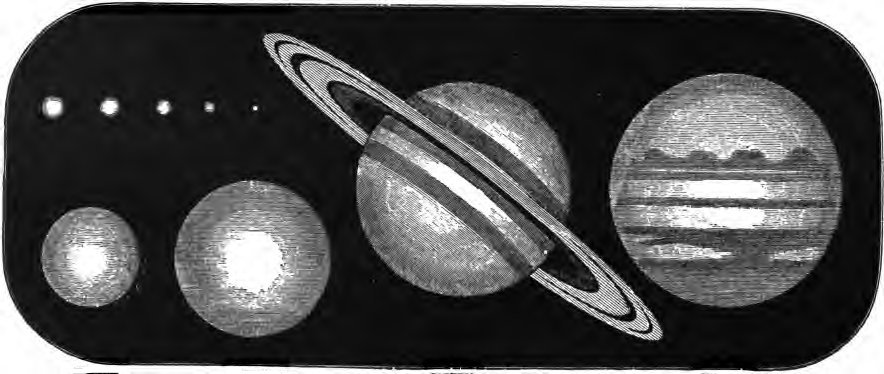
Comparative Size of Planets
Chapter IV.Contents
PREPARING TO ALIGHT.
That afternoon Ayrault brought out some statistical tables he hadcompiled from a great number of books, and also a diagram of thecomparative sizes of the planets. "I have been not a littlepuzzled at the discrepancies between even the best authors," hesaid, "scarcely any two being exactly alike, while every decadehas seen accepted theories radically changed." Saying which, hespread out the result of his labours (shown on the followingpages), which the three friends then studied.
-----------------------------------------------------------------
| Planets | Mean distance from sun in millions of miles | Semimajor axis of orbit, earth's distance as 1 | Eccentricity of orbit | Inclination of orbit to elliptic | Light at perihelion | Light at apehelion | Heat, earth as 1 |
|---|---|---|---|---|---|---|---|
| Mercury | 36.0 | 0.387 | 0.2056 | 7° 0' 8" | 10.58 | 4.59 | 6.67 |
| Venus | 67.2 | 0.723 | 0.0068 | 3° 23' 35" | 1.94 | 1.91 | 1.91 |
| The Earth | 92.9 | 1.000 | 0.068 | 0° 0' 0" | 1.03 | 0.997 | 1.00 |
| Mars | 141.5 | 1.524 | 0.0933 | 1° 51' 2" | 0.52 | 0.360 | 1.43 |
| Asteroids | 204.4 to 325.2 | 2.200 to 3.5000 | 0.4 to 0.84 | 5° to 35° | |||
| Jupiter | 483.3 | 5.203 | 0.0483 | 1° 18' 41" | 0.04 | 0.034 | 0.037 |
| Saturn | 886.0 | 9.539 | 0.0561 | 2° 29' 40" | 0.012 | 0.0099 | 0.011 |
| Uranus | 1781.9 | 19.183 | 0.0463 | 0° 46' 20" | 0.0027 | 0.0025 | 0.003 |
| Neptune | 2791.6 | 30.055 | 0.0090 | 1° 47' 2" | 0.0011 | 0.0011 | 0.001 |
-----------------------------------------------------------------
| MOVEMENT IN ORBIT. | |||||||
|---|---|---|---|---|---|---|---|
| Planets | Period of revolution in years and days | Orbital velocity in miles per second. | Velocity, earth's as 1. | Mean diameter in miles. | Surface compared with earth as 1. | Volume compared with earth as 1. | Mass compared with earth as 1. |
| Mercury... | 0.88 | 23 to 35 | 1.6 | 3,000 | 0.14 | 0.056 | 0.13 |
| Venus..... | 0.224 1/2 | 21.9 | 1.17 | 7,700 | 0.94 | 0.92 | 0.78 |
| The Earth. | 1.00 | 18.5 | 1.0 | 7,918 | 1.00 | 1.00 | 1.00 |
| Mars...... | 1.88 | 15.0 | 0.81 | 4,230 | 0.28 | 0.139 | 0.124 |
| Asteroids | 3.29 to 6.56 | From a few miles to 300 | |||||
| Jupiter.. | 11.86 | 8.1 | 0.44 | 86,500 | 118.3 | 1309.000 | 316.0 |
| Saturn... | 29.46 | 6.0 | 0.32 | 71,000 | 80.4 | 760.0 | 95.0 |
| Uranus.. | 84.02 | 4.2 | 0.23 | 31,900 | 16.3 | 65.0 | 14.7 |
| Neptune. | 164.78 | 3.4 | 0.18 | 34,800 | 19.3 | 90.0 | 17.1 |
-----------------------------------------------------------------
| DENSITY | FORCE OF GRAVITY AT SURFACE OF PLANET | ||||||
|---|---|---|---|---|---|---|---|
| Planets | Compared with earth as 1 | Compared with water as 1 | Compared with earth as 1 | Bodies fall in one second. | Length of day. | Length of seasons | Inclination of axis. |
| Mercury. | 1.24 | 7.17 | 0.85 | 13.7 | |||
| Venus... | 0.92 | 5.21 | 0.83 | 13.4 | hr mn sc 23 21 22 | 53+ | |
| The Earth. | 1.00 | 5.67 | 1.00 | 16.09 | Spring, 93 days Summer, 93 days Autumn, 90 days Winter, 89 days | 23 1/2 | |
| Mars... | 0.96 | 2.54 | 0.38 | 6.2 | Spring, 191 days Summer, 181 days Autumn, 149 days Winter, 147 days | 27 1/2 | |
| Asteroids. | |||||||
| Jupiter. | 0.22 | 1.29 | 2.55 | 40.98 | 9 55 28 | 1 1/2 | |
| Saturn.. | 0.13 | 0.63 | 1.15 | 18.53 | 10 29 17 | 27 | |
| Uranus. | 0.18 | 1.41 | 0.91 | 14.6 | 102(?) | ||
| Neptune. | 0.20 | 0.94 | 0.88 | 14.2 | |||
-----------------------------------------------------------------
"You see," Ayrault explained, "on Jupiter we shall need ourapergetic outfits to enable us to make long marches, while onSaturn they will not be necessary, the increase in our weight asa result of that planet's size being considerably less than theusual load carried by the Roman soldier."
"I do not imagine," said Cortlandt, "we should long be troubledby gravitation without our apergetic outfits even on Jupiter,for, though our weight will be more than doubled, we can take offone quarter of the whole by remaining near the equator, theirrapid rotation having apparently been given providentially to allthe large planets. Nature will adapt herself to this change, asto all others, very readily. Although the reclamation of thevast areas of the North American Arctic Archipelago, Alaska,Siberia, and Antarctic Wilkes Land, from the death-grip of theice in which they have been held will relieve the pressure ofpopulation for another century, at the end of that time it willsurely be felt again; it is therefore a consolation to feel thatthe mighty planets Jupiter and Saturn, which we are coming tolook upon as our heritage, will not crush the life out of anyhuman beings by their own weight that may alight upon them."
Before going to bed that evening they decided to be up early thenext day, to study Jupiter, which was already a brilliant object.
The following morning, on awakening, they went at once to theirobservatory, and found that Jupiter's disk was plainly visible tothe naked eye, and before night it seemed as large as the fullmoon.
They then prepared to check the Callisto's headlong speed, whichJupiter's attraction was beginning to increase. When about twomillion miles from the great planet, which was considerably ontheir left, they espied Callisto ahead and slightly on theirright, as Deepwaters had calculated it would be. Applying a mildrepulsion to this--which was itself quite a world, with itsdiameter of over three thousand miles, though evidently as coldand dead as the earth's old moon--they retarded their forwardrush, knowing that the resulting motion towards Jupiter would behelped by the giant's pull. Wishing to be in good condition fortheir landing, they divided the remainder of the night intowatches, two going to sleep at a time, the man on duty standingby to control the course and to get photographic negatives, onwhich, when they were developed, they found two crescent-shapedcontinents, a speckled region, and a number of islands. By 7 A.M., according to Eastern standard time, they were but fiftythousand miles from Jupiter's surface, the gigantic globe fillingnearly one side of the sky. In preparation for a sally, they gottheir guns and accoutrements ready, and then gave a partingglance at the car. Their charge of electricity for developingthe repulsion seemed scarcely touched, and they had still anabundant supply of oxygen and provisions. The barometerregistered twenty-nine inches, showing that they had not lostmuch air in the numerous openings of the vestibule. The pressurewas about what would be found at an altitude of a few hundredfeet, part of the rarefaction being no doubt due to the fact thatthey did not close the windows until at a considerable heightabove Van Cortlandt Park.
They saw they should alight in a longitude on which the sun hadjust risen, the rocky tops of the great mountains shining likehelmets in its rays. Soon they felt a sharp checking of theirforward motion, and saw, from the changed appearance of the starsand the sun, that they had entered the atmosphere of their newhome.
Not even did Columbus, standing at the prow of the Santa Maria,with the New World before him, feel the exultation and delightexperienced by these latter-day explorers of the twenty-firstcentury. Their first adventures on landing the reader alreadyknows.
Chapter V.Contents
EXPLORATION AND EXCITEMENT.
When they awoke, the flowers were singing with the volume of acathedral organ, the chant rising from all around them, and thesun was already above the horizon. Finding a deep naturalspring, in which the water was at about blood-heat, they preparedfor breakfast by taking a bath, and then found they had broughtnothing to eat.
"It was stupid of us not to think of it," said Bearwarden, "yetit will be too much out of our way to return to the Callisto."
"We have two rifles and a gun," said Ayrault, "and have alsoplenty of water, and wood for a fire. All we need is game."
"The old excuse, that it has been already shot out, cannot holdhere," said Cortlandt.
"Seeing that we have neither wings nor pneumatic legs, and notknowing the advantage given us by our rifles," added Bearwarden,"it should not be shy either. So far," he continued, "we haveseen nothing edible, though just now we should not be tooparticular; but near a spring like this that kind must exist."
"The question is," said the professor, "whether the game likewarm water. If we can follow this stream till it has been on thesurface for some time, or till it spreads out, we shall doubtlessfind a huntsman's paradise."
"A bright idea," said Bearwarden. "Let's have our guns ready,and, as old Deepwaters would say, keep our weather eye open."
The stream flowed off in a southeasterly direction, so that byfollowing it they went towards the volcanoes.
"It is hard to realize," said the professor, "that thosemountains must be several hundred miles away, for the reason thatthey are almost entirely above the horizon. This apparentflatness and wide range of vision is of course the result ofJupiter's vast size. With sufficiently keen sight, or aided by agood glass, there is no reason why one should not see at leastfive hundred miles, with but a slight elevation."
"It is surprising," said Ayrault, "that in what is evidentlyJupiter's Carboniferous period the atmosphere should be so clear.Our idea has been that at that time on earth the air was heavyand dense."
"So it was, and doubtless is here," replied Cortlandt; "but youmust remember that both those qualities would be given it bycarbonic-acid gas, which is entirely invisible and transparent.No gas that would be likely to remain in the air would interferewith sight; water vapour is the only thing that could; and thoughthe crust of this planet, even near the surface, is still hot,the sun being so distant, the vapour would not be raised much.By avoiding low places near hot springs, we shall doubtless havevery nearly as clear an atmosphere as on earth. What doessurprise me is the ease with which we breathe. I can account forit only by supposing that, the Carboniferous period being alreadywell advanced, most of the carbonic acid is already locked up inthe forests or in Jupiter's coal-beds."
"How," asked Bearwarden, "do you account for the 'great red spot'that appeared here in 1878, lasted several years, and thengradually faded? It was taken as unmistakable evidence thatJupiter's atmosphere was filled with impenetrable banks of cloud.In fact, you remember many of the old books said we had probablynever seen the surface."
"That has puzzled me very much," replied Cortlandt, "but I neverbelieved the explanation then given was correct. TheCarboniferous period is essentially one of great forest growth;so there would be nothing out of the way in supposing the spot,notwithstanding its length of twenty-seven thousand miles and itsbreadth of eight thousand miles, to have been forest. Itoccurred in what would correspond to the temperate region onearth. Now, though the axis of this planet is practicallystraight, the winds of course change their direction, and so thetemperature does vary from day to day. What is more probablethan that, owing perhaps to a prolonged norther or cold spell, along strip of forest lying near the frost line was brought a fewdegrees below it, so that the leaves changed their colours asthey do on earth? It would, it seems to me, be enough to givethe surface a distinct colour; and the fact that the spot'sgreatest length was east and west, or along the lines oflatitude, so that the whole of that region might have beenexposed to the same conditions of temperature, strengthens thishypothesis. The strongest objection is, that the spot is said tohave moved; but the motion--five seconds--was so slight that itmight easily have been an error in observation, or the first areaaffected by the cold may have been enlarged on one side. Itseems to me that the stability the spot DID have would make thecloud theory impossible on earth, and much more so here, with thefar more rapid rotation and more violent winds. It may also havebeen a cloud of smoke from a volcano in eruption, such as we sawon our arrival, though it is doubtful whether in that case itwould have remained nearly stationary while going through itsgreatest intensity and fading, which would look as though theturned leaves had fallen off and been gradually replaced by newones; and, in addition to this, the spot since it was firstnoticed has never entirely disappeared, which might mean avolcanic region constantly emitting smoke, or that the surface,doubtless from some covering whose colour can change, is normallyof a different shade from the surrounding region. In any case,we have as yet seen nothing that would indicate a permanentlyclouded atmosphere."
Though they had walked a considerable distance, the water was notmuch cooled; and though the stream's descent was so slight thaton earth its current would have been very slow, here it rushedalong like a mountain torrent, the reason, of course, being thata given amount of water on Jupiter would depress a spring balance2.55 times as much as on the earth.
"It is strange," said Ayrault, "that, notwithstanding its greatspeed, the water remains so hot; you would think its motion wouldcool it."
"So it does," answered the professor. "It of course coolsconsiderably more in a given period--as, for instance, oneminute--than if it were moving more slowly, but on account of itsspeed it has been exposed to the air but a very short time sinceleaving the spring."
Just before them the stream now widened into a narrow lake, whichthey could see was straight for some distance.
"The fact is," said Bearwarden, "this water seems in such hasteto reach the ocean that it turns neither to right nor to left,and does not even seem to wish to widen out."
As the huge ferns and palms grew to the water's edge, theyconcluded the best way to traverse the lake would be on a raft.Accordingly, choosing a large overhanging palm, Bearwarden andAyrault fired each an explosive ball into its trunk, abouteighteen inches from the ground. One round was enough to put itin the water, each explosion removing several cubic feet of wood.By repeating this process on other trees they soon had enoughlarge timber for buoyancy, so that they had but to superimposelighter cross-logs and bind the whole together with pliablebranches and creepers to form a substantial raft. The doctorclimbed on, after which Bearwarden and Ayrault cast off, havingprepared long poles for navigating. With a little care they kepttheir bark from catching on projecting roots, and as the streamcontinued to widen till it was about one hundred yards across,their work became easy. Carried along at a speed of two or threemiles an hour, they now saw that the water and the banks theypassed were literally alive with reptiles and all sorts ofamphibious creatures, while winged lizards sailed from everyoverhanging branch into the water as they approached. Theynoticed also many birds similar to storks and cranes, about thesize of ostriches, standing on logs in the water, whose billswere provided with teeth.
"We might almost think we were on earth," said Ayrault, "from thelooks of those storks standing on one leg, with the other drawnup, were it not for their size."
"How do you suppose they defend themselves," asked Bearwarden,"from the snakes with which the water is filled?"
"I suspect they can give a pretty good account of themselves,"replied Cortlandt, "with those teeth. Besides, with only one legexposed, there is but a very small object for a snake to strikeat. For their number and size, I should say their struggle forexistence was comparatively mild. Doubtless non-poisonous, or,for that matter, poisonous snakes, form a great part of theirdiet."
On passing the bend in the lake they noticed that the banks wereslightly higher, while palms, pine-trees, and rubber plantssucceeded the ferns. In the distance they now heard a tremendouscrashing, which grew louder as the seconds passed. It finallysounded like an earthquake. Involuntarily they held their breathand grasped their weapons. Finally, at some distance in thewoods they saw a dark mass moving rapidly and approaching theriver obliquely. Palms and pine-trees went down before it likestraws, while its head was continually among the upper branches.As the monster neared the lake, the water at the edges quivered,showing how its weight shook the banks at each stride, whilestumps and tree-trunks on which it stepped were pressed out ofsight in the ground. A general exodus of the other inhabitantsfrom his line of march began; the moccasins slid into the waterwith a low splash, while the boa-constrictors and the tree-snakesmoved off along the ground when they felt it tremble, and anumber of night birds retreated into the denser woods with loudcries at being so rudely disturbed. The huge beast did not stoptill he reached the bank, where he switched his tail, raised hisproboscis, and sniffed the air uneasily, his height being fullythirty feet and his length about fifty. On seeing the raft andits occupants, he looked at them stupidly and threw back hishead.
"He seems to be turning up his nose at us," said Bearwarden."All the same, he will do well for breakfast."
As the creature moved, his chest struck a huge overhanging palm,tearing it off as though it had been a reed. Brushing it asidewith his trunk, he was about to continue his march, when tworifle reports rang out together, rousing the echoes and a numberof birds that screeched loudly.
Chapter VI.Contents
MASTODON AND WILL-O'-THE WISPS.
Bearwarden's bullet struck the mammoth in the shoulder, whileAyrault's aim was farther back. As the balls exploded, ahalf-barrelful of flesh and hide was shot from each, leaving twogaping holes. Instantly he rushed among the trees, making hiscourse known for some time by his roars. As he turned,Bearwarden fired again, but the ball flew over him, blowing offthe top of a tree.
"Now for the chase!" said Ayrault. "There would be no excuse forlosing him."
Quickly pushing their raft to shore and securing it to the bank,the three jumped off. Thanks to their rubber boots and galvanicoutfits which automatically kept them charged, they were as spryas they would have been on earth. The ground all about them, andin a strip twelve feet wide where the mammoth had gone, was tornup, and the vegetation trodden down. Following this trail, theystruck back into the woods, where in places the gloom cast by thethick foliage was so dense that there was a mere twilight,startling as they went numbers of birds of grey and sombreplumage, whose necks and heads, and the sounds they uttered, wereso reptilian that the three terrestrials believed they must alsopossess poison fangs.
"The most highly developed things we have seen here," saidBearwarden, "are the flowers and fireflies, most of the birds andamphibians being simply loathsome."
As they proceeded they found tracks of blood, which were rapidlyattracting swarms of the reptile birds and snakes, which,however, as a rule, fled at their approach.
"I wonder what can have caused that mammoth to move so fast, andto have seemed so ill at ease?" said the doctor. "His motivecertainly was not thirst, for he did not approach the water in adirect line, neither did he drink on reaching it. One wouldthink nothing short of an earthquake or a land-slide couldtrouble him.""There can be no land-slide here," said Ayrault, "for the countryis too flat."
"And after yesterday's eruptions," added Bearwarden, "it wouldseem as though the volcanoes could have scarcely enough steamleft to make trouble."
The blood-tracks, continuing to become fresher, showed them theywere nearing the game, when suddenly the trail took a sharp turnto the right, even returning towards the lake. A little fartherit took another sharp turn, then followed a series of doublings,while still farther the ground was completely denuded of trees,its torn-up and trampled condition and the enormous amount ofstill warm blood showing how terrific a battle had just takenplace.
While they looked about they saw what appeared to be the trunk ofa tree about four feet in diameter and six feet long, with aslight crook. On coming closer, they recognized in it one of theforefeet of the mammoth, cut as cleanly as though with a knifefrom the leg just above the ankle, and still warm. A littlefarther they found the huge trunk cut to slivers, and, justbeyond, the body of the unfortunate beast with three of its feetgone, and the thick hide cut and slashed like so much paper. Itstill breathed, and Ayrault, who had a tender heart, sent anexplosive ball into its skull, which ended its suffering.
The three hunters then surveyed the scene. The largest and mostpowerful beast they had believed could exist lay before themdead, not from the bite of a snake or any other poison, but frommechanical injuries of which those they had inflicted formed buta very small part, and literally cut to pieces.
"I am curious to see the animal," said Cortlandt, "capable ofdoing this, though nothing short of dynamite bombs would protectus from him."
"As he has not stopped to eat his victim," said Bearwarden, "itis fair to suppose he is not carnivorous, and so must have hadsome other motive than hunger in making the attack; unless we cansuppose that our approach frightened him away, which, with suchpower as he must possess, seems unlikely. Let us see," hecontinued, "parts of two legs remain unaccounted for. Perhaps,on account of their shape, he has been able the more easily tocarry or roll them off, for we know that elephant foot makes acapital dish."
"From the way you talk," said Cortlandt, "one would suppose youattributed this to men. The Goliath we picture to ourselveswould be a child compared to the man that could cut through theselegs, though the necessity of believing him to have merely greatsize does not disprove his existence here. I think it probablewe shall find this is the work of some animal with incisors ofsuch power as it is difficult for us to conceive of."
"There is no indication here of teeth," said Bearwarden, "eachfoot being taken off with a clean cut. Besides, we are coming tobelieve that man existed on earth during the greater part, if notthe whole, of our Carboniferous period."
"We must reserve our decision pending further evidence," saidCortlandt.
"I vote we take the heart," said Ayrault, "and cook it, sinceotherwise the mammoth will be devoured before our eyes."
While Bearwarden and Ayrault delved for this, Cortlandt, withsome difficulty, parted the mammoth's lips and examined theteeth. "From the conical projections on the molars," said he,"this should be classed rather as a mastodon than as a mammoth."
When the huge heart was secured, Bearwarden arranged slices onsharpened sticks, while Ayrault set about starting a fire. Hehad to use Cortlandt's gun to clear the dry wood of snakes,which, attracted doubtless by the dead mastodon, came in suchnumbers that they covered the ground, while huge pterodactyls,more venomous-looking than the reptiles, hovered about theopening above.
Arranging a double line of electric wires in a circle about themastodon and themselves, they sat down and did justice to themeal, with appetites that might have dismayed the waiting throng.Whenever a snake's head came in contact with one wire, while histail touched the other, he gave a spasmodic leap and fell backdead. If he happened to fall across the wires, he immediatelybegan to sizzle, a cloud of smoke arose, and lie was reduced toashes.
"Any time that we are short of mastodon or other good game," saidAyrault, "we need not hunger if we are not above grilled snake."
All laughed at this, and Bearwarden, drawing a whiskey-flask fromhis pocket, passed it to his friends.
"When we rig our fishing-tackle," he continued, "and have freshfish for dinner, an entree of rattlesnake, roast mastodon for thepiece de resistance, and begin the whole with turtle soup andclams, of which there must be plenty on the ocean beach, we shallwant to stay here the rest of our lives."
"I suspect we shall have to," replied Ayrault "for we shallbecome so like Thanksgiving turkeys that the Callisto's door willbe too small for us."
While they sat and talked, the flowers and plants about themsoftly began their song, and, as a visual accompaniment, thefire-flies they had not before noticed twinkled through theforest.
"My goodness!" exclaimed Cortlandt, "how time goes here! Westarted to get breakfast, and now it's growing dark."
Hastily cutting some thick but tender slices from the mastodon,and impaling them with the remains of the heart on a sharpenedstake, they took up the wires, and the battery that had beensupplying the current, and retraced their steps by the way theyhad come. Their rubber-lined cowhide boots protected them fromall but the largest snakes, and as these were for the most partalready enjoying their gorge, they trampled with impunity onthose that remained in their path. When they had covered abouthalf the distance to the raft, a huge boa-constrictor, which theyhad mistaken for a branch, fell upon Cortlandt, pinioning hisarms and bearing him to the ground. Dropping their loads,Bearwarden and Ayrault threw themselves upon the monster withtheir hunting-knives with such vim that in a few seconds it beata hasty retreat, leaving, as it did so, a wake of phosphorescentlight.
"Are you hurt?" asked Bearwarden, helping him up.
"Not in the least," replied Cortlandt. "What surprises me isthat I am not. The weight of that boa-constrictor would be verygreat on earth, and here I should think it would be simplycrushing."
Groping their way through the rapidly growing darkness, theyreached the raft without further adventure, and, once on thelake, had plenty of light. Two moons, one at three quarters andthe other full, shone brightly, while the water was alive withgymnotuses and other luminous creatures. Sitting and living uponthe cross-timbers, they looked up at the sky. The Great Bear andthe north star had exactly the same relation to each other aswhen seen from the earth, while the other constellations and theMilky Way looked identically as when they had so often gazed atthem before, and some idea of the immensity of space was conveyedto them. Here was no change; though they had travelled threehundred and eighty million miles, there was no more perceptibledifference than if they had not moved a foot. Perhaps, theythought, to the telescopes--if there are any--among the stars,the sun was seen to be accompanied by two small, dark companions,for Jupiter and Saturn might be visible, or perhaps it seemedmerely as a slightly variable star, in years when sun-spots werenumerous, or as the larger planets in their revolutionsoccasionally intercepted a part of its light. As they floatedalong they noticed a number of what they took to beWill-o'-the-wisps. Several of these great globules of pale flamehovered about them in the air, near the surface of the water, andanon they rose till they hung above the trees, apparently havingno forward or horizontal motion except when taken by the gentlebreeze, merely sinking and rising.
"How pretty they are!" said Cortlandt, as they watched them."For bodies consisting of marsh gas, they hold togetherwonderfully."
Presently one alighted on the water near them. It wasconsiderably brighter than any glow-worm, and somewhat largerthan an arc lamp, being nearly three feet in diameter; it did notemit much light, but would itself have been visible from aconsiderable distance. Cortlandt tried to touch it with araft-pole, but could not reach far enough. Presently a largefish approached it, swimming near the surface of the water. Whenit was close to the Jack-o'-lantern, or whatever it was, therewas a splash, the fish turned up its white under side, and, thebreeze being away from the raft, the fire-ball and its victimslowly floated off together. There were frequently a dozen ofthese great globules in sight at once, rising and descending, theobservers noticing one peculiarity, viz., that their brightnessincreased as they rose, and decreased as they sank.About two and a half hours after sunset, or midnight according toJupiter time, they fell asleep, but about an hour later Cortlandtwas awakened by a weight on his chest. Starting up, he perceiveda huge white-faced bat, with its head but a few inches from his.Its outstretched wings were about eight feet across, and itfastened its sharp claws upon him. Seizing it by the throat, hestruggled violently. His companions, awakened by the noise,quickly came to his rescue, grasping him just as he was in dangerof being dragged off the raft, and in another moment Bearwarden'sknife had entered the creature's spine.
"This evidently belongs to the blood-sucking species," saidCortlandt. "I seem to be the target for all these beasts, andhenceforth shall keep my eyes open at night."
As day would break in but little over an hour, they decided toremain awake, and they pushed the dead bat overboard, where itwas soon devoured by fishes. A chill had come upon the air, andthe incessant noise of the forms of life about them had in ameasure ceased.
Cortlandt passed around a box of quinine as a preventive againstmalaria, and again they lay back and looked at the stars. Themost splendid sight in their sky now was Saturn. At thecomparatively short distance this great planet was from them, itcast a distinct shadow, its vast rings making it appear twice itsreal size. With the first glimmer of dawn, the fire-ballsdescended to the surface of the water and disappeared within it,their lights going out. With a suddenness to which the explorerswere becoming accustomed, the sun burst upon them, rising asperpendicularly as at the earth's equator, and more than twice asfast, having first tinged the sky with the most brilliant hues.
The stream had left the forest and swamp, and was now flowingthrough open country between high banks. Pushing the raftashore, they stepped off on the sand, and, warming up the remainsof the mastodon's heart, ate a substantial breakfast.
While washing their knives in the stream preparatory to leavingit--for they wished to return to the Callisto by completing thecircle they had begun--they noticed a huge flat jelly-fish inshallow water. It was so transparent that they could see thesandy bottom through it. As it seemed to be asleep, Bearwardenstirred up the water around it and poked it with a stick. Thejelly-fish first drew itself together till it touched thesurface of the water, being nearly round, then it slowly left thestream and rose till it was wholly in the air, and,notwithstanding the sunlight, it emitted a faint glow.
"Ah!" exclaimed Bearwarden, "here we have one of ourJack-o'-lanterns. Let us see what it is going to do."
"It is incomprehensible to me," said Cortlandt, "how it maintainsitself; for it has neither wings nor visible means of support,yet, as it was able to immerse itself in the stream, therebydisplacing a volume of liquid equivalent to its bulk, it must beat least as heavy as water."
The jelly-fish remained poised in the air until directly abovethem, when it began to descend.
"Stand from under!" cried Bearwarden, stepping back. "I, for one,should not care to be touched."
The great soft mass came directly over the spot on which they hadbeen standing, and stopped its descent about three feet from theground, parallel to which it was slowly carried by the wind. Afew yards off, in the direction in which it was moving, lay along black snake asleep on the sand. When directly over itsvictim the jelly globule again sank till it touched the middle ofthe reptile's back. The serpent immediately coiled itself in aknot, but was already dead. The jellyfish did not swallow, butcompletely surrounded its prey, and again rose in the air, withthe snake's black body clearly visible within it.
"Our Will-o'-the-wisp is prettier by night than by day," saidBearwarden. "I suggest that we investigate this further."
"How?" asked Cortlandt.
"By destroying its life," replied Bearwarden. "Give it onebarrel from your gun, doctor, and see if it can then defygravitation."
Accordingly Cortlandt took careful aim at the object, abouttwenty-yards away, and fired. The main portion of the jellyfish,with the snake still in its embrace, sailed away, but many poundsof jelly fell to the ground. Most of this remained where it hadfallen, but a few of the larger pieces showed a faint luminosityand rose again.
"You cannot kill that which is simply a mass of protoplasm," saidCortlandt. "Doubtless each of those pieces will form a neworganism. This proves that there are ramifications anddevelopments of life which we never dreamed of."
Chapter VII.Contents
AN UNSEEN HUNTER.
They calculated that they had come ten or twelve miles from theplace at which they built the raft, while the damp salt breezeblowing from the south showed them they were near the ocean.Concluding that large bodies of water must be very much alike onall planets, they decided to make for a range of hills due northand a few miles off, and to complete the circuit of the square inreturning to the Callisto. The soft wet sand was covered withhuge and curious tracks, doubtless made by creatures that hadcome to the stream during the night to drink, and they noticedwith satisfaction as they set out that the fresher ones led offin the direction in which they were going. For practice, theyblew off the heads of the boa-constrictors as they hung from thetrees, and of the other huge snakes that moved along the ground,with explosive bullets, in every thicket through which theypassed, knowing that the game, never having been shot at, wouldnot take fright at the noise. Sometimes they came upon greatmasses of snakes, intertwined and coiled like worms; in thesecases Cortlandt brought his gun into play, raking them withduck-shot to his heart's content. "As the function of thesereptiles," he explained, "is to form a soil on which higher lifemay grow, we may as well help along their metamorphosis byartificial means." They were impressed by the tremendouscannon-like reports of their firearms, which they perceived atonce resulted from the great density of the Jovian atmosphere.And this was also a considerable aid to them in making muscularexertion, for it had just the reverse effect of rarefied mountainair, and they seldom had to expand their lungs fully in order tobreathe.
The ground continued to be marked with very large footprints.Often the impressions were those of a biped like some huge bird,except that occasionally the creature had put down one or bothforefeet, and a thick tail had evidently dragged nearly all thetime it walked erect. Presently, coming to something they hadtaken for a large flat rock, they were surprised to see it move.It was about twelve feet wide by eighteen feet long, while itsshell seemed at least a foot thick, and it was of course thelargest turtle they had ever seen.
"Twenty-four people could dine at a table of this size withease," said Bearwarden, "while it would make soup for a regiment.I wonder if it belongs to the snapping or diamond-backedspecies."
At this juncture the monster again moved.
"As it is heading in our direction," resumed Bearwarden, "I votewe strike for a free pass," and, taking a run, he sprang with hisspiked boots upon the turtle's shell and clambered upon the flattop, which was about six feet from the ground. He was quicklyfollowed by Ayrault, who was not much ahead of Cortlandt, for,notwithstanding his fifty years, the professor was very spry.The tortoise was almost the exact counterpart of the Glyptodonasper that formerly existed on earth, and shambled along at ajerky gait, about half as fast again as they could walk, andwhile it continued to go in their direction they were greatlypleased. They soon found that by dropping the butts of theirrifles sharply and simultaneously on either side, just back ofthe head, they could direct their course, by making their steedswerve away from the stamping.
"It is strange," said Ayrault, "that, with theexception of the mastodon and this tortoise, we have seennone of the monsters that seem to appear at the close ofCarboniferous periods, although the ground is coveredwith their tracks."
"Probably we did not reach the grounds at the right time of day,"replied Bearwarden. "The large game doubtless stays in the woodsand jungles till night."
"I fancy," said Cortlandt, "we shall find representatives of allthe species that once lived upon the earth. In the case of thesinging flowers and the Jack-o'-lantern jelly-fish, we have, inaddition, seen developments the existence of which no scientisthas ever before even suspected."
Occasionally the tortoise stopped, whereupon they poked it frombehind with their knives. It was a vicious-looking brute, andhad a huge horny beak, with which it bit off young trees thatstood in its way as though they had been blades of grass. Theywere passing through a valley about half a mile wide, bordered oneach side by woods, when Bearwarden suddenly exclaimed, "Here wehave it!" and, looking forward, they unexpectedly saw a head riseand remain poised about fifteen feet from the ground. It was adinosaur, and belonged to the scaled or armoured species. In afew moments another head appeared, and towered several feet abovethe first. The head was obviously reptilian, but had a beaksimilar to that of their tortoise. The hind legs were developedlike those of a kangaroo, while the small rudimentary forepaws,which could be used as hands or for going quadruped-fashion, nowhung down. The strong thick tail was evidently of great use tothem when standing erect, by forming a sort of tripod.
"How I wish we could take a pair of those creatures with us whenwe return to the earth!" said Cortlandt.
"They would be trump cards," replied Bearwarden, "in a zoologicalgarden or a dime museum, and would take the wind out of the sailsof all the other freaks."
As they lay flat on the turtle's back, the monsters gazed at themunconcernedly, munching the palm-tree fruit so loudly that theycould be heard a long distance.
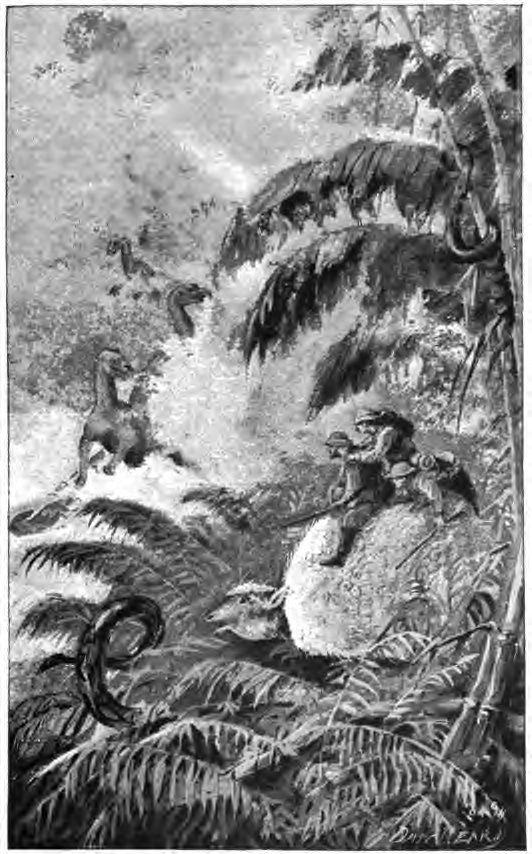
The ride on the giant tortoise.
"Having nothing to fear from a tortoise," resumed Cortlandt,"they may allow us to stalk them. We are in their eyes likehippocentaurs, except that we are part of a tortoise instead ofpart of a horse, or else they take us for a parasite or fibrousgrowth on the shell."
"They would not have much to fear from us as we really are,"replied Bearwarden, "were it not for our explosive bullets."
"I am surprised," said Ayrault, "that graminivorous animalsshould be so heavily armed as these, since there can be no greatstruggle in obtaining their food."
"From the looks of their jaws," replied Cortlandt, "I should saythey are omnivorous, and would doubtless prefer meat to what theyare eating now. Something seems to have gone wrong with theanimal creation hereabouts to-day."
Their war-horse clanked along like a badly rusted machine,approaching the dinosaurs obliquely. When only about fifty yardsintervened, as the hunters were preparing to aim, their attentionwas diverted by a tremendous commotion in the woods on their leftand somewhat ahead. With the crunching of dead branches andswaying of the trees, a drove of monsters made a hasty exit andsped across the open valley. Some showed only the tops of theirbacks above the long grass, while others shambled and leaped withtheir heads nearly thirty feet above the ground. The dinosaursinstantly dropped on all-fours and joined in the flight, thoughat about half-minute intervals they rose on their hind legs andfor a few seconds ran erect. The drove passed about half a milebefore the travellers, and made straight for the woods opposite;but hardly had the monsters been out of sight two minutes whenthey reappeared, even more precipitately than before, and fled upthe valley in the same direction as the tortoise.
"The animals here," said Bearwarden, "behave as though they weregoing to catch a train; only our friend beneath us seems superiorto haste."
"I would give a good deal to know," said Cortlandt, "what ispursuing those giants, and whether it is identical or similar tothe mutilator of the mastodon. Nothing but abject terror couldmake them run like that."
"I have a well-formed idea," said Bearwarden, "that a hunt isgoing on, with no doubt two parties, one in the woods on eitherside, and that the hunters may be on a scale commensurate withthat of their victims."
"If the excitement is caused by men," replied Cortlandt, "ourexploration may turn out to be a far more difficult undertakingthan we anticipated. But why, if there are men in those woods,do they not show themselves?--for they could certainly keep pacewith the game more easily in the open than among the trees."
"Because," replied Bearwarden, "the men in the woods aredoubtless the beaters, whose duty it is to drive the game intoand up the valley, at the end of which the killing will be done."
"We may have a chance to see it," said Ayrault, "or to take ahand, for we are travelling straight in that direction, and shallbe able to give a good account ourselves if our rights arechallenged."
"Why," asked Cortlandt, "if the hunting parties that have been inour vicinity were only beaters, should they have mutilated themastodon in such a way that he could not walk? And how werethey able to take themselves off so quickly--for man in hisnatural state has never been a fast mover? I repeat, it willupset my theories if we find men."
It was obvious to them that tortoises were not much troubled bythe apparently general foe, for the specimen in which they werejust then interested continued his course entirely unconcerned.Soon, however, he seemed to feel fatigue, for he drew his feetand head within his shell, which he tightly closed, and afterthat no poking or prodding had the desired effect.
"I suspect we must depend on shank's mares for a time," saidBearwarden, cheerfully, as they scrambled down.
"We can now see," said Cortlandt, "why our friend was sounconcerned, since he has but to draw himself within himself tobecome invulnerable to anything short of a stroke of lightning;for no bird could have power enough to raise and drop him from agreat height upon rocks, as the eagles do on earth."
"I suspect, if anxious for turtle soup," said Bearwarden, "wemust attach a lightning--rod, and wait for a thunderstorm toelectrocute him."
Chapter VIII.Contents
SPORTSMEN'S REVERIES.
Feeling grateful to the huge tortoise for the good service he hadrendered, they shot a number of the great snakes that weregliding about on the ground, and placed them where he would findthem on awaiting. They then picked their way carefully towardsstretches on which the grass was shortest. When they had goneabout two miles, and had already reached higher ground, they cameto a ridge of rock running at right angles to their course. Thisthey climbed, and on looking over the edge of the crest beheld asight that made their hearts stand still. A monster, somewhatresembling an alligator, except that the back was arched, waswaddling about perhaps seventy-five yards from them. It wassixty feet long, and to the top of its scales was at leasttwenty-five feet high. It was constantly moving, and thetravellers noticed with some dismay that its motion was far morerapid than they would have supposed it could be.
"It is also a dinosaur," said the professor, watching it sharply,"and very closely resembles the Stegosaurus ungulatus restored inthe museums. The question is, What shall we do with the livingspecimen, now that we have it?"
"Our chairman," said Ayrault, "must find a way to kill it, sothat we may examine it closely."
"The trouble is," said Bearwarden, "our bullets will explodebefore they penetrate the scales. In the absence of any way ofmaking a passage for an explosive ball by means of a solid one,we must strike a vital spot. His scales being no harder than thetrunk of a tree, we can wound him terribly by touching himanywhere; but there is no object in doing this unless we can killhim, especially as there is no deep stream, such as would havedelayed the mastodon in reaching us, to protect us here. We mustspread out so as to divert his attention from one to another."
After some consultation it was decided that Cortlandt, who hadonly a shot-gun, should remain where they were, while Bearwardenand Ayrault moved some distance to the right and left. At asignal from Cortlandt, who was to attract the monster'sattention, the wings were to advance simultaneously. Thesearrangements they carried out to the letter. When Bearwarden andAyrault had gone about twenty-five yards on either side, thedoctor imitated the peculiar grunting sound of an alligator, atwhich the colossal monster turned and faced him, while Bearwardenand Ayrault moved to the attack. The plan of this was good, for,with his attention fixed on three objects, the dinosaur seemedconfused, and though Bearwarden and Ayrault had good angles fromwhich to shoot, there was no possibility of their hitting eachother. They therefore advanced steadily with their rifles halfup. Though their own danger increased with each step, in theevent of their missing, the chance of their shooting wilddecreased, the idea being to reach the brain through the eye.Cortlandt's part had also its risks, for, being entirelydefenceless with his shot-gun against the large creature, whoseattention it was his duty to attract, he staked all on themarksmanship of his friends. Not considering this, however, hestood his ground, having the thumb-piece on his Winchestermagazine shoved up and ready to make a noisy diversion ifnecessary in behalf of either wing. Having aroused the monster'scuriosity, Cortlandt sprang up, waving his arms and his gun. Thedinosaur lowered his head as if to charge, thereby bringing it toa level with the rifles, either of which could have given it thefatal shot. But as their fingers pressed the triggers thereptile soared up thirty feet in the air. Ayrault pulled for hisfirst sight, shooting through the lower jaw, and shivering thatmember, while Bearwarden changed his aim and sighted straight forthe heart. In an instant the monster was down again, justmissing Ayrault's head as he stepped back, and Bearwarden's riflepoured a stream of explosive balls against its side, rending andblowing away the heavy scales. Having drawn the dinosaur'sattention to himself, he retreated, while Ayrault renewed theattack. Cortlandt, seeing that the original plan had miscarried,poured showers of small shot against the huge beast's face.Finally, one of Ayrault's balls exploded in the brain, and allwas over.
"We have killed it at last," said Bearwarden "but the firstattack, though artistic, had not the brilliant results weexpected. These creatures' mode of fighting is doubtlesssomewhat similar to that of the kangaroo, which it is said putsits forepaws gently, almost lovingly, on a man's shoulders, andthen disembowels him by the rapid movement of a hind leg. But weshall get used to their method, and can do better next time."
They then reloaded their weapons and, while Cortlandt examinedtheir victim from a naturalist's point of view, Bearwarden andAyrault secured the heart, which they thought would be the mostedible part, the operation being rendered possible by the amountof armour the explosive balls had stripped off.
"To-morrow," said Bearwarden, "we must make it a point to getsome well-fed birds; for I can roast, broil, or fricassee them toa turn. Life is too short to live on this meat in such asportsman's paradise. In any case there can be no end ofmastodons, mammoths, woolly rhinoceroses, moa birds, and all suchshooting."
As the sun was already near the horizon, they chose a dry, sandyplace, to secure as much immunity as possible from nocturnalvisits, and, after procuring a supply of water from a pool,proceeded to arrange their camp for the night. They first laidout the protection-wires, setting them while the sun stillshone. Next they built a fire and prepared their evening meal.While they ate it, twilight became night, and the fire-flies,twinkling in legions in the neighbouring valley, seemed like thelamps of a great city.
"Their lights," said Bearwarden, pointing to them, "are not asfine as the jelly-fish Will-o'-the wisps were last night, butthey are not so dangerous. No gymnotus or electric eel that Ihave ever seen compared with them, and I am convinced that anyone of us they might have touched would have been in kingdomcome."
The balmy air soothed the travellers' brows as they reclinedagainst mounds of sand, while the flowers in the valley sent uptheir dying notes. One by one the moons arose, till four--amongthem the Lilliputian, discovered by Prof. Barnard in 1893--werein the sky, flooding the landscape with their silvery light, andsomething in the surroundings touched a sympathetic cord in themen.
"Oh that I were young again," said Cortlandt, "and had lifebefore me! I should like to remain here and grow up with thisplanet, in which we already perceive the next New World. Thebeauties of earth are barren compared with the scenes we havehere."
"You remember," replied Bearwarden, "how Cicero defends old agein his De Senectute, and shows that while it has almosteverything that youth has, it has also a sense of calm and manythings besides."
"Yes," answered Cortlandt, "but, while plausible, it does notconvince. The pleasures of age are largely negative, the oldbeing happy when free from pain."
"Since the highest joy of life," said Ayrault, "is coming to knowour Creator, I should say the old, being further advanced, wouldbe the happier of the two. I should never regard this materiallife as greatly to be prized for itself. You remember the oldsong:
"'O Youth! When we come to consider The pain, the toil, and the strife, The happiest man of all is The one who has finished his life.'
"I suspect," continued Ayrault, "that the man who reaches eventhe lowest plane in paradise will find far more beautiful visionsthan any we have here."
As they had but little rest the night before, they were alltired. The warm breeze swayed the long dry grass, causing it togive out a soft rustle; all birds except the flitting bats wereasleep among the tall ferns or on the great trees that spreadtheir branches towards heaven. There was nothing to recall apicture of the huge monsters they had seen that day, or of thestill more to be dreaded terror these had borne witness to. Thusnight closes the activities of the day, and in its serenegrandeur the soul has time to think. While they thought,however, drowsiness overcame them, and in a little while all wereasleep.
The double line of protection-wires encircled them like a silentguard, while the methodical ticking of the alarm-clock that wasto wake them at the approach of danger, and register the hour ofinterruption, formed a curious contrast to the irregular cries ofthe night-hawks in the distance. Time and again some hugeiguanodon or a hipsohopus would pass, shaking the ground with itstread; but so implicit was the travellers' trust in the vigilanceof their mechanical and tireless watch, that they slept on ascalmly and unconcernedly as though they had been in their beds athome, while the tick was as constant and regular as a sentry'smarch. The wires of course did not protect them from creatureshaving wings, and they ran some risk of a visitation from theblood-sucking bats. The far-away volcanoes occasionally sent upsheets of flame, which in the distance were like summerlightning; the torrents of lava and crashes that had sounded sothunderous when near, were now like the murmur of the ocean's ebbtide, lulling the terrestrials to deeper sleep. The pale moonswere at intervals momentarily obscured by the rushing clouds inthe upper air, only to reappear soon afterwards as serene asbefore. All Nature seemed at rest.
Shortly before dawn there was an unusually heavy step. A momentlater the ever-vigilant batteries poured forth their current, andthe clang of the alarm-bell made the still night ring. In aninstant the three men were awake, each resting on one knee, withtheir backs towards the centre and their polished barrels raised.It was not long before they perceived the intruder by themoonlight. A huge monster of the Triceratops prorsus species hadentered the camp. It was shaped something like an elephant, buthad ten or twelve times the bulk, being over forty feet inlength, not including the long, thick tail. The head carried twohuge horns on the forehead and one on the nose.
"A plague on my shot-gun!" said Cortlandt. "Had I known how muchof this kind of game we should see, I too should have brought arifle."
The monster was entangled in the wires, and in another secondwould have stepped on the batteries that were still causing thebell to ring.
"Aim for the heart," said Bearwarden to Ayrault. "When you showme his ribs, I will follow you in the hole."
Ayrault instantly fired for a point just back of the leftforeleg. The explosion had the same effect as on the mastodon,removing a half-barrel of hide, etc; and the next secondBearwarden sent a bullet less than an inch from where Ayrault'shad stopped. Before the colossus could turn, each had causedseveral explosions in close proximity to the first. The creaturewas of course terribly wounded, and several ribs were cracked,but no ball had gone through. With a roar it made straight forthe woods, and with surprising agility, running fully as fast asan elephant. Bearwarden and Ayrault kept up a rapid fire at theleft hind leg, and soon completely disabled it. The dinosaur,however, supported itself with its huge tail, and continued tomake good time. Knowing they could not give it a fatal wound atthe intervening distance, in the uncertain light, they stoppedfiring and set out in pursuit. Cortlandt paused to stop the bellthat still rang, and then put his best foot foremost in regaininghis friends. For half a mile they hurried along, until, seeingby the quantity of blood on the ground that they were in nodanger of losing the game, they determined to save theirstrength. The trail entered the woods by a narrow ravine, passedthrough what proved to be but a belt of timber, and then turnednorth to the right. Presently in the semi-darkness they saw themonster's head against the sky. He was browsing among the trees,tearing off the young branches, and the hunters succeeded ingetting within seventy-five yards before being discovered. Justas he began to run, the two rifles again fired, this time at theright hind leg, which they succeeded in hamstringing. After thatthe Triceratops prorsus was at their mercy, and they quickly putan end to its suffering."The sun is about to rise," said Bearwarden; "in a few minutes weshall have enough light."
They cut out a dozen thick slices of tenderloin steak, and soonwere broiling and eating a substantial breakfast.
"There are not as many spectators to watch us eat here," saidCortlandt, "as in the woods. I suggest that, after returning tocamp for our blankets and things, we steer for the Callisto, viathis Triceratops, to see what creatures have been attracted bythe body."
On finishing their meal they returned to the place at which theyhad passed the night. Having straightened the protection-wires,which had become twisted, and arranged their impedimenta, theyset out, and were soon once more beside their latest victim.
Chapter IX.Contents
THE HONEY OF DEATH.
At first nothing seemed to have been disturbed, when theysuddenly perceived that both forelegs were missing. On furtherexamination they found that the ponderous tail, seven feet indiameter, was cut through in two places, the thicker portionhaving disappeared, and that the heavy bones in this extremity ofthe vertebral column had been severed like straws. The cutsurfaces were but little cooler than the interior of the body,showing how recently the mutilation had been effected.
"By all the gods!" exclaimed Bearwarden, "it is easy to see themethod in this; the hunters have again cut off only those partsthat could be easily rolled. These Jovian fellows must haveweapons compared with which the old scythe chariots would be buttoys, with which they amputate the legs of their victims. Wemust see to it that their scimitars do not come too near to us,and I venture to hope that in our bullets they will find theirmatch. What say you, doctor?"
"I see no depression such as such heavy bodies would necessarilyhave made had they been rolled along the ground, neither does itseem to me that these curious tracks in the sand are those ofmen."
The loose earth looked as if the cross-ties of some railroad hadbeen removed, the space formerly occupied having been but partlyfilled, and these depressions were across the probable directionof motion.
"Whatever was capable of chasing mastodons and carrying suchweights," said Ayrault, "will, I suspect, have little to fearfrom us. Probably nothing short of light artillery would leavemuch effect."
"I dare say," replied Bearwarden, "we had better give the unknownquantity a wide berth, though I would give a year's salary to seewhat it is like. The absence of other tracks shows that hisconfreres leave 'Scissor-jaw' alone."
Keeping a sharp lookout in all directions, they resumed theirmarch along the third side of the square which was to bring themback to the Callisto. Their course was parallel to the stream,and on comparatively high ground. Cortlandt's gun did goodservice, bringing down between fifty and sixty birds that usuallyallowed them to get as near as they pleased, and often seemedunwilling to leave their branches. By the time they were readyfor luncheon they saw it would be dark in an hour. As therapidity of the planet's rotation did not give them a chance tobecome tired, they concluded not to pitch their camp, but toresume the march by moonlight, which would be easy in the high,open country they were traversing.
While in quest of fire-wood, they came upon great heaps of bones,mostly those of birds, and were attracted by the tall,bell-shaped flowers growing luxuriantly in their midst. Theseexhaled a most delicious perfume, and at the centre of eachflower was a viscous liquid, the colour of honey.
"If this tastes as well as it looks," said Bearwarden, "it willcome in well for dessert"; saying which he thrust his finger intothe recesses of the flower, intending to taste the essence.Quietly, but like a flash, the flower closed, his hand beingnearly caught and badly scratched by the long, sharp thorns thatnow appeared at the edges.
"Ha!" he exclaimed, "a sensitive and you may almost say aman-eating plant. This doubtless has been the fate of thesebirds, whose bones now lie bleaching at its feet after they havenourished its lips with their lives. No doubt the plant has usefor them still, since their skeletons may serve to fertilize itsroots."
Wishing to investigate further, Bearwarden placed one of thebirds they had shot within the bell of another flower, whichimmediately contracted with such force that they saw drops ofblood squeezed out. After some minutes the flower opened, asbeautiful as ever, and discharged an oblong ball compressed toabout the size of a hen's egg, though the bird that was placedwithin it had been as large as a small duck. Towards eveningthese flowers sent up their most beautiful song, to hear whichflocks of birds came from far and near, alighting on the trees,and many were lured to death by the siren strains and the honey.
Before resuming their journey, the travellers paid a partingvisit to the bell-shaped lilies on their pyramids of bones. Theflowers were closed for the night, and the travellers saw by themoonlight that the white mounds were simply alive withdiamond-headed snakes. These coiled themselves, flattened theirheads, and set up such a hissing on the explorers' approach thatthey were glad to retire, and leave this curious contrast ofhideousness and beauty to the fire-flies and the moons. Marchingalong in Indian file, the better to avoid treading on thewrithing serpents that strewed the ground, they kept on for abouttwo hours. They frequently passed huge heaps or mounds of bones,evidently the remains of bears or other large animals. Thecarnivorous plants growing at their centre were often like hollowtrees, and might easily have received the three travellers in oneembrace. But as before, the mounds were alive with serpents thatevidently made them their homes, and raised an angry hisswhenever the men approached.
"The wonder to me," said Bearwarden, "is, that these snakes donot protect the game, by keeping it from the life-devouringplants. It may be that they do not show themselves by day orwhen the victims are near, or that the quadrupeds on which theseplants live take a pleasure, like deer, in killing them byjumping with all four feet upon their backs or in some other way,and after that are entrapped by the flowers."
Shortly after midnight they rested for a half hour, but the dawnfound them trudging along steadily, though somewhat wearily, andhaving about completed the third side of their square.Accordingly, they soon made a right-angle turn to the left, andhad been picking their way over the rough ground for nearly twohours, with the sun already high in the sky, when they noticed adiminution of light. Glancing up, they saw that one of the moonswas passing across the sun, and that they were on the eve of atotal eclipse.
"Since all but the fifth moon," said Cortlandt, "revolve exactlyin the plane of Jupiter's equator, any inhabitants that settlethere will become accustomed to eclipses, for there must be oneof the sun, and also of the moons, at each revolution, or aboutforty-five hundred in every Jovian year. The reason we have seennone before is, because we are not exactly on the equator."
They had a glimpse of the coronal streamers as the last portionof the sun was covered, and all the other phenomena that attendan eclipse on earth. For a few minutes there was a total returnto night. The twinkling stars and other moons shone tranquillyin the sky, and even the noise of the insects ceased. Presentlythe edge of the sun that had been first obscured reappeared, andthen Nature went through the phenomenon of an accelerated dawn.Without awaiting a full return of light, the travellers proceededon their way, and had gone something over a hundred yards whenAyrault, who was marching second, suddenly grasped Bearwarden,who was in front, and pointed to a jet-black mass straight ahead,and about thirty yards from a pool of warm water, from which acloud of vapour arose. The top of the head was about seven feethigh, and the length of the body exceeded thirty feet. The sixlegs looked as strong as steel cables, and were about a footthrough, while a huge, bony proboscis nine feet in lengthpreceded the body. This was carried horizontally between two andthree feet from the ground. Presently a large ground sloth cameto the pool to drink, lapping up the water at the sides that hadpartly cooled. In an instant the black armored monster rusheddown the slope with the speed of a nineteenth-century locomotive,and seemed about as formidable. The sloth turned in thedirection of the sound, and for a moment seemed paralyzed withfear; it then started to run, but it was too late, for the nextsecond the enormously exaggerated ant--for such it was--overtookit. The huge mandible shears that when closed had formed theproboscis, snapped viciously, taking off the sloth's legs andthen cutting its body to slivers. The execution was finished ina few seconds, and the ponderous insect carried back about halfthe sloth to its hiding-place, where it leisurely devoured it.
"This reminds me," said Bearwarden, "of the old lady who nevercompleted her preparations for turning in without searching forburglars under the bed. Finally she found one, and exclaimed indelight, 'I've been looking for you fifty years, and at last youare here!' The question is, now that we have found our burglar,what shall we do with him?"
"I constantly regret not having a rifle," replied Cortlandt,"though it is doubtful if even that would help us here."
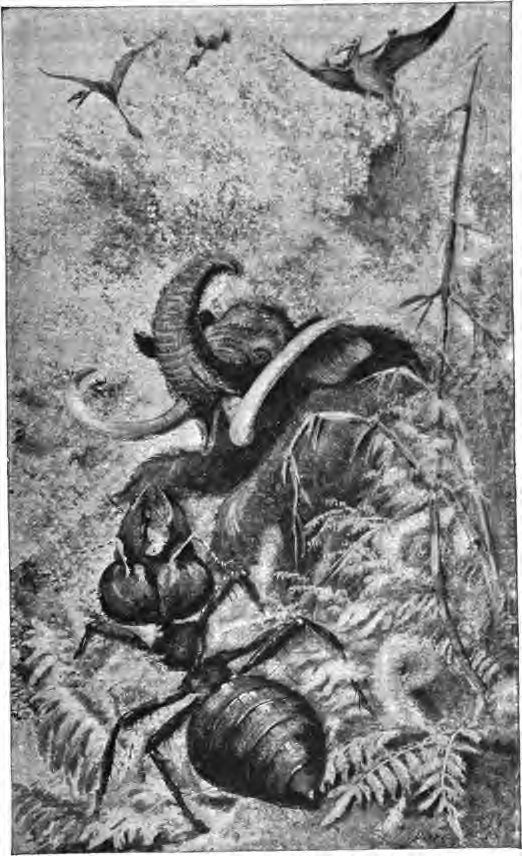 '
' A battle royal on Jupiter
"Let us sit down and wait," said Ayrault; "there may be anopening soon."
Anon a woolly rhinoceros, resembling the Rhinoceros tichorhinusthat existed contemporaneously on earth with the mammoth, came todrink the water that had partly cooled. It was itself aformidable-looking beast, but in an instant the monster againrushed from concealment with the same tremendous speed. Therhinoceros turned in the direction of the sound, and, loweringits head, faced the foe. The ant's shears, however, passedbeneath the horn, and, fastening upon the left foreleg, cut itoff with a loud snap.
"Now is our chance," exclaimed Cortlandt; "we may kill the brutebefore he is through with the rhinoceros."
"Stop a bit, doctor," said Bearwarden. "We have a good record sofar; let us keep up our reputation for being sports. Wait tillhe can attend to us."
The encounter was over in less than a minute, three of therhinoceros's legs being taken off, and the head almost severedfrom the body. Taking up the legs in its mandibles, themurderous creature was returning to its lair, when, with the cryof "Now for the fray!" Bearwarden aimed beneath the body andblew off one of the farther armoured legs, from the inside."Shoot off the legs on the same side," he counselled Ayrault,while he himself kept up a rapid fire. Cortlandt tried todisconcert the enemy by raining duck-shot on its scale-protectedeyes, while the two rifles tore off great masses of the horn thatcovered the enormously powerful legs. The men separated as theyretreated, knowing that one slash of the great shears would cuttheir three bodies in halves if they were caught together. Themonster had dropped the remains of the rhinoceros when attacked,and made for the hunters at its top speed, which was somewhatreduced by the loss of one leg. Before it came within cuttingdistance, however, another on the same side was gone, Ayraulthaving landed a bullet on a spot already stripped of armour.After this the men had no difficulty in keeping out of its way,though it still moved with some speed, snipping off young treesin its path like grass. Finally, having blown the scales fromone eye, the travellers sent in a bullet that exploded in thebrain and ended its career.
"This has been by all odds the most exciting hunt we have had,"said Ayrault, "both on account of the determined nature and greatspeed of the attack, and the almost impossibility of finding avulnerable spot."
"Anything short of explosive bullets," added Bearwarden, "wouldhave been powerless against this beast, for the armour in manyplaces is nearly a foot thick."
"This is also the most extraordinary as well as most dangerouscreature with which we have had to deal," said Cortlandt,"because it is an enormously enlarged insect, with all theinherent ferocity and strength. It is almost the exactcounterpart of an African soldier-ant magnified many hundredthousand times. I wonder," he continued thoughtfully, "if ourlatter-day insects may not be the deteriorated (in point of size)descendants of the monsters of mythology and geology, for nothingcould be a more terrible or ferocious antagonist than many of ourwell-known insects, if sufficiently enlarged. No animal nowalive has more than a small fraction of the strength, inproportion to its size, of the minutest spider or flea. It maybe that through lack of food, difficulties imposed by changingclimate, and the necessity of burrowing in winter, or throughsome other conditions changed from what they were accustomed to,their size has been reduced, and that the fire-flies, huge asthey seemed, are a step in advance of this specimen in the marchof deterioration or involution, which will end by making them asinsignificant as those on earth. These ants have probably comeinto the woods to lay their eggs, for, from the behaviour of theanimals we watched from the turtle, there must have been several;or perhaps a war is in progress between those of a differentcolour, as on earth, in which case the woods may be full of them.Doubtless the reason the turtle seemed so unconcerned at thegeneral uneasiness of the animals was because he knew he couldmake himself invulnerable to the marauder by simply closing hisshell, and we were unmolested because it did not occur to the antthat any soft-shelled creatures could be on the turtle's back."
"I think," said Bearwarden, "it will be the part of wisdom toreturn to the Callisto, and do the rest of our exploring onJupiter from a safe height; for, though we succeeded in disablingthis beauty, it was largely through luck, and had we not done sowe should probably have provided a bon bouche for our deceasedfriend, instead of standing at his grave."
Accordingly they proceeded, and were delighted, a few minuteslater, to see the sunlight reflected from the projectile'spolished roof.
Chapter X.Contents
CHANGING LANDSCAPES.
On reaching the Callisto, Ayrault worked the lock he had hadplaced on the lower door, which, to avoid carrying a key, wasopened by a combination. The car's interior was exactly as theyhad left it, and they were glad to be in it again.
"Now," said Bearwarden, "we can have a sound andundisturbed sleep, which is what I want more thananything else. No prowlers can trouble us here, and weshall not need the protection-wires."
They then opened a window in each side--for the large glassplates, admitting the sun when closed, made the Callisto ratherwarm--and placed a stout wire netting within them to keep outbirds and bats, and then, though it was but little past noon, gotinto their comfortable beds and slept nine hours at a stretch.Their strong metal house was securely at rest, receiving thesunlight and shedding the rain and dew as it might have done onearth. No winds or storms, lightnings or floods, could troubleit, while the multiformed monsters of antiquity and mythologyrestored in life, with which the terrestrials had been throwninto such close contact, roamed about its polished walls. Noteven the fiercest could affect them, and they would but seethemselves reflected in any vain assaults. The domed symmetricalcylinder stood there as a monument to human ingenuity and skill,and the travellers' last thought as they fell asleep was, "Man isreally lord of creation."
The following day at about noon they awoke, and had a bath in thewarm pool. They saw the armoured mass of the great ant evidentlyundisturbed, while the bodies of its victims were already shiningskeletons, and raised a small cairn of stones in memory of thestruggle they had had there.
"We should name this place Kentucky," said Bearwarden, "for it isindeed a dark and bloody ground," and, seeing the aptness of theappellation, they entered it so on their charts. While Ayraultgot the batteries in shape for resuming work, Bearwardenprepared a substantial breakfast. This consisted of oatmeal andcream kept hermetically sealed in glass, a dish of roast grouse,coffee, pilot bread, a bottle of Sauterne, and another of Rhinewine.
"This is the last meal we shall take hereabouts," said theircook, as they plied their knives and forks beneath the trees, "sohere is a toast to our adventures, and to all the game we havekilled." They drained their glasses in drinking this, afterwhich Bearwarden regaled them with the latest concert-hall songwhich he had at his tongue's end.
About an hour before dark they re-entered their projectile, and,as a mark of respect to their little ship, named the great branchof the continent on which they had alighted Callisto Point. Theythen got under way. The batteries had to develop almost theirmaximum power to overcome Jupiter's attraction; but they wereequal to the task, and the Callisto was soon in the air.Directing their apergy to the mountains towards the interior ofthe continent, and applying repulsion to any ridge or hill overwhich they passed, thereby easing the work of the batteriesengaged in supporting the Callisto, they were soon sweeping alongat seventy-five to one hundred miles an hour. By keeping theprojectile just strongly enough charged to neutralizegravitation, they remained for the most part within two hundredfeet of the ground, seldom rising to an altitude of more than amile, and were therefore able to keep the windows at the sidesopen and so obtain an unobstructed view. If, however, at anytime they felt oppressed by Jupiter's high barometric pressure,and preferred the terrestrial conditions, they had but to risetill the barometer fell to thirty. Then, if an object ofinterest recalled them to sea-level, they could keep theCallisto's inside pressure at what they found on the Jovianmountains, by screwing up the windows. On account of thedistance of sixty-four thousand miles from Jupiter's equator tothe pole, they calculated that going at the speed of a hundredmiles an hour, night and day, it would take them twenty-fiveterrestrial days to reach the pole even from latitude two degreesat which they started. But they knew that, if pressed for time,they could rise above the limits of the atmosphere, and move withplanetary speed; while, if they wished a still easier method ofpursuing their observation, they had but to remain poised betweenthe sun and Jupiter, beyond the latter's upper air, andphotograph or map it as it revolved before them.
By sunset they had gone a hundred miles. Wishing to push along,they closed the windows, rose higher to avoid any mountain-topsthat might be invisible in the moonlight, and increased theirspeed. The air made a gentle humming sound as they shot throughit, and towards morning they saw several bright points of lightin which they recognized, by the aid of their glasses, sheets offlame and torrents of molten glowing lava, bursting at intervalsor pouring steadily from several volcanoes. From this theyconcluded they were again near an ocean, since volcanoes need thepresence of a large body of water to provide steam for theireruptions.
With the rising sun they found the scene of the day beforeentirely changed. They were over the shore of a vast ocean thatextended to the left as far as they could see, for the range ofvision often exceeded the power of sight. The coast-line ranalmost due north and south, while the volcanoes that dotted it,and that had been luminous during the night, now revealed theirnature only by lines of smoke and vapours. They were struck bythe boldness and abruptness of the scenery. The mountains andcliffs had been but little cut down by water and frost action,and seemed in the full vigour of their youth, which was what thetravellers had a right to expect on a globe that was stillcooling and shrinking, and consequently throwing up ridges in theshape of mountains far more rapidly than a planet as matured andquiescent as the earth. The absence of lakes also showed themthat there had been no Glacial period, in the latitudes they werecrossing, for a very long time.
"We can account for the absence of ice-action and scratches,"said Cortlandt, "in one of two ways. Either the proximity of theinternal heat to the surface prevents water from freezing in alllatitudes, or Jupiter's axis has always been very nearlyperpendicular to its orbit, and consequently the thermometer hasnever been much below thirty-two degrees Fahrenheit; for, at theconsiderable distance we are now from the sun, it is easy toconceive that, with the axis much inclined, there might be coldweather, during the Northern hemisphere's winter, that would lastfor about six of our years, even as near the equator as this.The substantiation of an ice-cap at the pole will disprove thefirst hypothesis; for what we took for ice before alighting mayhave been but banks of cloud, since, having been in the plane ofthe planet's equator at the time, we had naturally but a veryoblique view of the poles; while the absence of glacial scratchesshows, I take it, that though the axis may have been a good dealmore inclined than at present, it has not, at all events sinceJupiter's Palaeozoic period, been as much so as that of Uranus orVenus. The land on Jupiter, corresponding to the LaurentianHills on earth, must even here have appeared at so remote aperiod that the first surface it showed must long since have beenworn away, and therefore any impressions it received have alsobeen erased."Comparing this land with the photographs we took from space, Ishould say it is the eastern of the two crescent-shapedcontinents we found apparently facing each other. Their presentform I take to be only the skeleton outline of what they will beat the next period of Jupiter's development. They will, Ipredict, become more like half moons than crescents, though theprofile may be much indented by gulfs and bays, their superficialarea being greatly increased, and the intervening oceancorrespondingly narrowed. We know that North America had a verydifferent shape during the Cretaceous or even the Middle Tertiaryperiod from what it has now, and that the Gulf of Mexico extendedup the valley of the Mississippi as far as the Ohio, by thepresence of a great coral reef in the Ohio River near Cincinnati.We know also that Florida and the Southeastern Atlantic Statesare a very recent addition to the continent, while the pampas ofthe Argentine Republic have, in a geological sense, but just beenupheaved from the sea, by the fact that the rivers are all on thesurface, not having had time to cut down their channels below thesurrounding country. By similar reasoning, we know that thecañon of the Colorado is a very old region, though theprecipitateness of its banks is due to the absence of rain, for alocal water-supply would cut back the banks, having most effectwhere they were steepest, since at those points it would movewith the greatest speed. Thus the majestic cañon owes itsexistence to two things: the length of time the river has been atwork, and the fact that the water flowing through it comes fromanother region where, of course, there is rain, and that it ismerely in transit, and so affects only the bed on which it moves.Granting that this is the eastern of the two continents weobserved, it evidently corresponds more in shape to the Easternhemisphere on earth than to the New World, both of which are setfacing one another, since both drain towards the Atlantic Ocean.But the analogy here holds also, for the past outlines of theEastern hemisphere differed radically from what they are now.The Mediterranean Sea was formerly of far greater extent than wesee it to-day, and covered nearly the whole of northern Africaand the old upheaved sea-bottom that we see in the Desert ofSahara. Much of this great desert, as we know, has aconsiderable elevation, though part of it is still below thelevel of the Mediterranean.
"Perhaps a more striking proof of this than are the remains offishes and marine life that are found there, is the dearth ofnatural harbours and indentations in Africa's northern coast,while just opposite, in southern Europe, there are any number;which shows that not enough time has elapsed since Africa'supheaval for liquid or congealed water to produce them. Many ofEurope's best harbours, and Boston's, in our country, have beendug out by slow ice-action in the oft-recurring Glacial periods.The Black and Caspian Seas were larger than we now find them;while the Adriatic extended much farther into the continent,covering most of the country now in the valley of the Po. InEurope the land has, of course, risen also, but so slowly thatthe rivers have been able to keep their channels cut down; proofof their ability to perform which feat we see when an ancientriver passes through a ridge of hills or mountains. The riverhad doubtless been there long before the mountains began to rise,but their elevation was so gradual that the rate of the river'scutting down equalled or exceeded their coming up; proof of whichwe have in the patent fact that the ancient river's courseremains unchanged, and is at right angles to the mountain chain.From all of which we see that the Eastern hemisphere's crescenthollow--of which, I take it, the Mediterranean, Black, andCaspian Sea depressions are the remains--has been graduallyfilled in, by the elevation of the sea's bottom, and theextension of deltas from the detrital matter brought from thehigh interior of the continents by the rivers, or by the combinedaction of the two. Now, since the Gulf of Mexico has beenconstantly growing smaller, and the Mediterranean is beinginvaded by the land, I reason that similar causes will producelike effects here, and give to each continent an area far greaterthan our entire globe. The stormy ocean we behold in the west,which corresponds to our Atlantic, though it is far more of amare clausum in the geographical sense, is also destined tobecome a calm and placid inland sea. There are, of course,modifications of and checks to the laws tending to increase theland area. England was formerly joined to the continent, theland connecting the two having been rather washed away by thewaves and great tides than by any sinking of the EnglishChannel's bottom, the whole of which is comparatively shallow.Another case of this kind is seen in Cape Cod and the islands ofMartha's Vineyard and Nantucket, all of which are washing away sorapidly that they would probably disappear before the nextGlacial period, were we not engaged in preventing its recurrence.These detached islands and sand-bars once formed one largeisland, which at a still earlier time undoubtedly was joined tothe mainland. The sands forming the detached masses are in agreat processional march towards the equator, but it is theresult simply of winds and waves, there being no indication ofsubsidence. Along the coast of New Jersey we see denudation andsinking going on together, the well-known sunken forestbeing aninstance of the latter. The border of the continent proper alsoextends many miles under the ocean before reaching the edge ofthe Atlantic basin. Volcanic eruptions sometimes demolish partsof headlands and islands, though these recompense us in theamount of material brought to the surface, and in the increaseddistance they enable water to penetrate by relieving the interiorof part of its heat, for any land they may destroy."
Chapter XI.Contents
A JOVIAN NIAGARA.
Four days later, after crossing a ridge of mountains that thepressure on the aneroid barometer showed to be about thirty-twothousand feet high, and a stretch of flat country a few miles inwidth, they came to a great arm of the sea. It was about thirtymiles wide at its mouth, which was narrowed like the neck of abottle, and farther inland was over one hundred miles across, andthough their glasses, the clear air, and the planet's sizeenabled them to see nearly five hundred miles, they could notfind its end. In the shallow water along its shores, and onthe islands rising but a few feet above the waves, they sawall kinds of amphibians and sea-monsters. Many of these werealmost the exact reproduction in life of the giant plesiosaurs,dinosaurs, and elasmosaurs, whose remains are preserved in themuseums on earth. The reptilian bodies of the elasmosaurs,seventy-five feet in length, with the forked tongues, distendedjaws and fangs of a snake, were easily taken for the oftendescribed but probably mythical sea-serpent, as partially coiledthey occasionally raised their heads twelve or fifteen feet.
"Man in his natural state," said Cortlandt, "would have but smallchance of surviving long among such neighbours. Buckland, Ithink, once indulged in the jeu d'esprit of supposing anichthyosaur lecturing on the human skull. 'You will at onceperceive,' said the lecturer, 'that the skull before us belongedto one of the lower order of animals. The teeth are veryinsignificant, the power of the jaws trifling, and altogether itseems wonderful how the creature could have procured food.'Armed with modern weapons, and in this machine, we are, ofcourse, superior to the most powerful monster; but it is notlikely that, had man been so surrounded during the whole of hisevolution, he could have reached his present plane."Notwithstanding the striking similarity of these creatures totheir terrestrial counterparts that existed on earth during itscorresponding period, there were some interesting modifications.The organs of locomotion in the amphibians were more developed,while the eyes of all were larger, the former being of coursenecessitated by the power of gravity, and the latter by thegreater distance from the sun.
"The adaptability and economy of Nature," said Cortlandt, "havealways amazed me. In the total blackness of the Kentucky MammothCave, where eyes would be of no use to the fishes, our commonmother has given them none; while if there is any light, thoughnot as much as we are accustomed to, she may be depended upon torise to the occasion by increasing the size of the pupil and thepower of the eye. In the development of the ambulatory muscleswe again see her handiwork, probably brought about through the'survival of the fittest.' The fishes and those wholly immersedneed no increase in power, for, though they weigh more than theywould on earth, the weight of the water they displace isincreased at the same rate also, and their buoyancy remainsunchanged. If the development of life here so closely followsits lines on earth, with the exception of comparatively slightmodifications, which are exactly what, had we stopped to think,we should have expected to find, may we not reasonably askwhether she will not continue on these lines, and in time producebeings like ourselves, but with more powerful muscles and eyescapable of seeing clearly with less light? Reasoning by analogy,we can come to no other conclusion, unless their advent isanticipated by the arrival of ready-made colonists from the moreadvanced earth, like ourselves. In that case man, by pursuingthe same destructive methods that he has pursued in regard tomany other species, may exterminate the intervening links, and soarrest evolution."
Before leaving Deepwaters Bay they secured a pail of its water,which they found, on examination, contained a far largerpercentage of salt and solid material than the oceans on earth,while a thermometer that they immediately immersed in it soonregistered eighty-five degrees Fahrenheit; both of whichdiscoveries confirmed them in what they already knew, namely,that Jupiter had advanced comparatively little from the conditionin which the water on the surface is hot, in which state theearth once was.
They were soon beyond the estuary at which they had stopped tostudy the forms of life and to make this test, and kept on duenorth for several days, occasionally rising above the air. Astheir familiarity with their surroundings increased, they madenotes of several things. The mountains covered far moreterritory at their bases than the terrestrial mountains, and theywere in places very rugged and showed vast yawning chasms. Theywere also wooded farther up their sides, and bore but littlesnow; but so far the travellers had not found them much higherthan those on earth, the greatest altitude being the thirty-twothousand feet south of Deepwaters Bay, and one other ridge thatwas forty thousand; so that, compared with the size of the planetand its continents, they seemed quite small, and the continentsthemselves were comparatively level. They also noted that spraywas blown in vast sheets, till the ocean for miles was white asmilk. The wind often attained tornado strength, and the wholesurface of the water, about what seemed to be the storm centre,frequently moved with rapidity in the form of foam. Yet,notwithstanding this, the waves were never as large as those towhich they were accustomed on earth. This they accounted forvery easily by the fact that, while water weighed 2.55 times asmuch as on earth, the pressure of air was but little more thanhalf as much again, and consequently its effect on all but thevery surface of the heavy liquid was comparatively slight.
"Gravity is a useful factor here," observed Cortlandt, as theymade a note of this; "for, in addition to giving immunity fromwaves, it is most effective in checking the elevation of highmountains or table-lands in the high latitudes, which we shalldoubtless find sufficiently cool, or even cold, while in tropicalregions, which might otherwise be too hot, it interferes withthem least, on account of being partly neutralized by the rapidrotation with which all four of the major planets are blessed."
At sunrise the following morning they saw they were approachinganother great arm of the sea. It was over a thousand miles wideat its mouth, and, had not the photographs showed the contrary,they would have thought the Callisto had reached the northern endof the continent. It extended into the land fifteen thousandmiles, and, on account of the shape of its mouth, they called itFunnel Bay. Rising to a height, they flew across, and came to agreat table-land peninsula, with a chain of mountains on eitherside. The southern range was something over, and the northernsomething less than, five thousand feet in height, while thetable-land between sloped almost imperceptibly towards themiddle, in which, as they expected, they found a river comparedto which the Mississippi or the Amazon would be but a brook. Inhonour of the President of the Terrestrial Axis StraighteningCompany, they called this great projection, which averaged aboutfour thousand miles across by twelve thousand miles long,Bearwarden Peninsula. They already noticed a change in climate;the ferns and palms became fewer, and were succeeded by pines,while the air was also a good deal cooler, which was easilyaccounted for by their altitude--though even at that height itwas considerably denser than at sea-level on earth--and by thefact that they were already near latitude thirty.
The exposed points on the plateau, as also the summits of thefirst mountains they had seen before alighting, were devoid ofvegetation, scarcely so much as a blade of grass being visible.Since they could not account for this by cold, they concludedthat the most probable explanation lay in the tremendoushurricanes that, produced by the planet's rapid rotation,frequently swept along its surface, like the earth's trade-winds,but with far more violence. On reaching the northern coast ofthe peninsula they increased their elevation and changed theircourse to northeast, not caring to remain long over the greatbody of water, which they named Cortlandt Bay. The thousands ofmiles of foam fast flew beneath them, the first thing attractingtheir attention being a change in the ocean's colour. In theeastern shore of Cortlandt Bay they soon observed the mouth of ariver, ten miles across, from which this tinted water issued in aflood. On account of its colour, which reminded them of a streamthey knew so well, they christened it the Harlem.
Believing that an expedition up its valley might reveal somethingof interest, they began the ascent, remaining at an elevation ofa few hundred feet. For about three hundred miles they followedthis river, which had but few bends, while its sides became moreand more precipitous, till it flowed through a cañon four and ahalf miles across. Though they knew from the wide discolorationof Cortlandt Bay that the volume of water discharged wastremendous, the stream seldom moved at a rate of more than fivemiles an hour, and for a time was free from rocks and rapids,from which they concluded that it must be very deep. Half anhour later they saw a cloud of steam or mist, which expanded, andalmost obscured the sky as they approached. Next they heard asound like distant thunder, which they took for the prolongederuption of some giant crater, though they had not expected tofind one so far towards the interior of the continent. Presentlyit became one continuous roar, the echo in the cañon, whose wallswere at this place over six hundred feet high, being simplydeafening, so that the near discharge of the heaviest artillerywould have been completely drowned."One would think the end of the world was approaching!" shoutedCortlandt through his hands.
"Look!" Bearwarden roared back, "the wind is scattering themist."
As he spoke, the vapoury curtain was drawn aside, revealing awaterfall of such vast proportions as to dwarf completelyanything they had ever seen or even imagined. A somewhat openhorseshoe lip, three and a half miles straight across and overfour miles following the line of the curve, discharged a sheet ofwater forty feet thick at the edge into an abyss six hundred feetbelow. Two islands on the brink divided this sheet of liquidinto three nearly equal parts, while myriads of rainbows hoveredin the clouds of spray. Two things especially struck theobservers: the water made but little curve or sweep on passingover the edge, and then rushed down to the abyss at almostlightning speed, shivering itself to infinitesimal particles onstriking any rock or projection at the side. Its behaviour was,of course, due to its weight, and to the fact that on Jupiterbodies fall 40.98 feet the first second, instead of sixteen feet,as on earth, and at correspondingly increasing speed.
Finding that they were being rapidly dazed and stunned by thenoise, the travellers caused the Callisto to rise rapidly, andwere soon surveying the superb sight from a considerableelevation. Their minds could grasp but slowly the full meaningand titanic power of what they saw, and not even the vast fallsin their nearness could make their significance clear. Here wasa sheet of water three and a half miles wide, averaging fortyfeet in depth, moving at a rapid rate towards a sheer fall of sixhundred feet. They felt, as they gazed at it, that the power ofthat waterfall would turn backward every engine and dynamo on theearth, and it seemed as if it might almost put out the fires ofthe sun. Yet it was but an illustration of the action of thesolar orb exerted on a vast area of ocean, the vapour in the formof rain being afterwards turned into these comparatively narrowlimits by the topography of the continent. Compared with this,Niagara, with its descent of less than two hundred feet, and itsrelatively small flow of water, would be but a rivulet, or atbest a rapid stream. Reluctantly leaving the fascinatingspectacle, they pursued their exploration along the river abovethe falls. For the first few miles the surface of the water wasnear that of the land; there were occasional rapids, but fewrocks, and the foaming torrent moved at great speed, the redsandstone banks of the river being as polished as though they hadbeen waxed. After a while the obstructions disappeared, but thewater continued to rush and surge along at a speed of ten ortwelve miles an hour, so that it would be easily navigable onlyfor logs or objects moving in one direction. The surface of theriver was soon on an average fifty feet below the edge of thebanks, this depression being one result of the water's rapidmotion and weight, which facilitated the carving of its channel.
When they had followed up the river about sixty miles towards itssource they came upon what at first had the appearance of anocean. They knew, however, from its elevation, and the floodcoming from it, that the water must be fresh, as they soon foundit was. This lake was about three hundred miles wide, andstretched from northeast to southwest. There was rolling landwith hills about its shores, and the foliage on the banks was abeautiful shade of bluish purple instead of the terrestrialubiquitous green.
When near the great lake's upper end, they passed the mouth of ariver on their left side, which, from its volume, they concludedmust be the principal source, and therefore they determined totrace it. They found it to be a most beautiful stream, averagingtwo and a half miles in width, evidently very deep, and with afull, steady current. After proceeding for several hours, theyfound that the general placidity grew less, the smooth surfaceoccasionally became ruffled by projecting rocks and rapids, andthe banks rose till the voyagers again found themselves in aravine or cañon.
During their sojourn on Jupiter they had had but littleexperience with the tremendous winds that they knew, from reasonand observation, must rage in its atmosphere. They now heardthem whistling over their heads, and, notwithstanding theprotection afforded by the sides of the cañon, occasionallyreceived a gust that made the Callisto swerve. They kept onsteadily, however, till sunset, at which time it became very darkon account of the high banks, which rose as steeply as thePalisades on the Hudson to a height of nearly a thousand feet.Finding a small island near the eastern bank, they were glad tosecure the Callisto there for the night, below the reach of thewinds, which they still heard singing loudly but with a musicalnote in what seemed to them like the sky.
"It is incomprehensible to me." said Ayrault, as they sat atdinner, "how the sun, at a distance of four hundred andeighty-three million miles, can raise the amount of water we havehere passing us, and compared with which the discharge of thegreatest river on earth would be insignificant, to say nothing ofthe stream we ascended before reaching this."
"We must remember," replied Cortlandt, "that many of theconditions are different here from those that exist on earth. Weknow that some of the streams are warm, and even hot, and thatthe temperature of Deepwaters Bay, and doubtless that of theocean also, is considerably higher than ours. This wouldfacilitate evaporation. The density of the atmosphere and thetremendous winds, of which I suspect we may see more later, mustalso help the sun very much in its work of raising vapour. Butthe most potent factor is undoubtedly the vast size of the basinthat these rivers drain."
"The great speed at which the atmospheric currents move," saidBearwarden, "coupled with the comparative lowness of the mountainchains and the slight obstruction they offer to their passage,must distribute the rain very thoroughly, notwithstanding thegreat unbroken area of the continents. There can be no suchstate of things here as exists in the western part of SouthAmerica, where the Andes are so high that any east-bound clouds,in crossing them, are shoved up so far into a cold region thatall moisture they may have brought from the Pacific is condensedinto rain, with which parts of the western slope are deluged,while clouds from the Atlantic have come so far they have alreadydispersed their moisture, in consequence of which the region justeast of the Andes gets little if any rain. It is bad for acontinent to have its high mountains near the ocean from which itshould get its rain, and good for it to have them set well back."
"I should not be surprised," said Cortlandt, "if we saw anotherwaterfall to-morrow, though not in the shape of rain. In thehour before we stopped we began to see rapids and protrudingrocks. That means that we are coming to a part of the channelthat is comparatively new, since the older parts have had time towear smooth. I take it, then, that we are near the foot of aretreating cascade, which we may hope soon to see. That isexactly the order in which we found smooth water and rapids inriver No. 1, which we have named the Harlem."
After this, not being tired, they used the remaining dark hoursfor recording their recent adventures.
Chapter XII.Contents
HILLS AND VALLEYS.
With the first light they resumed their journey, and an hourafter setting out they sighted, as Cortlandt had predicted,another cloud of vapour. The fall--for such it proved to be--wasmore beautiful than the other, for, though the volume of waterwas not so great, it fell at one leap, without a break, and atthe same tremendous speed, a distance of more than a thousandfeet. The cañon rang with the echoes, while the spray flew insheets against the smooth, glistening, sandstone walls. Insteadof coming from a river, as the first fall had, this poured atonce from the rocky lip, about two miles across, of a lake thatwas eleven hundred feet above the surging mass in the vale below.
"It is a thousand pities," said Bearwarden, "that this cataracthas got so near its source; for, at the rate these streams mustcut, this one in a few hundred years, unless something is done toprevent it, will have worn back to the lake, and then good-bye tothe falls, which will become a series of rapids. Perhaps thefirst effect will be merely to reduce by a few feet the height ofthe falls, in which case they will remain in practically the sameplace."
About the shores of this lake they saw rhinoceroses with longthick wool, and herds of creatures that much resembled buffaloes.
"I do not see," said Bearwarden, "why the identical speciesshould not exist here that till recently, in a geological sense,inhabited the earth. The climate and all other conditions arepractically the same on both planets, except a triflingdifference in weight, to which terrestrials would soon adaptthemselves. We know by spectroscopic analysis that hydrogen,iron, magnesium, and all our best-known substances exist in thesun, and even the stars, while the earth contains everything wehave found in meteorites. Then why make an exception of life,instead of supposing that at corresponding periods of developmentthe same living forms inhabit all? It would be assuming theeternal sterilization of the functions of Nature to suppose thatour earth is the only body that can produce them."
"The world of organic life is so much more complex," repliedCortlandt, "than that of the crystal, that it requires greatcontinuity. So far we certainly have seen no men, or anythinglike them, not even so much as a monkey, though I suppose,according to your reasoning, Jupiter has not advanced far enoughto produce even that."
"Exactly," replied Bearwarden, "for it will require vast periods;and, according to my belief, at least half the earth's time ofhabitability had passed before man appeared. But we see Jupiteris admirably suited for those who have been developed somewhereelse, and it would be an awful shame if we allowed it to lieunimproved till it produces appreciative inhabitants of its own,for we find more to admire in one half-hour than its entirepresent population during its lifetime. Yet, how magnificentthis world is, and how superior in its natural state to ours!The mountainous horns of these crescent-shaped continents protectthem and the ocean they enclose from the cold polar marinecurrents, and in a measure from the icy winds; while the elevatedcountry on the horns near the equator might be a Garden of Eden,or ideal resort. To be sure, the continents might support alarger population, if more broken up, notwithstanding theadvantage resulting from the comparatively low mountains alongthe coasts, and the useful winds. A greater subdivision of landand water, more great islands connected by isthmuses, and moremediterraneans joined by straits, would be a further advantage tocommerce; but with the sources of power at hand, the resistlesswinds and water-power, much increased in effectiveness by theirweight, the great tides when several moons are on the same side,or opposite the sun, internal heat near the surface, and abundantcoal-supply doubtless already formed and also near the surface,such small alterations could be made very easily, and would servemerely to prevent our becoming rusty.
"As Jupiter's distance from the sun varies from 506,563,000 milesat aphelion to only 460,013,000 at perihelion, this difference,in connection with even the slight inclination of the axis, mustmake a slight change in seasons, but as the inclination ispractically nothing, almost the entire change results from thedifference in distance. This means that the rise or fall intemperature is general on every degree of latitude, all beingwarmed simultaneously, more or less, as the planet approaches ordeparts from the sun. It means also that about the sameconditions that Secretary Deepwaters suggested as desirable forthe earth, prevail here, and that Jupiter represents, therefore,about the acme of climate naturally provided. On account of itsrapid rotation and vast size, the winds have a tornado'sstrength, but they are nothing at this distance from the sun towhat they would be if a planet with its present rate of rotationand size were where Venus or even the earth is. In either ofthese positions no land life with which we are acquainted couldlive on the surface; for the slope of the atmospheric isobars--i.e., the lines of equal barometric pressure that produce wind bybecoming tilted through unequal expansion, after which the air,as it were, flows down-hill--would be too great. The ascendingcurrents about the equator would also, of course, be vastlystrengthened; so that we see a wise dispensation of Providence inplacing the large planets, which also rotate so rapidly, at agreat distance from the sun, which is the father of all winds,rotation alone, however rapid, being unable to produce them."
They found this lake was about six times the size of LakeSuperior, and that several large and small streams ran into itsupper end. These had their sources in smaller lakes that were atslightly higher elevations. Though the air was cool, the sunshone brightly, while the ground was covered with flowersresembling those of the northern climes on earth, of all shapesand lines. Twice a day these sent up their song, and trees werecovered with buds, and the birds twittered gaily. The streamsmurmured and bubbled, and all things reminded the travellers ofearly morning in spring.
"If anything could reconcile me," said Bearwarden, "to exchangemy active utilitarian life for a rustic poetical existence, itwould be this place, for it is far more beautiful than anything Ihave seen on earth. It needs but a Maud Muller and a few cows tocomplete the picture, since Nature gives us a vision of eternalpeace and repose."
Somehow the mention of Maud Muller, and the delicate and refinedflowers, whose perfume he inhaled, brought up thoughts that werenever far below the surface in Ayrault's mind. "The place isheavenly enough," said he, "to make one wish to live and remainhere forever, but to me it would be Hamlet with Hamlet left out."
"Ah! poor chap," said Cortlandt, "you are in love, but you arenot to be pitied, for though the thrusts at the heart are sharp,they may be the sweetest that mortals know."
The following morning they reluctantly left the picturesqueshores of Lake Serenity, with their beautiful tints and foliage,and resumed the journey, to explore a number of islands in theocean in the west, which were recorded on their negatives.Ascending to rarefied air, they saw great chains of mountains,which they imagined ran parallel to the coast, rising toconsiderable altitudes in the east. The tops of all glistenedwith a mantle of snow in the sunlight, while between the ridgesthey saw darker and evidently fertile valleys. They passed,moving northwest, over large and small lakes, all evidently partof the same great system, and continued to sweep along forseveral days with a beautiful panorama, as varying as akaleidoscope, spread beneath their eyes. They observed that thecharacter of the country gradually changed. The symmetricallyrounded mountains and hills began to show angles, while greatslabs of rock were split from the faces. The sides also becameless vertical, and there was an accumulation of detritalfragments about their bases. These heaps of fractured stone hadin some cases begun to disintegrate and form soil, on which therewas a scant growth of vegetation; but the sides and summits,whose jaggedness increased with their height, were absolutelybare.
"Here," said Cortlandt, "we have unmistakable evidence of frostand ice action. The next interesting question is, How recentlyhas denudation occurred? The absence of plant life at theexposed places," he continued, as if lecturing to a class, "canbe accounted for here, as nearer the equator, by the violence ofthe wind; but I greatly doubt whether water will now freeze inthis latitude at any season of the year, for, even should theNorthern hemisphere's very insignificant winter coincide with theplanet's aphelion, the necessary drop from the presenttemperature would be too great to be at all probable. If, then,it is granted that ice does not form here now, notwithstandingthe fact that it has done so, the most plausible conclusion isthat the inclination of Jupiter's axis is automatically changing,as we know the earth's has often done. There being nothingincompatible in this view with the evidence at hand, we cansafely assume it correct for the time being at least. Whenfarther south, you remember, we found no trace of ice action,notwithstanding the comparative slowness with which we decidedthat the ridges in the crust had been upheaved on account of theresisting power of gravity, and, as I see now, also on account ofJupiter's great mass, which must prevent its losing its heatanything like as fast as the earth has, in which I think also wehave the explanation of the comparatively low elevation of themountains that we found we could not account for by the power ofgravitation alone.* From the fact that the exposed surfacefarther south must be old, on account of the slow upheaval andthe slight wear to which it is exposed, about the only wearingagent being the wind, which would be powerless to eraseice-scratches, especially since, on account of gravity's power,it cannot, like our desert winds, carry much sand--which, as weknow, has cut away the base of the Sphinx--I think it is logicalto conclude that, though Jupiter's axis is changing naturally asthe earth's has been, it has never varied as much as twenty-threeand a half degrees, and certainly to nothing like the extent towhich we see Venus and Uranus tilted to-day."
* It is well known that mountain chains are but ridges or foldings in the crust upheaved as the interior cools and shrinks.This is proved by reason and by experiments with viscous clay or other material placed upon a sheet of stretched rubber, which isafterwards allowed to contract, whereupon the analogues of mountain ridges are thrown up.
"I follow you," said Bearwarden, "and do not see how we couldarrive at anything else. From Jupiter's low specific gravity,weighing but little more than an equal bulk of water, I shouldsay the interior must be very hot, or else is composed of lightmaterial, for the crust's surface, or the part we see, isevidently about as dense as what we have on earth. These thingshave puzzled me a good deal, and I have been wondering if Jupitermay not have been formed before the earth and the smallerplanets."
"The discrepancies between even the best authorities," repliedCortlandt, "show that as yet but little has been discovered fromthe earth concerning Jupiter's real condition. The two theoriesthat try to account for its genesis are the ring theory and thenebulous. We know that the sun is constantly emitting vastvolumes of heat and light, and that, with the exception of theheat resulting from the impact of falling meteors, it receivesnone from outside, the principal source being the tremendousfriction and pressure between the cooling and shrinking stratawithin the great mass of the sun itself. A seeming paradoxtherefore comes in here, which must be considered: If the sunwere composed entirely of gas, it would for a time continue togrow hotter; but the sun is incessantly radiating light and heat,and consequently becoming smaller. Therefore the farther back wego the hotter we find the sun, and also the larger, till, insteadof having a diameter of eight hundred and eighty thousand miles,it filled the space now occupied by the entire solar system.Here is where the two theories start. According to the first,the revolving nebulous mass threw off a ring that became theplanet Neptune, afterwards another that contained the materialfor Uranus, and so on, the lightest substance in the sun beingthrown off first, by which they accounted for the lightness ofthe four great planets, and finally Mars, the earth, and thesmall dense planets near the sun. The advocates of this theorypointed to Saturn's rings as an illustration of the birth of aplanet, or, rather, in that case a satellite. According to this,the major planets have had a far longer separate existence thanthe minor, which would account for their being so advancednotwithstanding their size. This theory may again come intogeneral acceptance, but for the present it has been discreditedby the nebulous. According to this second theory, at the timethe sun filled all the space inside of Neptune's, orbit, orextended even farther, several centres of condensation wereformed within the nebulous, gaseous mass. The greatest centrebecame the sun, and the others, large and small, the planets,which--as a result of the spiral motion of the whole, such as isnow going on before our eyes in the great nebulæ of fifty-oneM. Canuin venaticorum, and many others--began to revolve aboutthe greatest central body of gas. As the separate masses cooled,they shrank, and their surfaces or extreme edges, which at firstwere contiguous, began to recede, which recession is still goingon with some rapidity on the part of the sun, for we may be sureits diameter diminishes as its density increases. According toeither theory, as I see it, the major planets, on account oftheir distance from the central mass, have had longer separateexistences than the minor, and are therefore more advanced thanthey would be had all been formed at the same time.
"This theory explains the practical uniformity in the chemicalcomposition of all members of this system by assuming that theywere all once a part of the same body, and you may say brothersand sisters of the sun, instead of its offspring. It also makessize the only factor determining temperature and density, but ofcourse modified by age, since otherwise Jupiter would have a farless developed crust than that with which we find it. I havealways considered the period from the molten condition to thatwith a crust as comparatively short, which stands to reason, forradiation has then no check; and the period from the formation ofthe crust, which acts as a blanket, to the death of a planet, asvery long. I have not found this view clearly set forth in anyof the books I have read, but it seems to me the simplest andmost natural explanation. Now, granted that the solar system wasonce a nebula, on which I think every one will agree--the sameforces that changed it into a system of sun and planets must beat work on fifty-one M. Canum venaticorum, Andromeda, and ninety-nineM. Virginis, and must inevitably change them to suns, eachwith doubtless a system of planets.
"If, then, the condition of a nebula or star depends simply onits size, it is reasonable to suppose that Andromeda, Sirius, andall the vast bodies we see, were created at the same time as oursystem, which involves the necessity of one general andsimultaneous creation day. But as Sirius, with its diameter oftwelve million miles, must be larger than some of the nebulaewill be when equally condensed, we must suppose rather thatnebulae are forming and coming into the condition of bright anddead stars, much as apples or pears on a fruit tree areconstantly growing and developing, so that the Mosaic descriptionof the creation would probably apply in point of time only to oursystem, or perhaps to our globe, though the rest will doubtlesspass through precisely the same stages. This, I think, I willpublish, on our return, as the Cortlandt astronomical doctrine,as the most rational I have seen devised, and one that I think wemay safely believe, until, perhaps, through increased knowledge,it can be disproved."
After they crossed a line of hills that ran at right angles totheir course they found the country more rolling. All streamsand water-courses flowed in their direction, while their aneroidshowed them that they were gradually descending. When they weremoving along near the surface of the ground, a delicious andrefined perfume exhaled by the blue and white flowers, that hadbeen growing smaller as they journeyed northward, frequentlyreached their nostrils. To Cortlandt and Bearwarden it wasmerely the scent of a flower, but to Ayrault it recalled mentalpictures of Sylvia wearing violets and lilies that he had givenher. He knew that the greatest telescopes on earth could notreveal the Callisto moving about in Jupiter's sunshine, as even apoint of light, at that distance, and, notwithstandingCortlandt's learning and Bearwarden's joviality, he felt at timesextremely lonely.
They swept along steadily for fifty hours, having bright sunnydays and beautifully moonlit nights. They passed over finelyrounded hills and valleys and well-watered plains. As theyapproached the ocean and its level the temperature rose, andthere was more moisture in the air. The plants and flowers alsoincreased in size, again resembling somewhat the large speciesthey had seen near the equator.
"This would be the place to live," said Bearwarden, looking atiron mountains, silver, copper, and lead formations, primevalforests, rich prairies, and regions evidently underlaid with coaland petroleum, not to mention huge beds of aluminum clay, andother natural resources, that made his materialistic mouth water."It would be joy and delight to develop industries here, with nosnow avalanches to clog your railroads, or icy blizzards toparalyze work, nor weather that blights you with sun-strokes andfevers. On our return to the earth we must organize a company torun regular interplanetary lines. We could start on this globeall that is best on our own. Think what boundless possibilitiesmay be before the human race on this planet, which on account ofits vast size will be in its prime when our insignificant earthis cold and dead and no longer capable of supporting life! Thinkalso of the indescribable blessing to the congested communitiesof Europe and America, to find an unlimited outlet here! Mars isalready past its prime, and Venus scarcely habitable, but inJupiter we have a new promised land, compared with which ourearth is a pygmy, or but little more than microscopic."
"I see," said Ayrault, "that the possibilities here have nolimit; but I do not see how you can compare it to the promisedland, since, till we undertook this journey, no one had eventhought of Jupiter as a habitable place." "I trace the Divine promise," replied Bearwarden, "in what youdescribed to us on earth as man's innate longing and desire torise, and in the fact that the Almighty has given the raceunbounded expansiveness in very limited space. This would lookto me as the return of man to the garden of Eden throughintellectual development, for here every man can sit under hisown vine and fig-tree."
"It seems to me," said Cortlandt, "that no paradise or heavendescribed in anything but the Bible compares with this.According to Virgil's description, the joys on the banks of hisriver Lethe must have been most sad and dreary, the generalidleness and monotony apparently being broken only by wrestlingmatches between the children, while the rest strolled about withlaurel wreaths or rested in the shade. The pilot Palinurus, whohad been drowned by falling overboard while asleep, but whobefore that had presumably done his duty, did not seem especiallyhappy; while the harsh, resentful disposition evidently remainedunsoftened, for Dido became like a cliff of Marpesian marble whenÆneas asked to be forgiven, though he had doubtless consideredhimself in duty bound to leave her, having been twice commandedto do so by Mercury, the messenger of Jove. She, like the rest,seems to have had no occupation, while the consciences of fewappear to have been sufficiently clear to enable them to enjoyunbroken rest."
"The idleness in the spirit-land of all profane writers," addedBearwarden, "has often surprised me too. Though I have alwaysrecommended a certain amount of recreation for my staff--in fact,more than I have generally had myself--an excess of it becomes abore. I think that all real progress comes through thoroughwork. Why should we assume that progress ceases at death? Ibelieve in the verse that says, 'We learn here on earth thosethings the knowledge of which is perfected in heaven.'"
"According to that," said Cortlandt, "you will some day besetting the axis of heaven right, for in order to do work theremust be work to be done--a necessary corollary to which is thatheaven is still imperfect."
"No," said Bearwarden, bristling up at the way Cortlandtsometimes received his speeches, "it means simply that itsdevelopment, though perfect so far as it goes, may not befinished, and that we may be the means, as on earth, of helpingit along."
"The conditions constituting heaven," said Ayrault, "may be asfixed as the laws of Nature, though the products of thoseconditions might, it seems to me, still be forming and subject tomodification thereby. The reductio ad absurdu would of courseapply if we supposed the work of creation absolutely finished."
Chapter XIII.Contents
NORTH-POLAR DISCOVERIES.
Two days later, on the western horizon, they beheld the ocean.Many of the streams whose sources they had seen when they crossedthe divide from the lake basin, and whose courses they hadfollowed, were now rivers a mile wide, with the tide ebbing andrising within them many hundreds of miles from their mouths.When they reached the shore line they found the waves breaking,as on earth, upon the sands, but with this difference: they hadbefore noted the smallness of the undulations compared with thestrength of the wind, the result of the water's weight. Thesewaves now reminded them of the behaviour of mercury, or of meltedlead when stirred on earth, by the rapidity with which the crestsdropped. Though the wind was blowing an on-shore gale, there wasbut little combing, and when there was any it lasted but asecond. The one effort of the crests and waves seemed to be toremain at rest, or, if stirred in spite of themselves, tosubside.
When over the surface of the ocean, the voyagers rose to a heightof thirty thousand metres, and after twenty-four hours'travelling saw, at a distance of about two hundred miles, whatlooked like another continent, but which they knew must be anisland. On finding themselves above it, they rose still higherto obtain a view of its outlines and compare its shape with thatof the islands in the photographs they had had time to develop.The length ran from southeast to northwest. Though crossed bylatitude forty, and notwithstanding Jupiter's distance from thesun, the southern side had a very luxuriant vegetation that wasalmost semi-tropical. This they accounted for by its totalimmunity from cold, the density of the air at sea-level, and thewarm moist breezes it received from the tepid ocean. The climatewas about the same as that of the Riviera or of Florida inwinter, and there was, of course, no parching summer.
"This shows me," said Bearwarden, "that a country's climatedepends less on the amount of heat it receives from the sun thanon the amount it retains; proof of which we have in the tops ofthe Himalayas perpetually covered with snow, and snow-cappedmountains on the very equator, where they get the most directrays, and where those rays have but little air to penetrate. Itshows that the presence of a substantial atmosphere is asnecessary a part of the calculation in practice as the sunitself. I am inclined to think that, with the constant effect ofthe internal heat on its oceans and atmosphere, Jupiter could getalong with a good deal less solar heat than it receives, in proofof which I expect to find the poles themselves quite comfortable.The reason the internal heat is so little taken into account onearth is because, from the thickness of the crust, it cannot makeitself felt; for if the earth were as chilled through as ice, thepeople on the surface would not feel the difference."A Jovian week's explorations disclosed the fact that though theisland's general outlines were fairly regular, it had deep-waterharbours, great rivers, and land-locked gulfs and bays, some ofwhich penetrated many hundred miles into the interior. It alsoshowed that the island's length was about six thousand miles, andits breadth about three thousand, and that it had therefore aboutthe superficial area of Asia. They found no trace of the greatmonsters that had been so numerous on the mainland, though therewere plenty of smaller and gentle-looking creatures, among themanimals whose build was much like that of the prehistoric horse,with undeveloped toes on each side of the hoof, which in themodern terrestrial horse have disappeared, the hoof being inreality but a rounded-off middle finger. "It is wonderful," said Bearwarden, "how comparatively narrowa body of water can keep different species entirely separate.The island of Sumatra, for instance, is inhabited by marsupialsbelonging to the distinct Australian type, in which the female,as in the kangaroo, carries the slightly developed young in apouch; while the Malay peninsula, joined to the mainland, has allthe highly developed animals of Asia and the connected land ofthe Eastern hemisphere, the narrow Malacca Strait being all thathas kept marsupials and mammals apart, though the separatingpower has been increased by the rapid current setting through.This has decreased the chance of creatures carried to sea ondrift-wood or uprooted trees getting safely over to such a degreethat apparently none have survived; for, had they done so, we maybe certain that the mammals, with the advantage their young haveover the marsupials, would soon have run them out, the marsupialsbeing the older and the less perfect form of life of the two."
Before leaving the beautiful sea-girt region beneath them,Cortlandt proposed that it be named after their host, whichBearwarden seconded, whereupon they entered it as Ayrault Islandon the charts. After this they rose to a great height, and flewswiftly over three thousand miles of ocean till they came toanother island not quite as large as the first. It was fourthousand five hundred miles long by something less than threethousand wide, and was therefore about the size of Africa. Ithad several high ranges of mountains and a number of great riversand fine harbours, while murmuring, bubbling brooks flowedthrough its forest glades. There were active volcanoes along thenorthern coast, and the blue, crimson, and purple lines in theluxuriant foliage were the most beautiful they had ever seen.
"I propose," said Bearwarden, "that we christen this Sylvialand."This Cortlandt immediately seconded, and it was so entered on thecharts.
"These two islands," said Bearwarden, "may become the centres ofcivilization. With flying machines and cables to carrypassengers and information, and ships of great displacement forthe interchange of commodities, there is no limit to theirpossible development. The absence of large waves will also bevery favourable to sea-spiders, which will be able to run attremendous speeds. The constancy in the eruptions of thevolcanoes will offer a great field to Jovian inventors, who willunquestionably be able to utilize their heat for the productionof steam or electricity, to say nothing of an inexhaustiblesupply of valuable chemicals. They may contain the means ofproducing some force entirely different from apergy, and assuperior to electricity as that is to steam. Our earthlyvolcanoes have been put to slight account because of the longintervals between eruptions."
After leaving Sylvialand they went westward to the eastern of thetwo crescent continents. It was separated from the island byabout six thousand miles of ocean, and had less width than thewestern, having about the proportions of a three-day crescent,while the western had the shape of the moon when four or fivedays old. They found the height of the mountains and plateaussomewhat less than on the eastern continent, but no greatdifference in other respects, except that, as they went towardsthe pole, the vegetation became more like that of Scotland or anorth temperate region than any they had seen. On reachinglatitude fifty they again came out over the ocean to investigatethe speckled condition they had observed there. They found avast archipelago covering as great an area as the whole PacificOcean. The islands varied from the size of Borneo and Madagascarto that of Sicily and Corsica, while some contained but a fewsquare miles. The surface of the archipelago was about equallydivided between land and water.
"It would take good navigation or an elaborate system oflight-houses," said Bearwarden, "for a captain to find theshortest course through these groups."
The islands were covered with shade trees much resembling thoseon earth, and the leaves on many were turning yellow and red, forthis hemisphere's autumn had already begun.
"The Jovian trees," said Cortlandt, "can never cease to bear,though the change of seasons is evidently able to turn theircolour, perhaps by merely ripening them. When a ripe leaf fallsoff, its place is doubtless soon taken by a bud, for germinationand fructification go on side by side."
Before leaving, they decided to name this Twentieth CenturyArchipelago, since so much of the knowledge appertaining to ithad been acquired in their own day. At latitude sixty thenorthern arms of the two continents came within fifteen hundredmiles of each other. The eastern extension was split like thetail of a fish, the great bay formed thereby being filled withislands, which also extended about half of the distance across.The western extremity shelved very gradually, the sand-barsrunning out for miles just below the surface of the water.
After this the travellers flew northward at great speed in theupper regions of the air, for they were anxious to hasten theirjourney. They found nothing but unbroken sea, and not till theyreached latitude eighty-seven was there a sign of ice. They thensaw some small bergs and field ice, but in no great quantities.As their outside thermometer, when just above the placidwater--for there were no waves here--registered twenty-onedegrees Fahrenheit, they accounted for this scarcity of ice bythe absence of land on which fresh water could freeze, and by thefact that it was not cold enough to congeal the very saltsea-water.
Finally they reached another archipelago a few hundred miles inextent, the larger islands of which were covered with a sheet ofice, at the edges of which small icebergs were being formed bybreaking off and slowly floating. Finding a small island onwhich the coating was thin, they grounded the Callisto, andstepped out for the first time in several days. The air was sostill that a small piece of paper released at a height of sixfeet sank slowly and went as straight as the string of aplumb-line. The sun was bisected by the line of the horizon, andappeared to be moving about them in a circle, with only its upperhalf visible. As Jupiter's northern hemisphere was passingthrough its autumnal equinox, they concluded they had landedexactly at the pole."Now to work on our experiment," said Cortlandt. "I wonder how wemay best get below the frozen surface?""We can explode a small quantity of dynamite," repliedBearwarden, "after which the digging will be comparatively easy."
While Cortlandt and Bearwarden prepared the mine, Ayrault broughtout a pickaxe, two shovels, and the battery and wires with whichto ignite the explosive. They made their preparations within onehundred feet of the Callisto, or much nearer than an equivalentamount of gunpowder could have been discharged.
"This recalls an old laboratory experiment, or rather lecture,"said Cortlandt, as they completed the arrangements, "for theillustration is not as a rule carried out. Explode two pounds ofpowder on an iron safe in a room with the windows closed, and thewindows will be blown out, while the safe remains uninjured.Explode an equivalent amount of dynamite on top of the safe, andit will be destroyed, while the glass panes are not even cracked.This illustrates the difference in rapidity with which theexplosions take place. To the intensely rapid action of dynamitethe air affords as much resistance as a solid substance, whilethe explosion of the powder is so slow that the air has time tomove away; hence the destruction of the windows in the firstcase, and the safe in the second."When they had moved beyond the danger line, Bearwarden, as theparty's practising engineer, pressed the button, and theexplosion did the rest. They found that the ground was frozen toa depth of but little more than a foot, below which it becameperceptibly warm. Plying their shovels vigorously, they had soondug the hole so deep that its edges were above their heads. Whenthe floor was ten feet below the surrounding level thethermometer registered sixty.
"This is scarcely a fair test," said Cortlandt, "since the heatrises and is lost as fast as given off. Let us therefore closethe opening and see in what time it will melt a number of cubicfeet of ice."
Accordingly they climbed out, threw in about a cart-load of ice,and covered the opening with two of the Callisto's thick rugs.In half an hour all the ice had melted, and in another half hourthe water was hot.
"No arctic expedition need freeze to death here," saidBearwarden, "since all a man would have to do would be to burrowa few feet to be as warm as toast."
As the island on which they had landed was at one side of thearchipelago, but was itself at the exact pole, it followed thatthe centre of the archipelago was not the part farthest north.This in a measure accounted for the slight thickness of ice andsnow, for the isobaric lines would slope, and consequently whatwind there was would flow towards the interior of thearchipelago, whose surface was colder than the surrounding ocean.The moist air, however, coming almost entirely from the south,would lose most of its moisture by condensation in passing overthe ice-laden land, and so, like the clouds over the region eastof the Andes, would have but little left to let fall on thisextreme northern part. The blanketing effect of a greatthickness of snow would also cause, the lower strata of ice tomelt, by keeping in the heat constantly given off by the warmplanet."I think there can be no question," said Cortlandt, "that, as aresult of Jupiter's great flattening at the poles and the drawingof the crust, which moves faster in Jupiter's rotation than anyother part, towards the equator, the crust must be particularlythin here; for, were it as thin all over, there would be no spacefor the coal-beds, which, judging from the purity of theatmosphere, must be very extensive. Further, we can recall thatthe water in the hot spring near which we alighted, whichevidently came from a far greater depth than we have here, wasnot as hot as this. The conclusion is clear that elsewhere theinternal heat is not as near the surface as here.""The more I see of Jupiter," exclaimed Bearwardenenthusiastically, "the more charmed I become. It almost exactlysupplies what I have been conjuring up as my idea of a perfectplanet. Its compensations of high land near the equator, and lowwith effective internal heat at the poles, are ideal. The gradualslope of its continental elevations, on account of their extent,will ease the work of operating railways, and the atmosphere'sdensity will be just the thing for our flying machines, whileNature has supplied all sources of power so lavishly that noundertaking will be too great. Though land as yet, to judge byour photographs, occupies only about one eighth of the surface,we know, from the experience of the other planets, that this isbound to increase; so that, if the human race can perpetuateitself on Jupiter long enough, it will undoubtedly have onefourth or a larger proportion for occupation, though the landalready upheaved comprises fully forty times the area of ourentire globe, which, as we know, is still three-fourths water.""Since we have reached what we might call the end of Jupiter, andstill have time," continued Ayrault, "let us proceed to Saturn,where we may find even stranger things than here. I hoped wecould investigate the great red spot, but am convinced we haveseen the beginning of one in Twentieth Century Archipelago, andwhat, under favourable conditions, will be recognized as such onearth."
It was just six terrestrial weeks since they had set out, andtherefore February 2d on earth.
"It would be best, in any case, to start from Jupiter's equator,"said Cortlandt, "for the straight line we should make from thesurface here would be at right angles to Saturn. We shallprobably, in spite of ourselves, swing a few degrees beyond theline, and so can get a bird's-eye view of some portion of thesouthern hemisphere."
"All aboard for Saturn!" cried Bearwarden enthusiastically, inhis jovial way. "This will be a journey."
Chapter XIV.Contents
THE SCENE SHIFTS.
Having returned the rugs to the Callisto, they applied themaximum power of the batteries to rising, closed all openingswhen the barometer registered thirty, and moved off into space.When Several thousand miles above the pole, they diverted part ofthe power to attracting the nearest moon that was in the plane ofJupiter's equator, and by the time their upward motion had ceasedwere moving well in its direction. Their rapid motion aided thework of resisting gravity, since their car had in fact become asmall moon, revolving, like those of Uranus or that of Neptune,in an orbit varying greatly from the plane of the ecliptic. Asthey flew south at a height ranging from two thousand to threethousand miles, the planet revolved before them, and they had achance of obtaining a thorough view. There were but a fewscattered islands on the side of the Northern hemisphere oppositeto that over which they had reached the pole, and in the varyingcolours of the water, which they attributed to temperature or tosome substance in solution, they recognized what they had alwaysheard described on earth as the bands of Jupiter, encircling theplanet with great belts, the colour varying with the latitude.At about latitude forty-five these bands were purple, farthersouth light olive green, and at the equator a brown orange.Shortly after they swung across the equator the ocean againbecame purple, and at the same time a well-defined and verybrilliant white spot came into view. Its brightness showedslight variations in intensity, though its general shape remainedunchanged. It had another peculiarity, in that it possessed afairly rapid motion of its own, as it moved eastward across thesurface of the ocean. It exhibited all the phenomena of thestorm they had watched in crossing Secretary Deepwaters Bay, butcovered a larger area, and was far more violent. Their glassesshowed them vast sheets of spray driven along at tremendousspeed, while the surface was milky white.
"This," said Bearwarden, picking up a book, "solves to my mindthe mystery of the white spot described by the English writerChambers, in 1889, as follows:
"'During the last few years a brilliant white spot has beenvisible on the equatorial border of the great southern belt. Acurious fact in connection with this spot is, that it moves witha velocity of some two hundred and sixty miles per hour greaterthan the red spot. Denning obtained one hundred and sixty-nineobservations of this bright marking during the years 1880-1883,and determined the period as nine hours, fifty minutes, eight andseven tenths seconds (five and a half minutes less than that ofthe red spot). Although the latter is now somewhat faint, thewhite spot gives promise of remaining visible for many years.During the year 1886 a large number of observations of Jupiterwere made at the Dearborn Observatory, Chicago, U. S., by Prof.G. W. Hough, using the eighteen-and-a-half-inch refractor of theobservatory. Inasmuch as these observations are not only of highintrinsic interest, but are in conflict, to some extent, withprevious records, a somewhat full abstract of them will beuseful: The object of general interest was the great red spot.The outline, shape, and size of this remarkable object hasremained without material change from the year 1879, when it wasfirst observed here, until the present time. According to ourobservations, during the whole of this period it has shown asharp and well-defined outline, and at no time has it coalescedor been joined to any belt in its proximity, as has been allegedby some observers. During the year 1885 the middle of the spotwas very much paler in colour than the margins, causing it toappear as an elliptical ring. The ring form has continued up tothe present time. While the outline of the spot has remainedvery constant, the colour has changed materially from year toyear. During the past three years (1884-'86) it has at timesbeen very faint, so as barely to be visible. The persistence ofthis object for so many years leads me to infer that the formerlyaccepted theory, that the phenomena seen on the surface of theplanet are atmospheric, is no longer tenable. The statement sooften made in text-books, that in the course of a few days ormonths the whole aspect of the planet may be changed, isobviously erroneous. The oval white spots on the southernhemisphere of the planet, nine degrees south of the equator, havebeen systematically observed at every opposition during the pasteight years. They are generally found in groups of three ormore, but are rather difficult to observe. The rotation perioddeduced from them is nearly the same as from the great red spot.These spots usually have a slow drift in longitude of about fiveseconds daily in the direction of the planet's rotation, whenreferred to the great red spot; corresponding to a rotationperiod of twenty seconds less than the latter.'
"This shows," continued Bearwarden, "that as long ago as towardsthe close of the nineteenth century the old idea that we sawnothing but the clouds in Jupiter's atmosphere was beginning tochange; and also how closely the two English writers and Prof.Hough were studying the subject, though their views did notentirely agree. A white spot is merely a storm-centre passinground and round the planet, the wind running a little ahead ofthe surface, which accounts for its rapid rotation compared withthe red spot, which is a fixture. A critic may say we have nosuch winds on earth; to which I reply, that winds on a planet ofJupiter's size, with its rate of rotation--though it is480,000,000 miles from the sun and the internal heat is so nearthe surface--and with land and water arranged as they are, mayand indeed must be very different from those prevailing on earth,the conditions producing and affecting them being so changed.Though the storm-centre moves two hundred and sixty miles anhour, the wind need not blow at that rate."
Later they saw several smaller spots drifting eastward, butconcluded that any seaworthy ship might pass safely through them,for, though they were hurricanes of great violence, the waveswere small.
"There would be less danger," said Bearwarden, "of shipping seashere than there is on earth; the principal risk to travellerswould be that of being blown from the deck. On account of theair's weight in connection with its velocity, this wouldnecessitate some precaution."
The next object of interest was the great red spot. It proved,as Cortlandt had predicted, to be a continent, with at that timeno special colour, though they easily recognized it by comparingits outlines with those of the spot in the map. Its length, asthey already knew, was twenty-seven thousand miles, and itsbreadth about eight thousand miles, so that it contained moresquare miles than the entire surface of the earth, land and waterincluded.
"It is clear," said Cortlandt, "that at some season of Jupiter'slong year a change takes place that affects the colour of theleaves--some drought or prolonged norther; for it is obvious thatthat is the simplest explanation. In like manner we may expectthat at some times more white spots will move across the oceanthan at others."
"On account of the size of these continents and oceans," saidBearwarden, "it is easy to believe that many climatic conditionsmay prevail here that can scarcely exist on earth. But what amagnificent world to develop, with its great rivers, lakes, andmountains showing at even this distance, and what naturalresources must be lying there dormant, awaiting our call! Thisconstantly recurs to my mind. The subjugation and thoroughopening up of this red spot continent will probably supply moreinteresting problems than straightening the axis of the earth."
"At our next visit," replied Ayrault, "when we have establishedregular interplanetary lines of travel, we may have anopportunity to examine it more closely." Then they againattracted the nearest moon beyond which they had swung, increasedthe repulsion on Jupiter, and soared away towards Saturn.
"We have a striking illustration of Jupiter's enormous mass,"said Cortlandt, as the apparent diameter of the mighty planetrapidly decreased, "in the fact that notwithstanding its numerousmoons, it still rotates so rapidly. We know that the earth'sdays were formerly but half or a quarter as long as now, havinglasted but six or eight hours. The explanation of the elongationis simple: the earth rotates in about twenty-four hours, whilethe moon encircles it but once in nearly twenty-eight days, sothat our satellite is continually drawing the oceans backwardagainst its motion. These tidal brakes acting through thefriction of the water on the bottom, its unequal pressure, andthe impact of the waves on the shore, are continually retardingits rotation, so that the day is a fraction of a second longernow than it was in the time of Caesar. This same action is ofcourse taking place in Jupiter and the great planets, in thiscase there being five moons at work. Our moon, we know, rotateson its axis but once while it revolves about the earth, thisbeing no doubt due to its own comparative smallness and the greatattraction of the earth, which must have produced tremendoustides before the lunar oceans disappeared from its surface."
In crossing the orbits of the satellites, they passed nearGanymede, Jupiter's largest moon.
"This," said Cortlandt, "was discovered by Galileo in1610. It is three thousand four hundred and eighty milesin diameter, while our moon is but two thousand onehundred and sixty, revolves at a distance of six hundredand seventy-eight thousand three hundred miles fromJupiter, completes its revolution in seven days and fourhours, and has a specific gravity of 1.87."
In passing, they observed that Ganymede possessed an atmosphere,and continents and oceans of large area."Here," said Bearwarden, "we have a body with a diameter aboutfive hundred miles greater than the planet Mercury. Its size,light specific gravity, atmosphere, and oceans seem to indicatethat it is less advanced than that planet, yet you think Jupiterhas had a longer separate existence than the planets nearer thesun?"
"Undoubtedly," said Cortlandt. "Jupiter was condensed while inthe solar-system nebula, and began its individual existence andits evolutionary career long before Mercury was formed. Thematter now in Ganymede, however, doubtless remained part of theJupiter-system nebula till after Mercury's creation, and, beingpart of so great a mass, did not cool very rapidly. I should saythat this satellite has about the same relation to Jupiter thatJupiter has to the sun, and is therefore younger in point of timeas well as of development than the most distant Callisto, andolder, at all events in years, than Europa and Io, both of whichare nearer. This supposition is corroborated by the fact thatEuropa, the smallest of these four, is also the densest, having aspecific gravity of 2.14, its smallness having enabled it toovertake Ganymede in development, notwithstanding the latter'sstart. In the face of the evidence before us we must believethis, or else that, perhaps, as in the case of the asteroidHilda, something like a collision has rejuvenated it. This mightaccount for its size, and for the Nautical Almanac's statementthat there is a 'small and variable' inclination to its orbit,while Io and Europa revolve exactly in the plane of Jupiter'sequator."
They had about as long a journey before them as they had alreadymade in going from the earth to Jupiter. The great planet soonappeared as a huge crescent, since it was between them and thesun; its moons became as fifth- and sixth-magnitude stars, and inthe evening of the next day Jupiter's disk became invisible tothe unaided eye. Since there were no way stations, in the shapeof planets or asteroids, between Jupiter and Saturn, they keptthe maximum repulsion on Jupiter as long as possible, and movedat tremendous speed. Saturn was somewhat in advance of Jupiterin its orbit, so that their course from the earth had been alongtwo sides of a triangle with an obtuse angle between. During thenext four terrestrial days they sighted several small comets, butspent most of their time writing out their Jovian experiences.During the sixth day Saturn's rings, although not as much tiltedas they would be later in the planet's season, presented a mostsuperb sight, while they spun in the sun's rays. Soon after thisthe eight moons became visible, and, while slightly reducing theCallisto's speed, they crossed the orbits of Iapetus, Hyperion,and Titan, when they knew they were but seven hundred and fiftythousand miles from Saturn.
"I am anxious to ascertain," said Cortlandt, "whether thecomposition of yonder rings is similar to that of the cometthrough which we passed. I am sure they shine with more thanreflected light."
"We have been in the habit," said Ayrault, "of associating heatwith light, but it is obvious there is something far more subtleabout cometary light and that of Saturn's rings, both of whichseem to have their birth in the intense cold of interplanetaryspace."
Passing close to Mimas, Saturn's nearest moon, they supplementedits attraction, after swinging by, by their own strong pull,bringing their speed down to dead slow as they entered theoutside ring. At distances often of half a mile they foundmeteoric masses, sometimes lumps the size of a house, often nolarger than apples, while small particles like grains of sandmoved between them. There were two motions. The ring revolvedabout Saturn, and the particles vibrated among themselves,evidently kept apart by a mutual repulsion, which seemed both toincrease and decrease faster than gravitation; for on approachingone another they were more strongly repelled than attracted, butwhen they separated the repulsion decreased faster than theattraction, so that after a time divergence ceased, and theyremained at fixed distances.
The Callisto soon became imbued with motion also, but nothingever struck it. When any large mass came unusually near, both itand their car emitted light, and they rapidly separated. Thesunlight was not as strong here as it had been when they enteredthe comet, and as they penetrated farther they were better ableto observe the omnipresent luminosity. They were somewhatpuzzled by the approach of certain light-centres, which seemed tocontain nothing but this concentrated brightness. Occasionallyone of these centres would glow very brightly near them, andsimultaneously recede. At such times the Callisto also glowed,and itself recoiled slightly. At first the travellers could notaccount for this, but finally they concluded that the centresmust be meteoric masses consisting entirely of gases, possessingweight though invisible.
"We have again to face," said Cortlandt, "that singular law thattill recently we did not suppose existed on earth. All kinds ofsuppositions have been advanced in explanation of these rings.Some writers have their thickness, looked at from the thin edge,as four hundred miles, some one hundred, and some but forty. Oneastronomer of the nineteenth century, a man of considerableeminence, was convinced that they consisted of sheets of liquid.Now, it should be obvious that no liquid could maintain itselfhere for a minute, for it would either fall upon the planet as acrushing hail, or, if dependent for its shape on its owntenacity, it would break if formed of the toughest steel, onaccount of the tremendous weight. Any number of theories havebeen advanced by any number of men, but in weight we have therub. No one has ever shown how these innumerable fragmentsmaintain themselves at a height of but a few thousand miles aboveSaturn, withstanding the giant's gravitation-pull. Their rate ofrevolution, though rapid, does not seem fast enough to sustainthem. Neither have I ever seen it explained why the smallfragments do not fall upon the large ones, though manyastronomers have pictured the composition of these rings as wefind they exist. Nor do we know why the molecules of a gas aredriven farther apart by heat, while their activity is alsoincreased, though if this activity were revolution about oneanother to develop the centrifugal, it would not need to be asstrong then as when they are cold and nearer together. There maybe explanations, but I have found none in any of the literature Ihave read. It seems to me that all this leads to but oneconclusion, viz.: apergy is the constant and visible companion ofgravitation, on these great planets Jupiter and Saturn, perhapson account of some peculiar influence they possess, and also incomets, in the case of large masses, while on earth it appearsnaturally only among molecules--those of gases and every othersubstance."
"I should go a step further," said Bearwarden, "and say our earthhas the peculiarity, since it does not possess the influencenecessary to generate naturally a great or even considerabledevelopment of apergy. The electricity of thunderstorms,northern lights, and other forces seems to be produced freely,but as regards apergy our planet's natural productiveness appearsto be small."
The omnipresent luminosity continued, but the glow was scarcelybright enough to be perceived from the earth.
"I believe, however," said Bearwarden, referring to this, "thatwhenever a satellite passes near these fragments, preferably whenit enters the planet's shadow, since that will remove its ownlight, it will create such activity among them as to make theluminosity visible to the large telescopes or gelatine plates onearth."
"Now," said Ayrault, "that we have evolved enough theories tokeep astronomers busy for some time, if they attempt to discussthem, I suggest that we alight and leave the abstract for theconcrete."
Whereupon they passed through the inner ring and rapidly sank tothe ground.
Book III.
Chapter I.Contents
SATURN.
Landing on a place about ten degrees north of the equator, sothat they might obtain a good view of the great rings--since ONthe line only the thin edge would be visible--they opened aport-hole with the same caution they had exercised on Jupiter.Again there was a rush of air, showing that the pressure withoutwas greater than that within; but on this occasion the barometerstopped at thirty-eight, from which they calculated that thepressure was nineteen pounds to the square inch on their bodies,instead of fifteen as at sea-level on earth. This difference wasso slight that they scarcely felt it. They also discarded theapergetic outfits that had been so useful on Jupiter, asunnecessary here. The air was an icy blast, and though theyquickly closed the opening, the interior of the Callisto wasconsiderably chilled.
"We shall want our winter clothes," said Bearwarden; "it might bemore comfortable for us exactly on the equator, though the sceneat night will be far finer here, if we can stand the climate.Doubtless it will also be warmer soon, for the sun has but justrisen."
"I suspect this is merely one of the cold waves that rush towardsthe equator at this season, which corresponds to about the 10thof our September," replied Cortlandt. "The poles of Saturn mustbe intensely cold during its long winter of fourteen and threequarter years, for, the axis being inclined twenty-seven degreesfrom the perpendicular of its orbit, the pole turned from the sunis more shut off from its heat than ours, and in addition to thisthe mean distance--more than eight hundred and eighty millionmiles--is very great. Since the chemical composition of the airwe have inhaled has not troubled our lungs, it is fair to supposewe shall have no difficulty in breathing."
Having dressed themselves more warmly, and seen by a thermometerthey had placed outside that the temperature was thirty-eightdegrees Fahrenheit, which had seemed very cold compared with thewarmth inside the Callisto, they again opened the port-hole, thistime leaving it open longer. What they had felt before wasevidently merely a sudden gust, for the air was now comparativelycalm.
Finding that the doctor's prediction as to the suitability of theair to their lungs was correct, they ventured out, closing thedoor as they went.
Expecting, as on Jupiter, to find principally vertebrates of thereptile and bird order, they carried guns and cartridges loadedwith buckshot and No. 1, trusting for solid-ball projectiles totheir revolvers, which they shoved into their belts. They alsotook test-tubes for experiments on the Saturnian bacilli.Hanging a bucket under the pipe leading from the roof, to catchany rain that might fall--for they remembered the scarcity ofdrinking-water on Jupiter--they set out in a southwesterlydirection.
Walking along, they noticed on all sides tall lilies immaculatelypure in their whiteness, and mushrooms and toadstools nearly afoot high, the former having a delicious flavour and extremefreshness, as though only an hour old. They had seen no animallife, or even sign of it, and were wondering at its dearth, whensuddenly two large white birds rose directly in front of them.Like thought, Bearwarden and Ayrault had their guns up, snappingthe thumb-pieces over "safe" and pulling the triggers almostsimultaneously. Bearwarden, having double buckshot, killed hisbird at the first fire; but Ayrault, having only No. 1, had togive his the second barrel, almost all damage in both cases beingin the head. On coming close to their victims they found them tomeasure twelve feet from tip to tip, and to have a tremendousthickness of feathers and down.
"From the looks of these beauties," said Bearwarden, "I shouldsay they probably inhabited a pretty cold place."
"They are doubtless northern birds," said Cortlandt, "that havejust come south. It is easy to believe that the depth to whichthe temperature may fall in the upper air of this planet must besomething startling."
As they turned from the cranes, to which species the birds seemedto belong, they became mute with astonishment. Every mushroomhad disappeared, but the toadstools still remained.
"Is it possible we did not see them?" gasped Ayrault.
"We must inadvertently have walked some distance since we sawthem," said Cortlandt.
"They were what I looked forward to for lunch," exclaimedBearwarden.
They were greatly perplexed. The mushrooms were all about themwhen they shot the birds, which still lay where they had fallen.
"We must be very absent-minded," said the doctor, "or perchanceour brains are affected by the air. We must analyze it to see ifit contains our own proportion of oxygen and nitrogen. There wasa good deal of carbonic-acid gas on Jupiter, but that wouldhardly confuse our senses. The strange thing is, that we allseem to have been impressed the same way."
Concluding that they must have been mistaken, they continued ontheir journey.All about they heard a curious humming, as that of bees, or likethe murmuring of prayers in a resonant cathedral. Thinking itwas the wind in the great trees that grew singly around them,they paid no attention to it until, emerging on an open plain andfinding that the sound continued, they stopped.
"Now," said Bearwarden, "this is more curious than anything wefound on Jupiter. Here we have an incessant and rather pleasantsound, with no visible cause."
"It may possibly be some peculiarity of the grass," repliedCortlandt, "though, should it continue when we reach sandy orbare soil, I shall believe we need a dose of quinine."
"I FEEL perfectly well," said Ayrault; "how is it with you?"
Each finding that he was in a normal state, they proceeded,determined, if possible, to discover the source from which thesounds came. Suddenly Bearwarden raised his gun to bring down along-beaked hawk; but the bird flew off, and he did not shoot."Plague the luck!" said he; "I went blind just as I was about topull. A haze seemed to cover both barrels, and completelyscreened the bird."
"The Callisto will soon be hidden by those trees," saidCortlandt. "I think we had better take our bearings, for, if ourcrack shot is going to miss like that, we may want cannedprovisions."
Accordingly, he got out his sextant, took the altitude of thesun, got cross-bearings and a few angles, and began to make arough calculation. For several minutes he worked industriously,used the rubber at the end of his pencil, tried again, and thenscratched out. "That humming confuses me so that I cannot workcorrectly," said he, "while the most irrelevant things enter mymind in spite of me, and mix up my figures."
"I found the same thing," said Bearwarden, "but said nothing, forfear I should not be believed. In addition to going blind, for amoment I almost forgot what I was trying to do."
Changing their course slightly, they went towards a range ofhills, in the hope of finding rocky or sandy soil, in order totest the sounds, and ascertain if they would cease or vary.
Having ascended a few hundred feet, they sat down near some treesto rest, the musical hum continuing meanwhile unchanged. Theground was strewn with large coloured crystals, apparentlyrubies, sapphires, and emeralds, about the size of hens' eggs,and also large sheets of isinglass. Picking up one of thelatter, Ayrault examined it. Points of light and shade keptforming on its surface, from which rings radiated like thecircles spreading in all directions from a place in still waterat which a pebble is thrown. He called his companions, and thethree examined it. The isinglass was about ten inches long byeight across, and contained but few impurities. In addition tothe spreading rings, curious forms were continually taking shapeand dissolving.
"This is more interesting," said Bearwarden, "than soundingshells at the sea-shore. We must make a note of it as anotherthing to study."
They then spread their handkerchiefs on a mound of earth, so asto make a table, and began examining the gems.
"Does it not seem to you," asked Ayrault, a few minutes later,addressing his companions, "as though we were not alone? I havethought many times there was some one--or perhaps severalpersons--here besides ourselves.""The same idea has occurred to me," replied Cortlandt. "I wasconvinced, a moment ago, that a shadow crossed the page on whichI was taking notes. Can it be there are objects about us wecannot see? We know there are vibrations of both light and soundthat do not affect our senses. I wish we had brought themagnetic eye; perchance that might tell us."
"Anything sufficiently dense to cast a shadow," said Ayrault,"should be seen, since it would also be able to make an image onour retinas. I believe any impressions we are receiving areproduced through our minds, as if some one were thinking veryintently about us, and that neither the magnetic eye nor asensitive plate could reveal anything."
They then returned to the study of the isinglass, which they wereable to split into extremely thin sheets. Suddenly a cloudpassed over the table, and almost immediately disappeared, andthen a sharpened pencil with which Ayrault had been writing beganto trace on a sheet of paper, in an even hand, and with a slightfrictional sound.
"Stop!" said Bearwarden; "let us each for himself describe inwriting what he has seen."
In a moment they had done this, and then compared notes. In eachcase the vision was the same. Then they looked at the writingmade by the invisible hand. "Absorpta est mors in Victoria," itran.
"Gentlemen," began Bearwarden, as if addressing a meeting, "thiscannot be coincidence; we are undoubtedly and unquestionably inthe presence of a spirit or of several spirits. That theyunderstand Latin, we see; and, from what they say, they may haveknown death. Time may show whether they have been terrestrialslike ourselves. Though the conditions of life here might make usdelirious, it is scarcely possible that different temperamentslike ours should be affected in so precisely the same way;besides, in this writing we have tangible proof."
"It is perfectly reasonable," said Ayrault, "to conclude it was aspirit, if we may assume that spirits have the power to move thepencil, which is a material object. Nobody doubts nowadays thatafter death we live again; that being the case, we must admitthat we live somewhere. Space, as I take it, can be no obstacleto a spirit; therefore, why suppose they remain on earth?"
"This is a wonderful place," said Cortlandt. "We have alreadyseen enough to convince us of the existence of many unknown laws.I wish the spirit would reveal itself in some other way."
As he finished speaking, the rays of the distant and cold-lookingsun were split, and the colours of the spectrum danced upon thelinen cloth, as if obtained by a prism. In astonishment, theyrose and looked closely at the table, when suddenly a shadow thatno one recognized as his own appeared upon the cover. Tracing itto its source, their eyes met those of an old man with a whiterobe and beard and a look of great intelligence on his calm face.They knew he had not been in the little grove thirty secondsbefore, and as this was surrounded by open country there was noplace from which he could have come.
Chapter II.Contents
THE SPIRIT'S FIRST VISIT.
"Greetings and congratulations," he said. "Man hassteadfastly striven to rise, and we see the results inyou."
"I have always believed in the existence of spirits," saidCortlandt, "but never expected to see one with my natural eyes."
"And you never will, in its spiritual state," replied the shade,"unless you supplement sight with reason. A spirit has merelyexistence, entity, and will, and is entirely invisible to youreyes."
"How is it, then, that we see and hear you?" asked Cortlandt."Are you a man, or a spectre that is able to affect our senses?"
"I WAS a man," replied the spirit, "and I have given myselfvisible and tangible form to warn you of danger. My colleaguesand I watched you when you left the cylinder and when you shotthe birds, and, seeing your doom in the air, have been trying tocommunicate with you."
"What were the strange shadows and prismatic colours that keptpassing across our table?" asked Bearwarden.
"They were the obstructions and refractions of light caused byspirits trying to take shape," replied the shade.
"Do you mind our asking you questions?" said Cortlandt.
"No," replied their visitor. "If I can, I will answer them."
"Then," said Cortlandt, "how is it that, of the several spiritsthat tried to become embodied, we see but one, namely, you?"
"That," said the shade, "is because no natural law is broken. Onearth one man can learn a handicraft better in a few days thananother in a month, while some can solve with ease a mathematicalproblem that others could never grasp. So it is here. Perhaps Iwas in a favourable frame of mind on dying, for the so-calledsupernatural always interested me on earth, or I had a naturalaptitude for these things; for soon after death I was able toaffect the senses of the friends I had left."
"Are we to understand, then," asked Cortlandt, "that the reasonmore of our departed do not reappear to us is because theycannot?""Precisely," replied the shade. "But though the percentage ofthose that can return and reappear on earth is small, theirnumber is fairly large. History has many cases. We know thatthe prophet Samuel raised the witch of Endor at the behest ofSaul; that Moses and Elias became visible in the transfiguration;and that after his crucifixion and burial Christ returned to hisdisciples, and was seen and heard by many others."
"How," asked Bearwarden deferentially, "do you occupy your time?"
"Time," replied the spirit, "has not the same significance to usthat it has to you. You know that while the earth rotates intwenty-four hours, this planet takes but about ten; and the sunturns on its own axis but once in a terrestrial month; while theyears of the planets vary from less than three months for Mercuryto Neptune's one hundred and sixty-four years. Being insensibleto heat and cold, darkness and light, we have no more changingseasons, neither is there any night. When a man dies," hecontinued with solemnity, "he comes at once into the enjoyment ofsenses vastly keener than any he possessed before. Our eyes--ifsuch they can be called--are both microscopes and telescopes, thechange in focus being effected as instantaneously as thought,enabling us to perceive the smallest microbe or disease-germ, andto see the planets that revolve about the stars. The step of afly is to us as audible as the tramp of a regiment, while we hearthe mechanical and chemical action of a snake's poison on theblood of any poor creature bitten, as plainly as the waves on theshore. We also have a chemical and electrical sense, showing uswhat effect different substances will have on one another, andwhat changes to expect in the weather. The most complex andsubtle of our senses, however, is a sort of second sight that wecall intuition or prescience, which we are still studying toperfect and understand. With our eyes closed it reveals to usapproaching astronomical and other bodies, or what is happeningon the other side of the planet, and enables us to view thefuture as you do the past. The eyes of all but the highestangels require some light, and can be dazzled by an excess; butthis attribute of divinity nothing can obscure, and it is thesense that will first enable us to know God. By means of thesenew and sharpened faculties, which, like children, we arecontinually learning to use to better advantage, we constantlyincrease our knowledge, and this is next to our greatesthappiness."
"Is there any limit," asked Bearwarden, "to human progress on theearth?"
"Practically none," replied the spirit. "Progress dependslargely on your command of the forces of Nature. At present yourprincipal sources of power are food, fuel, electricity, the heatof the interior of the earth, wind, and tide. From the first twoyou cannot expect much more than now, but from the internal heateverywhere available, tradewinds, and falling water, as atNiagara, and from tides, you can obtain power almost withoutlimit. Were this all, however, your progress would be slow; butthe Eternal, realizing the shortness of your lives, has given youpower with which to rend the globe. You have the action of alluncombined chemicals, atmospheric electricity, the excess orfroth of which you now see in thunderstorms, and the electricityand magnetism of your own bodies. There is also molecular andsympathetic vibration, by which Joshua not understandinglylevelled the walls of Jericho; and the power of your minds overmatter, but little more developed now than when I moved in theflesh upon the earth. By lowering large quantities ofhigh-powered explosives to the deepest parts of the ocean bed,and exploding them there, you can produce chasms through whichsome water will be forced towards the heated interior by theenormous pressure of its own weight. At a comparatively slightdepth it will be converted into steam and produce an earthquake.This will so enlarge your chasm, that a great volume of waterwill rush into the red-hot interior, which will cause a series ofsuch terrific eruptions that large islands will be upheaved. Bythe reduction of the heat of that part of the interior there willalso be a shrinkage, which, in connection with the explosions,will cause the earth's solid crust to be thrown up in folds tillwhole continents appear. Some of the water displaced by the newland will also, as a result of the cooling, be able permanentlyto penetrate farther, thereby decreasing by that much the amountof water in the oceans, so that the tide-level in your existingseaports will be but slightly changed. By persevering in thiswork, you will become so skilled that it will be possible toevoke land of whatever kind you wish, at any place; and by havinghigh table-land at the equator, sloping off into low plainstowards north and south, and maintaining volcanoes in eruption atthe poles to throw out heat and start warm ocean currents, itwill be possible, in connection with the change you are nowmaking in the axis, to render the conditions of life so easy thatthe earth will support a far larger number of souls.
"With the powers at your disposal you can also alter and improveexisting continents, and thereby still further increase thenumber of the children of men. Perhaps with mild climate,fertile soil, and decreased struggle for existence, man willdevelop his spiritual side.
"Finally, you have apergy, one of the highest forces, for it putsyou almost on a plane with angels, and with it you have alreadyvisited Jupiter and Saturn. It was impossible that man shouldremain chained to the earth during the entire life of his race,like an inferior animal or a mineral, lower even in freedom ofbody than birds. Heretofore you have, as I have said, seen butone side in many workings of Nature, as if you had discoveredeither negative or positive electricity, but not both; forgravitation and apergy are as inseparably combined in the rest ofthe universe as those two, separated temporarily on earth thatthe discovery of the utilization of one with the other mightserve as an incentive to your minds. You saw it in Nature onJupiter in the case of several creatures, suspecting it in theboa-constrictor and Will-o'-the-wisp and jelly-fish, and havestanding illustrations of it in all tailed comets--luminosity inthe case of large bodies being one manifestation--in the rings ofthis planet, and in the molecular motion and porosity of allgases, liquids, and solids on earth; since what else is it thatkeeps the molecules apart, heat serving merely to increase itspower? God made man in his own image; does it not stand toreason that he will allow him to continue to become more and morelike himself? Would he begrudge him the power to move mountainsthrough the intelligent application of Nature's laws, when hehimself said they might be moved by faith? So far you have beencontent to use the mechanical power of water, its momentum ordead weight merely; to attain a much higher civilization, youmust break it up chemically and use its constituent gases."
"How," asked Bearwarden, "can this be done?"
"Force superheated steam," replied the spirit, "through anintensely heated substance, as you now do in makingwater-gas--preferably platinum heated by electricity--apply anapergetic shock, and the oxygen and hydrogen will separate likeoil and water, the oxygen being so much the heavier. Lead themin different directions as fast as the water is decomposed--sinceotherwise they would reunite--and your supply of power will beinexhaustible."
"Will you not stay and dine with us?" asked Ayrault. "While inthe flesh you must be subject to its laws, and must need food tomaintain your strength, like ourselves."
"It will give me great pleasure," replied the spirit, "to tarrywith you, and once more to taste earthly food, but most of all tohave the blessed joy of being of service to you. Here, all beingimmaterial spirits, no physical injury can befall any of us; andsince no one wants anything that any one else can give, we haveno opportunity of doing anything for each other. You see weneither eat nor sleep, neither can any of us again know physicalpain or death, nor can we comfort one another, for every oneknows the truth about himself and every one else, and we read oneanother's thoughts as an open book."
"Do you," asked Bearwarden, "not eat at all?"
"We absorb vitality in a sense," replied the spirit. "As the suncombines certain substances into food for mortals, it alsoproduces molecular vibration and charges the air with magnetismand electricity, which we absorb without effort. In fact, thereis a faint pleasure in the absorption of this strength, when, inmagnetic disturbances, there is an unusual amount of immortalfood. Should we try to resist it, there would eventually be agreater pressure without than within, and we should assimilateinvoluntarily. We are part of the intangible universe, and canfeel no hunger that is not instantly appeased, neither can weever more know thirst."
"Why," asked Cortlandt reverently, "did the angel with the swordof flame drive Adam from the Tree of Life, since with his soul hehad received that which could never die?"
"That was part of the mercy of God," the shade replied; "forimmortality could be enjoyed but meagrely on earth, where naturallimitations are so abrupt. And know this, ye who are somethingof chemists, that had Adam eaten of that substance called fruit,he would have lived in the flesh to this day, and would have beenof all men the most unhappy."
"Will the Fountain of Youth ever be discovered?" asked Cortlandt.
"That substances exist," replied the spirit, "that render itimpossible for the germs of old age and decay to lodge in thebody, I know; in fact, it would be a break in the continuity andbalance of Nature did they not; but I believe their discoverywill be coincident with Christ's second visible advent on earth.You are, however, only on the shore of the ocean of knowledge,and, by continuing to advance in geometric ratio, will soon beable to retain your mortal bodies till the average longevityexceeds Methuselah's; but, except for more opportunities of doinggood, or setting a longer example to your fellows by your lives,where would be the gain?
"I now see how what appeared to me while I lived on earthinsignificant incidents, were the acts of God, and that what Ithought injustice or misfortune was but evidence of his wisdomand love; for we know that not a sparrow falleth without God, andthat the hairs of our heads are numbered. Every act of kindnessor unselfishness on my part, also, stands out like a goldenletter or a white stone, and gives me unspeakable comfort. Atthe last judgment, and in eternity following, we shall have verydifferent but just as real bodies as those that we possessed inthe flesh. The dead at the last trump will rise clothed in them,and at that time the souls in paradise will receive them also."
"I wonder," thought Ayrault, "on which hand we shall be placed inthat last day."
"The classification is now going on," said the spirit, answeringhis thought, "and I know that in the final judgment eachindividual will range himself automatically on his proper side."
"Do tell me," said Ayrault, "how you were able to answer mythought."
"I see the vibrations of the grey matter of your brain as plainlyas the movements of your lips; in fact, I see the thoughts inthe embryonic state taking shape."
When their meal was ready they sat down, Ayrault placing thespirit on his right, with Cortlandt on his left, and havingBearwarden opposite. On this occasion their chief had given thema particularly good dinner, but the spirit took only a slice ofmeat and a glass of claret.
"Won't you tell us the story of your life," said Ayrault to thespirit, "and your experiences since your death? They would be oftremendous interest to us."
"I was a bishop in one of the Atlantic States," replied thespirit gravely, "and died shortly before the civil war. Peoplecame from other cities to hear my sermons, and the biographicalwriters have honoured my memory by saying that I was a great man.I was contemporaneous with Daniel Webster and Henry Clay.Shortly after I reached threescore and ten, according to earthlyyears, I caught what I considered only a slight cold, for I hadalways had good health, but it became pneumonia. My friends,children, and grandchildren came to see me, and all seemed goingwell, when, without warning, my physician told me I had but a fewhours to live. I could scarcely believe my ears; and though, asa Churchman, I had ministered to others and had always tried tolead a good life, I was greatly shocked. I suddenly rememberedall the things I had left undone and all the things I intended todo, and the old saying, 'Hell is paved with good intentions,'crossed my mind very forcibly. In less than an hour I saw thephysician was right; I grew weaker and my pulse fluttered, but mymind remained clear. I prayed to my Creator with all my soul, 'Ospare me a little, that I may recover my strength, before I gohence, and be no more seen.' As if for an answer, the thoughtcrossed my brain, 'Set thine house in order, for thou shalt notlive, but die.' I then called my children and made dispositionof such of my property and personal effects as were not coveredby my will. I also gave to each the advice that my experiencehad shown me he or she needed. Then came another wave of remorseand regret, and again an intense longing to pray; but along withthe thought of sins and neglected duties came also the memory ofthe honest efforts I had made to obey my conscience, and thesewere like rifts of sunshine during a storm. These thoughts, andthe blessed promises of religion I had so often preached in thechurches of my diocese, were an indescribable comfort, and savedme from the depths of blank despair. Finally my breathing becamelaboured, I had sharp spasms of pain, and my pulse almoststopped. I felt that I was dying, and my sight grew dim. Thecrisis and climax of life were at hand. 'Oh!' I thought, withthe philosophers and sages, 'is it to this end I lived? Theflower appears, briefly blooms amid troublous toil, and is gone;my body returns to its primordial dust, and my works are buriedin oblivion. The paths of life and glory lead but to the grave.'My soul was filled with conflicting thoughts, and for a momenteven my faith seemed at a low ebb. I could hear my children'sstifled sobs, and my darling wife shed silent tears. The thoughtof parting from them gave me the bitterest wrench. With myfleeting breath I gasped these words, 'That mercy I showedothers, that show thou me.' The darkened room grew darker, andafter that I died. In my sleep I seemed to dream. All aboutwere refined and heavenly flowers, while the most delightfulsounds and perfumes filled the air. Gradually the vision becamemore distinct, and I experienced an indescribable feeling ofpeace and repose. I passed through fields and scenes I had neverseen before, while every place was filled with an all-pervadinglight. Sometimes I seemed to be miles in air; countless suns andtheir planets shone, and dazzled my eyes, while nobird-of-paradise was as happy or free as I. Gradually it came tome that I was awake, and that it was no dream. Then I rememberedmy last moments, and perceived that I had died. Death hadbrought freedom, my work in the flesh was ended, I was indeedalive.
"'O Death, where is thy sting? O Grave, where is thy victory?'In my dying moments I had forgotten what I had so oftenpreached--'Thou fool, that which thou sowest is not quickenedexcept it die.' In a moment my life lay before me like a valleyor an open page. All along its paths and waysides I saw thelittle seeds of word and deed that I had sown extending andbearing fruit forever for good or evil. I then saw things asthey were, and realized the faultiness of my former conclusions,based as they had been on the incomplete knowledge obtainedthrough embryonic senses. I also saw the Divine purpose in lifeas the design in a piece of tapestry, whereas before I had seenbut the wrong side. It is not till we have lost the life in theflesh that we realize its dignity and value, for every hour givesus opportunities of helping or elevating some human being--itmay be ourselves--of doing something in His service.
"Now that time is past, the books are closed, and we can donothing further ourselves to alter our status for eternity,however much we may wish to. It is on this account, and notmerely to save you from death, which in itself is nothing, that Inow tell you to run to the Callisto, seal the doors hermetically,and come not forth till a sudden rush of air that you will see onthe trees has passed. A gust in which even birds drop dead, ifthey are unable to escape, will be here when you reach safety.Do not delay to take this food, and eat none of it when youreturn, for it will be filled with poisonous germs.""How can we find you?" asked Ayrault, grasping his hand. "Youmust not leave us till we know how we can see you again.""Think hard and steadfastly of me, you three," replied thespirit, "if you want me, and I shall feel your thought"; sayingwhich, he vanished before their eyes, and the three friends ranto the Callisto.
Chapter III.Contents
DOUBTS AND PHILOSOPHY.
On reaching it, they climbed the ladder leading to thesecond-story opening, and entering through this, they closed thedoor, screwing it tightly in place.
"Now," said Cortlandt, "we can see what changes, if any, thiswonderful gust will effect."
"He made no strictures on our senses, such as they are," saidBearwarden, "but implied that evolution would be carried muchfurther in us, from which I suppose we may infer that it has notyet gone far. I wish we had recorked those brandy peaches, fornow they will be filled with poisonous germs. I wonder if ourshady friend could not tell us of an antiseptic with which theymight be treated?"
"Those fellows," thought Ayrault, who had climbed to the dome,from which he had an extended view, "would jeer at an angel,while the deference they showed the spirit seems, as usual, tohave been merely superficial."
"Let us note," said Cortlandt, "that the spirit thermometeroutside has fallen several degrees since we entered, though, fromthe time taken, I should not say that the sudden change would beone of temperature."
Just then they saw a number of birds, which had been resting in aclump of trees, take flight suddenly; but they fell to the groundbefore they had risen far, and were dashed to pieces. In anothermoment the trees began to bend and sway before the storm; and asthey gazed, the colour of the leaves turned from green and purpleto orange and red. The wind blew off many of these, and theywere carried along by the gusts, or fluttered to the ground,which was soon strewed with them. It was a typical autumnalscene. Presently the wind shifted, and this was followed by acold shower of rain.
"I think the worst is over," said Bearwarden. "The Sailor'sGuide says:
'When the rain's before the wind, Halliards, sheets, and braces mind; When the wind's before the rain, Soon you can make sail again.'
Doubtless that will hold good here."
This proved to be correct; and, after a repetition of theprecautions they had taken on their arrival on the planet inregard to the inhalability of the air, they again sallied forth.They left their magazine shot-guns, taking instead thedouble-barrelled kind, on account of the rapidity with which thisenabled them to fire the second barrel after the first, and threwaway the water that had collected in the bucket, out of respectto the spirit's warning. They noticed a pungent odour, anddecided to remain on high ground, since they had observed thatthe birds, in their effort to escape, had flown almost verticallyinto the air. On reaching the grove in which they had seen thestorm, they found their table and everything on it exactly asthey had left it. Bearwarden threw out the brandy peaches on theground, exclaiming that it was a shame to lose such goodpreserves, and they proceeded on their walk. They passedhundreds of dead birds, and on reaching the edge of the toadstoolvalley were not a little surprised to find that every toadstoolhad disappeared.
"I wonder," said the doctor, "if there can be any connectionbetween the phenomenon of the disappearance of those toadstoolsand the death of the birds? We could easily discover it if theyhad eaten them, or if in any other way the plants could haveentered their bodies; but I see no way in which that can havehappened."Resolving to investigate carefully any other fungi they mightsee, they resumed their march. The cold, distant-looking sun,apparently about the size of an orange, was near the horizon.Saturn's rotation on its axis occupying only ten hours andfourteen minutes, being but a few minutes longer than Jupiter's,they knew it would soon be night. Finding a place on a range ofhills sheltered by rocks and a clump of trees of the evergreenspecies, they arranged themselves as comfortably as possible, atesome of the sandwiches they had brought, lighted their pipes, andwatched the dying day. Here were no fire-flies to light thedarkening minutes, nor singing flowers to lull them to sleep withtheir song but six of the eight moons, each at a different phase,and with varied brightness, bathed the landscape in their pale,cold rays; while far above them, like a huge rainbow, stretchedthe great rings in effulgent sheets, reaching thousands of milesinto space, and flooded everything with their silvery light.
"How poor a place compared with this," they thought tothemselves, "is our world!" and Ayrault wished that his soul wasalready free; while the dead leaves rustling in the gentlebreeze, and the nightwinds, sighing among the trees, seemed toecho his thought. Far above their heads, and in the vastness ofspace, the well-known stars and constellations, notwithstandingthe enormous distance they had now come, looked absolutelyunchanged, and seemed to them emblematic of tranquillity andeternal repose. The days were changed by their shortness, and bythe apparent loss of power in the sun; and the nights, as if incompensation, were magnificently illuminated by the numerousmoons and splendid rings, though neither rings nor satellitesshone with as strong a light as the terrestrial moon. But innothing outside of the solar system was there any change; andcould Æneas's Palinurus, or one of Philip of Macedon'sshepherds, be brought to life here, he would see exactly the samestars in the same positions; and, did he not know of his owndeath or of the lapse of time, he might suppose, so far as theheavens were affected, that he had but fallen asleep, or had justclosed his eyes.
"I have always regretted," said Cortlandt, "that I was not born athousand years later."
"Were it not," added Ayrault, "that our earth is the vestibule tospace, and for the opportunities it opens, I should rather neverhave lived, for life in itself is unsatisfying."
"You fellows are too indefinite and abstract for me," saidBearwarden. "I like something tangible and concrete. Theutilitarianism of the twentieth century, by which I live,paradoxical though it may seem, would be out of place in space,unless we can colonize the other planets, and improve theirarrangements and axes."
Mixed with Ayrault's philosophical and metaphysical thoughts werethe memories of his sweetheart at Vassar, and he longed, morethan his companions, for the spirit's return, that he might askhim if perchance he could tell him aught of her, and whether herthoughts were then of him.
Finally, worn out by the fatigue and excitement of the day, theyset the protection-wires, more from force of habit than becausethey feared molestation and, rolling themselves in theirblankets--for the night was cold--were soon fast asleep;Ayrault's last thought having been of his fiancee, Cortlandt's ofthe question he wished to ask the spirit, and Bearwarden's of theprogress of his Company in the work of straightening theterrestrial axis. Thus they slept seven hundred and ninetymillion miles beyond their earth's orbit, and more than eighthundred million from the place where the earth was then. Whilethey lay unconscious, the clouds above them froze, and beforemorning there was a fall of snow that covered the ground and themas they lay upon it. Soon three white mounds were all thatmarked their presence, and the cranes and eagles, rising fromtheir roosts in response to the coming day, looked unconcernedlyat all that was human that they had ever seen. Finally, wakenedby the resounding cries of these birds, Bearwarden and Cortlandtarose, and meeting Ayrault, who had already risen, mistook thesnowy form before them for the spirit, and thinking the deadbishop had revisited them, they were preparing to welcome him,and to propound the questions they had formulated, when Ayrault'sfamiliar voice showed them their mistake.
"Seeing your white figures," said he, "rise apparently inresponse to those loud calls, reminded me of what the spirit toldus of the last day, and of the awakening and resurrection of thedead."
The scene was indeed weird. The east, already streaked with therays of the rising far-away sun, and the pale moons nearing thehorizon in the west, seemed connected by the huge bow of light.The snow on the dark evergreens produced a contrast of colour,while the other trees raised their almost bare and whitenedbranches against the sky, as though in supplication to themysterious rings, which cast their light upon them and on theground. As they gazed, however, the rings became grey, the moonsdisappeared, and another day began. Feeling sure the snow musthave cleared the air of any deleterious substances it containedthe day before, they descended into the neighbouring valley,which, having a southerly exposure, was warm in comparison withthe hills. As they walked they disturbed a number of smallrodents, which quickly ran away and disappeared in their holes.
"Though we have seen none of the huge creatures here," saidCortlandt, "that were so plentiful on Jupiter, these burrowersbelong to a distinctly higher scale than those we found there,from which I take it we may infer that the evolution of theanimal kingdom has advanced further on this planet than onJupiter, which is just what we have a right to expect; forSaturn, in addition to being the smaller and therefore morematured of the two, has doubtless had a longer individualexistence, being the farther from the sun."
Notwithstanding the cold of the night, the flowers, especiallythe lilies, were as beautiful as ever, which surprised them not alittle, until, on examining them closely, they found that thestems and veins in the leaves were fluted, and therefore elastic,so that, should the sap freeze, it could expand without burstingthe cells, thereby enabling the flowers to withstand a shortfrost. They noticed that many of the curiously shaped birds theysaw at a distance from time to time were able to move with greatrapidity along the ground, and had about concluded that they musthave four legs, being similar to winged squirrels, when a long,low quadruped, about twenty-five feet from nostrils to tail,which they were endeavouring to stalk, suddenly spread two pairsof wings, flapping the four at once, and then soared off at greatspeed.
"I hope we can get one of those, or at least his photograph,"said Cortlandt.
"If they go in pairs," said Bearwarden, "we may find thecompanion near."
At that moment another great winged lizard, considerably largerthan the first, rose with a snort, not twenty yards on theirleft. Cortlandt, who was a good shot with a gun at short range,immediately raised his twelve-bore and fired both barrels at themonster; but the double-B shots had no more disabling effect thanif they had been number eights. They, however, excited thecreature's ire; for, sweeping around quickly, it made straightfor Cortlandt, breathing at him when near, and almostoverpowering the three men with the malodorous, poisonous cloudit exhaled. Instantly Bearwarden fired several revolver bulletsdown its throat, while Ayrault pulled both barrels almostsimultaneously, with the muzzles but a few inches from its side.In this case the initial velocity of the heavy buckshot was sogreat, and they were still so close together, that theypenetrated the leathery hide, tearing a large hole. With a roarthe wounded monster beat a retreat, first almost prostrating themwith another blast of its awful breath.
"It would take a stronger light than we get here," saidBearwarden, "to impress a negative through that haze. I think,"he continued, "I know a trick that will do the business, if wesee any more of these dragons." Saying which, he withdrew thecartridges from his gun, and with his hunting-knife cut the toughpaper shell nearly through between the wads separating the powderfrom the shot, drawing his knife entirely around.
"Now," said he, "when I fire those, the entire forward end of thecartridge will go out, keeping the fifteen buckshot together likea slug, and with such penetration that it will go through atwo-inch plank. It is a trick I learned from hunters, and,unless your guns are choke-bore, in which case it might burst thebarrel, I advise you to follow suit."
Finding they had brought straight-bored guns, they arranged theircartridges similarly, and set out in the direction in which thewinged lizards or dragons had gone.
Chapter IV.Contents
A PROVIDENTIAL INTERVENTION.
The valley narrowed as they advanced, the banks rising gently onboth sides. Both dragons had flown straight to a grove of tall,spreading trees. On coming near to this, they noticed a faintsmell like that of the dragon, and also like the trace they foundin the air on leaving the Callisto the day before, after they hadsought safety within it. Soon it almost knocked them down.
"We must get to windward," said Cortlandt. "I already feelfaint, and believe those dragons could kill a man by breathing onhim."
Accordingly, they skirted around the grove, and having made aquarter circle--for they did not wish the dragons to windthem--again drew nearer. Tree after tree was passed, and finallythey saw an open space twelve or fifteen acres in area at thecentre of the grove, when they were arrested by a curious soundof munching. Peering among the trunks of the huge trees, theyadvanced cautiously, but stopped aghast. In the opening were atleast a hundred dragons devouring the toadstools with which theground was covered. Many of them were thirty to forty feet long,with huge and terribly long, sharp claws, and jaws armed withgleaming batteries of teeth. Though they had evidently lungs,and the claws and mouth of an animal, they reminded the observersin many respects of insects enormously exaggerated, for theirwings, composed of a sort of transparent scale, were small, andmoved, as they had already seen, at far greater speed than thoseof a bird. Their projecting eyes were also set rigidly in theirheads instead of turning, and consisted of a number of flatsurfaces or facets, like a fly's eye, so that they could seebackward and all around, each facet seeing anything the rays fromwhich came at right angles to its surface. This beautiful grovewas doubtless their feeding-ground, and, as such, was likely tobe visited by many more. Concluding it would be wise to lettheir wounded game escape, the three men were about to retreat,having found it difficult to breathe the air even at thatdistance from the monsters, when the wounded dragon that they hadobserved moving about in a very restless manner, and evidentlysuffering a good deal from the effect of its wounds, espied them,and, with a roar that made the echoes ring, started towards themslowly along the ground, followed by the entire herd, the nearerof which now also saw them. Seeing that their lives were indanger, the hunters quickly regained the open, and then stretchedtheir legs against the wind. The dragons came through the treeson the ground, and then, raising themselves by their wings, thewhole swarm, snorting, and darkening the air with their deadlybreath, made straight for the men, who by comparison looked likeLilliputians. With the slug from his right barrel Bearwardenended the wounded dragon's career by shooting him through thehead, and with his left laid low the one following. Ayrault alsokilled two huge monsters, and Cortlandt killed one and woundedanother. Their supply of prepared cartridges was then exhausted,and they fell back on their revolvers and ineffective spreadingshot. Resolved to sell their lives dearly, they retreated,keeping their backs to the wind, with the poisonous dragons infront. But the breeze was very slight, and they were beingrapidly blinded and asphyxiated by the loathsome fumes, anddeafened by the hideous roaring and snapping of the dragons'jaws. Realizing that they could not much longer reply to thediabolical host with lead, they believed their last hour hadcome, when the ground on which they were making their last standshook, there was a rending of rocks and a rush of imprisonedsteam that drowned even the dragons' roar, and they wereseparated from them by a long fissure and a wall of smoke andvapour. Struggling back from the edge of the chasm, they fellupon the ground, and then for the first time fully realized thatthe earthquake had saved them, for the dragons could not comeacross the opening, and would not venture to fly through thesmoke and steam. When they recovered somewhat from the shock,they cut a number of cartridges in the same way that they hadprepared those that had done them such good service, and kept onebarrel of each gun loaded with that kind.
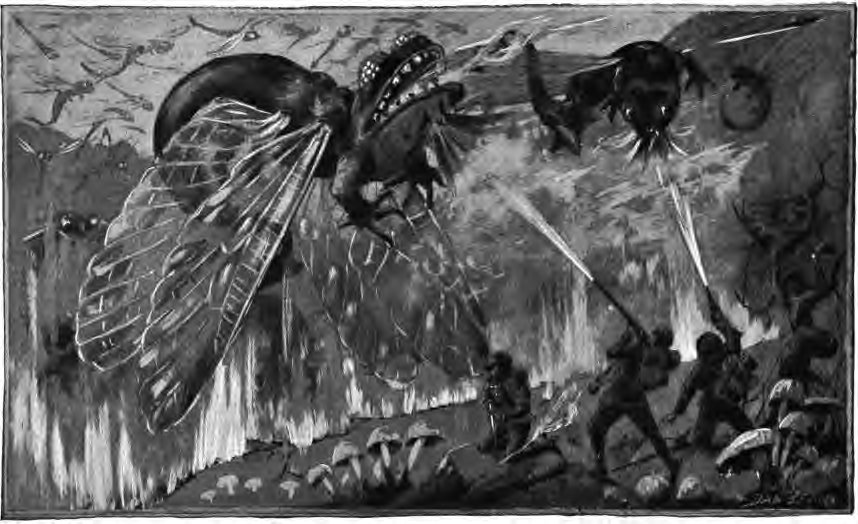 '
' The combat with the dragons
"We may thank Providence," said Bearwarden, "for that escape. Ihope we shall have no more such close calls."
With a parting glance at the chasm that had saved their lives,and from which a cloud still arose, they turned slightly to theright of their former course and climbed the gently rising bank.When near the top, being tired of their exciting experiences,they sat down to rest. The ground all about them was coveredwith mushrooms, white on top and pink underneath.
"This is a wonderful place for fungi," said Ayrault. "Here,doubtless, we shall be safe from the dragons, for they seemed toprefer the toadstools." As he lay on the ground he watched oneparticular mushroom that seemed to grow before his eyes.Suddenly, as he looked, it vanished. Dumfounded at thisunmistakable manifestation of the phenomenon they thought theyhad seen on landing, he called his companions, and, choosinganother mushroom, the three watched it closely. Presently,without the least noise or commotion, that also disappeared,leaving no trace, and the same fate befell a number of others.At a certain point of their development they vanished ascompletely as a bubble of air coming to the surface of water,except that they caused no ripple, leaving merely a smalldepression where they had stood.
"Well," said Bearwarden, "in all my travels I never have seenanything like this. If I were at a sleight-of-hand performance,and the prestidigitateur, after doing that, asked for my theory,I should say, 'I give it up.' How is it with you, doctor?" heasked, addressing Cortlandt.
"There must be an explanation," replied Cortlandt, "only we donot know the natural law to which the phenomenon is subject,having had no experience with it on earth. We know that allsubstances can be converted into gases, and that all gases can bereduced to liquids, and even solids, by the application ofpressure and cold. If there is any way by which the visiblesubstance of these fungi can be converted into its invisiblegases, as water into oxygen and hydrogen, what we have seen canbe logically explained. Perhaps, favoured by some affinity ofthe atmosphere, its constituent parts are broken up and becomegases at this barometric pressure and temperature. We must askthe spirit, if he visits us again."
"I wish he would," said Ayrault; "there are lots of things Ishould like to ask him."
"Presidents of corporations and other chairmen," said Bearwarden,"are not usually superstitious, and I, of course, take no stockin the supernatural; but somehow I have a well-formed idea thatour friend the bishop, with the great power of his mind overmatter, had a hand in that earthquake. He seems to have anexalted idea of our importance, and may be exerting himself tomake things pleasant."
At this point the sun sank below the horizon, and they foundthemselves confronted with night.
"Dear, dear!" said Bearwarden, "and we haven't a crumb to eat.I'll stand the drinks and the pipes," he continued, passingaround his ubiquitous flask and tobacco-pouch.
"If I played such pranks with my interior on earth," saidCortlandt, helping himself to both, "as I do on this planet, itwould give me no end of trouble, but here I seem to have thedigestion of an ostrich."
So they sat and smoked for an hour, till the stars twinkled andthe rings shone in their glory. "Well," said Ayrault, finally, "since we have nothing butmotions to lay on the table, I move we adjourn."
"The only motion I shall make," said Cortlandt, who was alreadyundressed, "will be that of getting into bed," saying which, herolled himself in his blanket and soon was fast asleep.
Having decided that, on account of the proximity of the dragons,a man must in any event be on the watch, they did not set theprotection-wires. From the shortness of the nights, they dividedthem into only two watches of from two hours to two and a halfeach, so that, even when constant watch duty was necessary, eachman had one full night's sleep in three. On this occasionAyrault and Cortlandt were the watchers, Cortlandt having themorning and Ayrault the evening watch. Many curious quadrupedbirds, about the size of large bears, and similar in shape,having bear-shaped heads, and several creatures that looked likethe dragons, flew about them in the moonlight; but neitherwatcher fired a shot, as the creatures showed no desire to makean attack. All these species seemed to belong to the owl or battribe, for they roamed abroad at night.
Chapter V.Contents
AYRAULT'S VISION.
When Ayrault's watch was ended, he roused Cortlandt, who took hisplace, and feeling a desire for solitude and for a last long lookat the earth, he crossed the top of the ridge on the slope ofwhich they had camped, and lay down on the farther side. TheSouth wind in the upper air rushed along in the mighty whirl,occasionally carrying filmy clouds across the faces of the moons;but about Ayrault all was still, and he felt a quiet and serenerepose. He had every intention of remaining awake, and waspondering on the steadfastness of the human heart and theconstancy of love, when his meditations began to wander, and,with his last thoughts on Sylvia, he fell asleep. Not a branchmoved, nor did a leaf fall, yet before Ayrault's sleeping eyes astrange scene was enacted. A figure in white came near and stoodbefore him, and he recognized in it one Violet Slade, a veryattractive girl to whom he had been attentive in his collegedays. She was at that time just eighteen, and people believedthat she loved him, but for some reason, he knew not why, he hadnot proposed.
"I thought you had died," he said, as she gazed at him, "but youare now looking better than ever."
"From the world's point of view I AM dead," she replied. "I diedand was buried. It is therefore permissible that I should showyou the truth. You never believed I loved you. I have wishedearnestly to see you, and to have you know that I did."
"I did you an injustice," Ayrault answered, perceiving all thatwas in her heart. "Could mortals but see as spirits do, therewould be no misunderstandings."
"I am so glad to see you," she continued, "and to know you arewell. Had you not come here, we could probably not have metuntil after your death; for I shall not be sufficiently advancedto return to earth for a long time, though my greatest solacewhile there was my religion, which is all that brought me here.We, however, know that as our capacity for true happinessincreases we shall be happier, and that after the resurrectionthere will be no more tears. Farewell," she whispered, while hereyes were filled with love.
Ayrault's sleep was then undisturbed for some time, when suddenlyan angel, wreathed in light, appeared before him and spoke thesewords: "He that walked with Adam and talked with Moses has sentme to guard you while you sleep. No plague or fever, wild beastor earthquake, can molest you, for you are equally protected fromthe most powerful monster and the most insidious disease-germ.'Blessed is the man whose offences are covered and whose sins areforgiven.' Sleep on, therefore, and be refreshed, for the bodymust have rest."
"A man may rest indeed," replied Ayrault, "when he has a guardianangel. I had the most unbounded faith in your existence before Isaw you, and believe and know that you or others have oftenshielded me from danger and saved my life. Why am I worthy of somuch care?"
"'Whoso dwelleth under the defence of the Most High shall abideunder the shadow of the Almighty,'" answered the angel, andthereupon he became invisible, a diffused light taking his place.Shortly afterwards this paled and completely vanished.
"Not only am I in paradise," thought Ayrault; "I believe I amalso in the seventh heaven. Would I might hear such wordsagain!"
A group of lilies then appeared before the sleeper's eyes. Inthe midst was one lily far larger than the rest, and of adazzling white. This spoke in a gentle voice, but with the tonesof a trombone:
"Thy thoughts and acts are a pleasure to me. Thou hast raised noidols within thy heart, and thy faith is as incense before me.Thy name is now in the Book of Life. Continue as thou hastbegun, and thou shalt live and reign forever."
Hereupon the earth shook, and Ayrault was awakened. Greatboulders were rolling and crashing down the slope about him,while the dawn was already in the east.
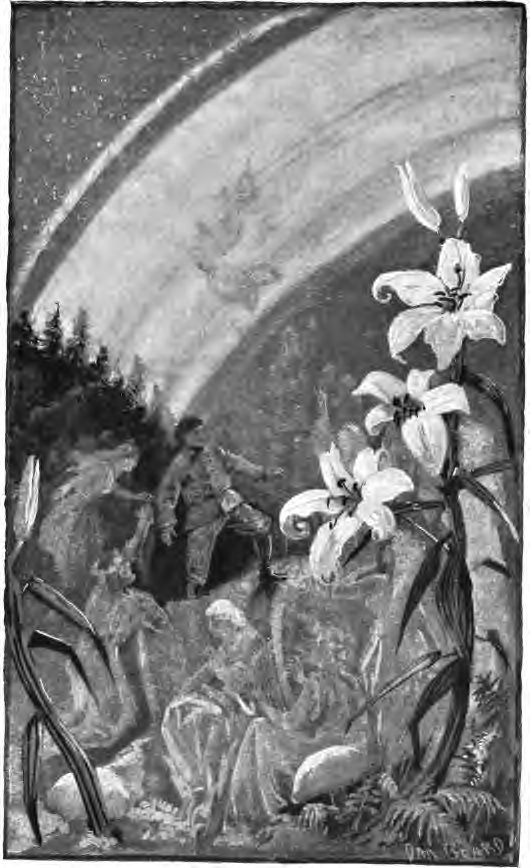 '
' Ayrault's Vision
"My mortal eyes and senses are keener here while I sleep thanwhen I wake," he thought, as he looked about him, "for spirits,unable to affect me while waking, have made themselves felt in mymore sensitive state while I was asleep. Nevertheless, this isnone other but the house of God, and this is the gate of heaven.
"The boulders were still in motion when I opened my eyes," hemused; "can it be that there is hereabouts such a flower as in mydreams I seemed to see?" and looking beyond where his head hadlain, he beheld the identical lily surrounded by the group thathis closed eyes had already seen. Thereupon he uncovered hishead and departed quickly. Crossing the divide, he descended tocamp, where he found Cortlandt in deep thought.
"I cannot get over the dreams," said the doctor, "I had in thefirst part of the night. Notwithstanding yesterday's excitementand fatigue, my sleep was most disturbed, and I was visited byvisions of my wife, who died long ago. She warned me againstskepticism, and seemed much distressed at my present spiritualstate."
"I," said Bearwarden, who had been out early, and had succeededin bringing in half a dozen birds, "was so disturbed I could notsleep. It seemed to me as though half the men I have ever knowncame and warned me against agnosticism and my materialistictendencies. They kept repeating, 'You are losing the reality forthe shadow.'"
"I am convinced," said Ayrault, "that they were not altogetherdreams, or, if dreams indeed, that they were superinduced by ahigher will. We know that angels have often appeared to men inthe past. May it not be that, as our appreciativeness increases,these communications will recur?" Thereupon he related his ownexperiences.
"The thing that surprised me," said Cortlandt, as they finishedbreakfast, "was the extraordinary realism of the scene. We mustsee if our visions return on anything but an empty stomach."
Chapter VI.Contents
A GREAT VOID AND A GREAT LONGING.
Resuming their march, the travellers proceeded along thecircumference of a circle having a radius of about three miles,with the Callisto in the centre. In crossing soft places theyobserved foot-prints forming in the earth all around them. Theimpressions were of all sizes, and ceased when they reachedrising or hard ground, only to reappear in the swamps, regulatingtheir speed by that of the travellers. The three men were greatlysurprised at this.
"You may observe," said Cortlandt, "that the surface of theimpression is depressed as you watch it, as though by a weight,and you can see, and even hear, the water being squeezed out,though whatever is doing it is entirely invisible. They must bemade by spirits sufficiently advanced to have weight, but notadvanced enough to make themselves visible."
Moved by a species of vandalism, Bearwarden raised histwelve-bore, and fired an ordinary cartridge that he had notprepared for the dragons, at the space directly over the nearestforming prints. There was a brilliant display of prismaticcolours, as in a rainbow, and though the impressions already maderemained, no new ones were formed.
"Now you have done it!" said Cortlandt. "I hoped to be able toinvestigate this further."
"We shall doubtless see other and perhaps more wonderful things,"replied Bearwarden. "I must say this gives me an uncannyfeeling."When they had completed a little over half their circle, theycame upon another of the groves with which Saturn seemed toabound, at the edge of which, in a side-hill, was a cave, theentrance of which was composed of rocky masses that hadapparently fallen together, the floor being but little higherthan the surface outside. The arched roof of the vestibule wasrendered watertight by the soil that had formed upon it, whichagain was overgrown by vines and bushes.
"This," said Bearwarden, "will be a good place to camp, for thecave will protect us from dragons, unless they should take anotion to breathe at us from the outside, and it will keep us dryin case of rain. To-morrow we can start with this as a centre,and make another circuit."
"We can explore Saturn on foot," said Cortlandt, "and far morethoroughly than Jupiter, on account of its comparative freedomfrom monsters. Not even the dragons can trouble us, unless wemeet them in large numbers."
Thereupon they set about getting fuel for their fire. Besidescollecting some of the dead wood that was lying all about, theysplit up a number of resinous pine and fir trees with explosivebullets from their revolvers, so that soon they not only had aroaring fire, but filled the back part of the cave with logs todry, in case they should camp there again at some later day.Neither Cortlandt nor Bearwarden felt much like sleeping, and so,after finishing the birds the president had brought down thatmorning, they persuaded Ayrault to sit up and smoke with them.Wrapping themselves in their blankets--for there was a chill inthe air--they sat about the camp-fire they had built in the mouthof the cave. Two moons that were at the full rose rapidly in theclear, cold sky. On account of their distance from the sun, theywere less bright than the terrestrial moon, but they shone with amarvellously pure pale light. The larger contained the exactfeatures of a man. There was the somewhat aquiline nose, aclear-cut and expressive mouth, and large, handsome eyes, whichwere shaded by well-marked eyebrows. The whole face was verystriking, but was a personification of the most intense grief.The expression was indeed sadder than that of any face they hadever seen. The other contained the profile of a surpassinglybeautiful young woman. The handsome eyes, shaded by lashes,looked straight ahead. The nose was perfect, and the ear small,while the hair was artistically arranged at the top and back ofthe head. This moon also reflected a pure white ray. The formerappeared about once and a quarter, the latter but three quarters,the size of the terrestrial moon, and the travellers immediatelyrecognized them by their sizes and relative positions as Tethysand Dione, discovered by J. D. Cassini in March, 1684. The sadface was turned slightly towards that of its companion, and itlooked as if some tale of the human heart, some romance, had beenengraved and preserved for all time on the features of these deadbodies, as they silently swung in their orbits forever and anonwere side by side.
"In all the ages," said Cortlandt, "that these moons havewandered with Saturn about the sun, and with the solar system inits journey through space, they can never have gazed upon thescene they now behold, for we may be convinced that no mortal manhas been here before."
"We may say," said Ayrault, "that they see in our bodies a typeof the source from which come all the spiritual beings that arehere."
"If, as the writers of mythology supposed," replied Cortlandt,"inanimate objects were endowed with senses, these moons woulddoubtless be unable to perceive the spiritual beings here; forthe satellites, being material, should, to be consistent, haveonly those senses possessed by ourselves, so that to them thisplanet would ordinarily appear deserted."
"I shall be glad," said Bearwarden, gloomily, "when those moonswane and are succeeded by their fellows, for one would give me anattack of the blues, while the other would subject me to theinconvenience of falling in love."
As he spoke, the upper branches of the trees in the grove beganto sway as a cold gust from the north sighed among them. "Loseno more opportunities," it seemed to cry, "for life is short anduncertain. Soon you will all be colder than I, and your future,still as easily moulded as clay, will be set as Marpesian marble,more fixed than the hardest rock."
"Paradise," said Cortlandt, "contains sights and sounds thatmight, I should think, arouse sad reminiscences without the aidof the waters of Lethe, unless the joy of its souls in their newresources and the sense of forgiveness outweigh all else."
With a parting look at the refined, silvery moon, and itssorrow-laden companion, they retired to the sheltering cave,piled up the fire, and talked on for an hour.
"I do not see how it is," said Bearwarden, "that these moons,considering their distance from the sun, and the consequentlysmall amount of light they receive, are so bright."
"A body's brightness in reflecting light," replied Cortlandt,"depends as much on the colour and composition of its own surfaceas on the amount it receives. It is conceivable that thesemoons, if placed at the earth's distance from the sun, would befar brighter than our moon, and that our familiar satellite, ifremoved to Saturn, would seem very dim. We know how much morebrilliant a mountain in the sunlight is when clad in snow thanwhen its sides are bare. These moons evidently reflect a largeproportion of the light they receive."
When they came out shortly after midnight the girl's-face moonhad already set, leaving a dark and dreary void in the part ofthe sky it had so ideally filled. The inexpressibly sadsatellite (on account of its shorter distance and more rapid rateof revolution) was still above the horizon, and, being slightlytilted, had a more melancholy, heart-broken look than before.While they gazed sadly at the emptiness left by Dione, Cortlandtsaw Ayrault's expression change, and, not clearly perceiving itscause, said, wishing to cheer him: "Never mind, Dick; to-morrownight we shall see it again."
"Ah, prosaic reasoner," retorted Bearwarden, who saw that this,like so many other things, had reminded Ayrault of Sylvia, "thatis but small consolation for having lost it now, though I supposeour lot is not so hard as if we were never to see it again. Inthat moon's face I find the realization of my fancied idealwoman; while that sad one yonder seems as though some celestiallover, in search of his fate, had become enamoured of her, andtried in vain to win her, and the grief in his mind had impresseditself on the then molten face of a satellite to be the monumentthroughout eternity of love and a broken heart. If the spiritsand souls of the departed have any command of matter, why may nottheir intensest thoughts engrave themselves on a moon that, whendead and frozen, may reflect and shine as they did, whileimmersed in the depths of space? At first Dione bored me; now Ishould greatly like to see her again."
"History repeats itself," replied Cortlandt, "and the same phasesof life recur. It is we that are in a changed receptive mood.The change that seems to be in them is in reality in us. Remainas you are now, and Dione will give you the same pleasuretomorrow that she gave to-day."
To Ayrault this meant more than the mere setting to rise again ofa heavenly body. The perfume of a flower, the sighing of thewind, suggesting some harmony or song, a full or crescent moon,recalled thoughts and associations of Sylvia. Everything seemedto bring out memory, and he realized the utter inability ofabsence to cure the heart of love. "If Sylvia should pass frommy life as that moon has left my vision," his thoughts continued,"existence would be but sadness and memory would be its cause,for the most beautiful sounds entail sorrow; the most beautifulsights, intense pain. Ah," he went on with a trace ofbitterness, while his friends fell asleep in the cave, "I mightbetter have remained in love with science; for whose studiesNature, which is but a form of God, in the right spirit, is notdependent for his joy or despair on the whims of a girl. She, ofcourse, sees many others, and, being only twenty, may forget me.Must I content myself with philosophical rules and mathematicalformulæ, when she, whose changefulness I may find greater thanthe winds that sigh over me, now loves me no longer? O love,which makes us miserable when we feel it, and more miserablestill when it is gone!"
He strung a number of copper wires at different degrees oftension between two trees, and listened to the wind as it rangedup and down on this improvised Æolian harp. It gradually raninto a regular refrain, which became more and more like words.Ayrault was puzzled, and then amazed. There could be no doubtabout it. "You should be happy," it kept repeating--"you shouldbe happy," in soft musical tones.
"I know I should," replied Ayrault, finally recognizing the voiceof Violet Slade in the song of the wind, "and I cannot understandwhy I am not. Tell me, is this paradise, Violet, or is it notrather purgatory?"
The notes ranged up and down again, and he perceived that she wascausing the wind to blow as she desired--in other words, she wasmaking it play upon his harp.
"That depends on the individual," she replied. "It is rathersheol, the place of departed spirits. Those whose consciencesmade them happy on earth are in paradise here; while those goodenough to reach heaven at last, but in whom some dross remains,are further refined in spirit, and to them it is purgatory.Those who are in love can be happy in but one way while theirlove lasts. What IS happiness, anyway?"
"It is the state in which desires are satisfied, my fair Violet,"answered Ayrault.
"Say, rather, the state in which desire coincides with duty,"replied the song. "Self-sacrifice for others gives the truestjoy; being with the object of one's love, the next. You neverbelieved that I loved you. I dissembled well; but you will seefor yourself some day, as clearly as I see your love for anothernow."
"Yes," replied Ayrault, sadly, "I am in love. I have no reasonto believe there is cause for my unrest, and, considering everything, I should be happy as man can be; yet, mirabile dictu, I amin--hades, in the very depths!"
"Your beloved is beyond my vision; your heart is all I can see.Yet I am convinced she will not forget you. I am sure she lovesyou still."
"I have always believed in homoeopathy to the extent of thesimilia similibus curantur, Violet, and it is certain that wherenothing else will cure a man of love for one woman, his love foranother will. You can see how I love Sylvia, but you have neverseemed so sweet to me as to-day."
"It is a sacrilege, my friend, to speak so to me now. You aredone with me forever. I am but a disembodied spirit, and escapedhades by the grace of the Omnipotent, rather than by virtue ofany good I did on earth. So far as any elasticity is left in myopportunities, I am dead as yon moon. You have still the giftthat but one can give. Within your animal body you hold animmortal soul. It is pliable as wax; you can mould it by yourwill. As you shape that soul, so will your future be. It is theark that can traverse the flood. Raise it, and it will raiseyou. It is all there is in yourself. Preserve that gift, andwhen you die you will, I hope, start on a plane many thousands ofyears in advance of me. There should be no more comparisonbetween us than between a person with all his senses and one thatis deaf and blind. Though you are a layman, you should, withyour faith and frame of mind, soon be but little behind ourspiritual bishop."
"I supposed after death a man had rest. Is he, then, a bishopstill?"
"The progress, as he told you, is largely on the old lines. Ashe stirred men's hearts on earth, he will stir their souls inheaven; and this is no irksome or unwelcome work."
"You say he WILL do this in heaven. Is he, then, not there yet?"
"He was not far from heaven on earth, yet technically none of uscan be in heaven till after the general resurrection. Then, aswe knew on earth, we shall receive bodies, though, as yet,concerning their exact nature we know but little more than then.We are all in sheol--the just in purgatory and paradise, theunjust in hell."
"Since you are still in purgatory, are you unhappy?"
"No, our state is very happy. All physical pain is past, and cannever be felt again. We know that our evil desires are overcome,and that their imprints are being gradually erased. Ioccasionally shed an intangible tear, yet for most of those whostrove to obey their consciences, purgatory, when essential,though occasionally giving us a bitter twinge, is a joy-producingstate. Not all the glories imaginable or unimaginable could makeus happy, were our consciences ill at ease. I have advancedslowly, yet some things are given us at once. After I realized Ihad irrevocably lost your love, though for a time I had hoped toregain it, I became very restless; earth seemed a prison, and Ilooked forward to death as my deliverer. I bore you no malice;you had never especially tried to win me; the infatuation--thatof a girl of eighteen--had been all on my side. I lived five sadand lonely years, although, as you know, I had much attention.People thought me cold and heartless. How could I have a heart,having failed to win yours, and mine being broken? Having lostthe only man I loved, I knew no one else could replace him, and Iwas not the kind to marry for pique. People thought me handsome,but I felt myself aged when you ceased to call. Perhaps when youand she who holds all your love come to sheol, she may spare youto me a little, for as a spirit my every thought is known; orperhaps after the resurrection, when I, too, can leave thisplanet, we shall all soar through space together, and we canstudy the stars as of old."
"Your voice is a symphony, sweetest Violet, and I love to hearyour words. Ah, would you could once more return to earth, orthat I were an ethereal spirit, that we might commune face toface! I would follow you from one end of Shadowland to theother. Of what use is life to me, with distractions that draw mythoughts to earth as gravitation drew my body? I wish I were ashade."
"You are talking for effect, Dick--which is useless here, for Isee how utterly you are in love."
"I AM in love, Violet; and though, as I said, I have no reason todoubt Sylvia's steadfastness and constancy, I am very unhappy. Ihave always heard that time is a balsam that cures all ills, yetI become more wretched every day."
"Do all you can to preserve that love, and it will bring you joyall your life. Your happiness is my happiness. What distressesyou, distresses me."
The tones here grew fainter and seemed about to cease.
"Before you leave me," cried Ayrault, "tell me how and when I maysee or hear you again."
"While you remain on this planet, I shall be near; but beyondSaturn I cannot go."
"Yet tell me, Violet, how I may see you? My love unattained, youperceive, makes me wretched, while you always gave me calm andpeace. If I may not kiss the hand I almost asked might be mine,let me have but a glance from your sweet eyes, which will comfortme so much now."
"If you break the ice in the pool behind you, you shall see metill the frame melts."
After this the silence was broken only by the sighing of the windin the trees. The pool had suddenly become covered with iceseveral inches thick. Taking an axe, Ayrault hewed out aparallelogram about three feet by four and set it on end againstthe bank. The cold grey of morning was already colouring theeast, and in the growing light Ayrault beheld a vision of Violetwithin the ice. The face was at about three fourths, and had acontemplative air. The hair was arranged as he had formerly seenit, and the thoughtful look was strongest in the beautiful greyeyes, which were more serious than of yore. Ayrault stoodriveted to the spot and gazed. "I could have been happy withher," he mused, "and to think she is no more!"
As drops fell from the ice, tears rose to his eyes.
. . . . . . ."What a pretty girl!" said Bearwarden to Cortlandt, as they cameupon it later in the day. "The face seems etched or imprinted bysome peculiar form of freezing far within the ice."
The next morning they again set out, and so tramped, hunted, andinvestigated with varying success for ten Saturnian days. Theyfound that in the animal and plant forms of life Nature hadoften, by some seeming accident, struck out in a course verydifferent from any on the earth. Many of the animals were bipedsand tripeds, the latter arranged in tandem, the last leg beingevidently an enormously developed tail, by which the creaturepropelled itself as with a spring. The quadrupeds had alsosometimes wings, and their bones were hollow, like those ofbirds. Whether this great motive and lifting power was theresult of the planet's size and the power of gravitation, orwhether some creatures had in addition the power of developing adegree of apergetic repulsion to offset it, as they suspected inthe case of the boa-constrictor that fell upon Cortlandt onJupiter, they could not absolutely ascertain. Life was far lessprolific on Saturn than on Jupiter, doubtless as a result of itsgreater distance from the sun, and of its extremes of climate,almost all organic life being driven to the latitudes near theequator. There were, as on Jupiter, many variations from theforms of life to which they were accustomed, and adaptations tothe conditions in which they found themselves; but, with theexception of the strange manifestations of spirit life, theyfound the workings of the fundamental laws the same. Often whenthey woke at night the air was luminous, and they were convincedthat if they remained there long enough it would be easy todevise some telegraphic code of light-flashes by which they couldcommunicate with the spirit world, and so get ideas from the hostof spirits that had already solved the problem of life and death,but who were not as yet sufficiently developed to be able toreturn to the earth. One day they stopped to investigate whatthey had supposed to be an optical illusion. They observed thatleaves and other light substances floated several inches abovethe surface of the water in the pools. On coming to the edge andmaking tests, they found a light liquid, as invisible as air,superimposed upon the water, with sufficient buoyancy to sustaindry wood and also some forms of life. They also observed thatinsects coming close to the surface and apparently inhaling it,rapidly increased in size and weight, from which they concludedit must throw off nitrogen, carbon, or some other nourishment inthe form of gas. The depth upon the water was unaffected byrain, which passed through it, but depended rather on thecondition of the atmosphere, from which it was evidentlycondensed. There seemed also to be a relation between the amountof this liquid and the activity of the spirits. Finally, whentheir ammunition showed signs of running low, they decided toreturn to the Callisto, go in it to the other side of the planet,and resume their investigations there. Accordingly, they set outto retrace their steps, returning by a course a few miles to oneside of the way they had come, and making the cave theirobjective point. Arriving there one evening about sunset, theypitched their camp. The cave was sheltered and comfortable, andthey made preparation for passing the night.
"I shall be sorry," said Ayrault, as they sat near their fire,"to leave this place without again seeing the bishop. He said wecould impress him anywhere, but it may be more difficult to dothat at the antipodes than here.""It does seem," said Bearwarden, "as though we should be missingit in not seeing him again, if that is possible. Nothing but apoison-storm brought him the first time, and it is not certainthat even in such an emergency would he come again uncalled.""I think," said Ayrault, "as none of the spirits here aremalevolent, they would warn us of danger if they could. Thebishop's spirit seems to have been the only one with sufficientlydeveloped power to reappear as a man. I therefore suggest thatto-morrow we try to make him feel our thought and bring him tous."
Chapter VII.Contents
THE SPIRIT'S SECOND VISIT.
Accordingly, the next morning they concentrated their mindssimultaneously on the spirit, wishing with all their strengththat he should reappear.
"Whether he be far or near," said Ayrault, "he must feel that,for we are using the entire force of ourminds."
Shadows began to form, and dancing prismatic colours appeared,but as yet there was no sign of the deceased bishop, whensuddenly he took shape among them, his appearance anddisappearance being much like that of stereopticon views on thesheet before a lantern. He held himself erect, and histhoughtful, dignified face had the same calm expression it hadworn before.
"We attracted your attention," said Ayrault, "in the way you saidwe might, because we longed so to see you."
"Yes," added Bearwarden and Cortlandt, "we felt we MUST see youagain."
"I am always at your service," replied the spirit, "and willanswer your questions. With regard to my visibility andinvisibility"--he continued, with a smile, "for I will not waitfor you to ask the explanation of what is in your minds--it isvery simple. A man's soul can never die; a manifestation of thesoul is the spirit; this has entity, consciousness, and will, andthese also live forever. As in the natural or material life, asI shall call it, will affects the material first. Thus, a childhas power to move its hand or a material object, as a toy, beforeit can become the medium in a psychological seance. So it ishere. Before becoming visible to your eyes, I, by my will, drawcertain material substances in the form of gases from the ground,water, or air around me. These take any shape I wish--notnecessarily that of man, though it is more natural to appear aswe did on earth--and may absorb a portion of light, and so beable to cast a shadow or break up the white rays into prismaticcolours, or they may be wholly invisible. By an effort of thewill, then, I combine and condense these gases--which consistprincipally of oxygen, hydrogen, nitrogen, and carbon--intoflesh, blood, water, or anything else. You have already learnedon earth that, by the application of heat, every solid and everyliquid substance, which is solid or liquid simply because of thetemperature at which you find it, can be expanded into gas orgases; and that by cold and pressure every gas can be reduced toa liquid or a solid. On earth the state of a substance, whethersolid, liquid, or gaseous, depends simply upon those twoconditions. Here neither thermal nor barometric changes arerequired, for, by mastering the new natural laws that at deathbecome patent to our senses, we have all the necessary control.It requires but an effort of my will to be almost instantlyclothed in human form, and but another effort to rearrange themolecules in such a way as to make the envelope visible. Somewho have been dead longer, or had a greater natural aptitude thanI, have advanced further, and all are learning; but thedifference in the rate at which spirits acquire control ofpreviously unknown natural laws varies far more than amongindividuals on earth.
"These forms of organic life do not disintegrate till afterdeath; here in the natural state they break down and dissolveinto their structural elements in full bloom, as was done by thefungi. The poisonous element in the deadly gust, against which Iwarned you, came from the gaseous ingredients of toadstools,which but seldom, and then only when the atmosphere has thegreatest affinity for them, dissolve automatically, producing adeath-spreading wave, against which your meteorologicalinstruments in future can warn you. The slight fall you noticedin temperature was because the specific heat of these gases ishigh, and to become gas while in the solid state they had towithdraw some warmth from the air. The fatal breath of thewinged lizards--or dragons, as you call them--results from thesame cause, the action of their digestion breaking up the fungus,which does not kill them, because they exhale the poisonous partin gaseous form with their breath. The mushrooms dissolve moreeasily; the natural separation that takes place as they reach acertain stage in their development being precipitated byconcussion or shock.
"Having seen that, as on earth, we gain control of the materialfirst, our acquisitiveness then extends to a better understandingand appreciation of our new senses, and we are continuallyfinding new objects of beauty, and new beauties in things wesupposed we already understood. We were accustomed on earth tothe marvellous variety that Nature produced from apparentlysimple means and presented to our very limited senses; here thereis an indescribably greater variety to be examined by vastlykeener senses. The souls in hell have an equally keen butdistorted counterpart of our senses, so that they see in amagnified form everything vile in themselves and in each other.To their senses only the ugly and hateful side is visible, sothat the beauty and perfume of a flower are to them as loathsomeas the appearance and fumes of a toadstool. As evolution and thetendency of everything to perpetuate itself and intensify itspeculiarities are invariable throughout the universe, theseunhappy souls and ourselves seem destined to diverge more andmore as time goes on; and while we constantly become happier asour capacity for happiness increases, their sharpening senseswill give them a worse and worse idea of each other, till theirmutual repugnance will know no bounds, and of everythingconcerning which they obtain knowledge through their senses.Thus these poor creatures seem to be the victims of circumstancesand the unalterable laws of fate, and were there such a thing asdeath, their misery would unquestionably finally break theirhearts. That there will be final forgiveness for the condemned,has long been a human hope; but as yet they have experiencednone, and there is no analogy for it in Nature.
"But while you have still your earthly bodies and theopportunities they give you of serving God, you need not beconcerned about hell; no one on earth, knowing how things reallyare, would ever again forsake His ways. The earthly state is themost precious opportunity of securing that for which a man wouldgive his all. Even from the most worldly point of view, a man isan unspeakable fool not to improve his talents and do good. Whatwould those in sheol not give now for but one day in the flesh onearth, of which you unappreciatives may still have so many? Thewell-used opportunities of even one hour might bring joy to thosein paradise forever, and greatly ease the lot of those in hell.In doing acts of philanthropy, however, you must remember thetext of the sermon the doctor of divinity preached to Craninerand Ridley just before they perished at the stake: 'Though Igive my body to be burned, and have not charity, it profiteth menothing'--which shows that even good deeds must be performed inthe proper spirit.
"A new era is soon to dawn on earth. Notwithstanding your greatmaterial progress, the future will exceed all the past. Man willfind every substance's maximum use, thereby vastly increasing hiscomfort. Then, when advanced in science and reason, with thepower of his senses increased by the delicate instruments thatyou, as the forerunners of the coming man, are already learningto make, may he cease to be a groveller, like our progenitors thequadrupeds, and may his thoughts rise to his Creator, who hasbrought him to such heights through all the intricacies of theway. Your preparation for the life to come can also be greatlyaided by intercourse with those who have already died. When youreally want to associate spiritually with us, you can do so; for,though perhaps only one in a hundred million can, like me, soclothe himself as to be again visible to mortal eyes, many of uscould affect gelatine or extremely sensitive plates that wouldshow interruptions in the ultra-violet chemical rays that, likethe thermal red beyond the visible spectroscope, you know existthough you can neither see nor feel them. Spirits could notaffect the magnetic eye, because magnetism, though immaterialitself, is induced and affected only by a material substance.The impression on the plate, however, like the prismatic coloursyou have already noticed, can be produced by a slight rarefactionof the hydrogen in the air, so that, though no spirit could bephotographed as such, a code and language might be established bymeans of the effect produced on the air by the spirit's mind. Iam so interested in the subject of my disquisition that I hadalmost forgotten that your spirits are still subject to therequirements of the body. Last time I dined with you; let me nowplay the host."
"We shall be charmed to dine with you," said Ayrault, "and shallbe only too glad of anything that will keep you with us."
"Then," said the spirit, "as the tablecloth is laid, we need onlyto have something on it. Let each please hold a corner," hecontinued, taking one himself with his left hand, while he passedhis right to his brow. Soon flakes as of snow began to form inthe air above, and slowly descended upon the cloth; and, glancingup, the three men saw that for a considerable height this processwas going on, the flakes increasing in size as they fell tillthey attained a length of several inches. When there was enoughfor them all on the table-cloth the shower ceased. Sitting downon the ground, they began to eat this manna, which had adelicious flavour and marvellous purity and freshness.
"As you doubtless have already suspected," said the spirit, "thebasis of this in every case is carbon, combined with nitrogen inits solid form, and with the other gases the atmosphere herecontains. You may notice that the flakes vary in colour as wellas in taste, both of which are of course governed by the gas withwhich the carbon, also in its visible form, is combined. It isalmost the same process as that performed by every plant inwithdrawing carbon from the air and storing it in its trunk inthe form of wood, which, as charcoal, is again almost purecarbon, only in this case the metamorphosis is far more rapid.This is perhaps the natural law that Elijah, by God's aid,invoked in the miracle of the widow's cruse, and that producedthe manna that fed the Israelites in the desert; while apergycame in play in the case of the stream that Moses called from therock in the wilderness, which followed the descendants of Abrahamover the rough country through which they passed. In examiningmiracles with the utmost deference, as we have a right to, we seeone law running through all. Even in Christ's miracle ofchanging the water to wine, there was a natural law, though onlyone has dwelt on earth who could make that change, which, from achemist's standpoint, was peculiarly difficult on account of therequired fermentation, which is the result of a developed andmatured germ. Many of His miracles, however, are as far beyondmy small power as heaven is above the earth. Much of thesubstance of the loaves and fishes with which He fed themultitude--the carbon and nitrogenous products--also came fromthe air, though He could have taken them from many other sources.The combination and building up of these in the ordinary waywould have taken weeks or months, but was performedinstantaneously by His mighty power."
"What natural laws are known to you," asked Bearwarden, "that wedo not understand, or concerning the existence of which we areignorant?"
"Most of the laws in the invisible world," said the spirit, "arethe counterpart or extension of laws that appear on earth, thoughyou as yet understand but a small part of those, many not havingcome to your notice. You, for instance, know that light, heat,and motion are analogous, and either of the last two can beconverted into the other; but in practice you produce motion ofthe water molecules by the application of heat, and seldomreverse it. One of the first things we master here is the powerto freeze or boil water, by checking the motion of the moleculesin one case, and by increasing it, and their mutual repulsion, inthe other. This is by virtue of a simple law, though in thiscase there is no natural manifestation of it on earth with whichto compare it. While knowledge must be acquired here throughstudy, as on earth, the new senses we receive with the awakeningfrom death render the doing so easy, though with only the senseswe had before it would have been next to impossible.
"At this moment snow is falling on the Callisto; but this youcould not know by seeing, and scarcely any degree of evolutioncould develop your sight sufficiently, unassisted by death. Withyour instruments, however, you could already perceive it,notwithstanding the intervening rocks.
"Your research on earth is the best and most thorough in thehistory of the race; and could we but give you suggestions as tothe direction in which to push it, the difference betweenyourselves and angels might be but little more than that betweenthe number and intensity of the senses and the composition of thebody. By the combination of natural laws you have rid yourselvesof the impediment of material weight, and can roam through spacelike spirits, or as Columbus, by virtue of the confidence thatcame with the discovery of the mariner's compass, roamed upon andexplored the sea. You have made a good beginning, and were notyour lives so short, and their requirements so peremptory, youmight visit the distant stars.
"I will show you the working of evolution. Life sleeps inminerals, dreams in plants, and wakes in you. The rock worn byfrost and age crumbles to earth and soil. This enters thesubstance of the primordial plant, which, slowly rising; producesthe animal germ. After that the way is clear, and man is evolvedfrom protoplasm through the vertebrate and the ape. Here we havethe epitome of the struggle for life in the ages past, and theanalogue of the journey in the years to come. Does not theAlmighty Himself make this clear where He says through hisservant Isaiah, 'Behold of these stones will I raise upchildren'?--and the name Adam means red earth. God, havingbrought man so far, will not let evolution cease, and the nextstage of life must be the spiritual.""Can you tell us anything," asked Ayrault, "concerning the bodiesthat those surviving the final judgment will receive?"
"Notwithstanding the unfolding of knowledge that has come to ushere," replied the spirit, "there are still some subjectsconcerning which we must look for information to the inspiredwriters in the Bible, and every gain or discovery goes to provetheir veracity. We know that there are celestial bodies andbodies terrestrial, and that the spiritual bodies we shallreceive in the resurrection will have power and will beincorruptible and immortal. We also know by analogy and reasonthat they will be unaffected by the cold and void of space, sothat their possessors can range through the universe fornon-nillions and decillions of miles, that they will havemarvellous capacities for enjoying what they find, and that noundertaking or journey will be too difficult, though it be to thecentre of the sun. Though many of us can already visit theremote regions of space as spirits, none can as yet see God; butwe know that as the sight we are to receive with our new bodiessharpens, the pure in heart will see Him, though He is still asinvisible to the eyes of the most developed here as the ether ofspace is to yours."
Chapter VIII.Contents
CASSANDRA AND COSMOLOGY.
The water-jug being empty, Ayrault took it up, and, crossing theridge of a small hill, descended to a running-brook. He hadfilled it, and was straightening himself, when the stone on whichhe stood turned, and he might have fallen, had not the bishop, ofwhose presence he had been unaware, stretched out his hand andupheld him.
"I thought you might need a little help," he said with a smile,"and so walked beside you, though you knew it not. Water isheavy, and you may not yet have become accustomed to itsSaturnian weight."
"Many thanks, my master," replied Ayrault, retaining his hand."Were it not that I am engaged to the girl I love, and amsometimes haunted by the thought that in my absence she may beforgetting me, I should wish to spend the rest of my natural lifehere, unless I could persuade you to go with me to the earth."
"By remaining here," replied the spirit, with a sad look, "youwould be losing the most priceless opportunities of doing good.Neither will I go with you; but, as your distress is real, I willtell you of anything happening on earth that you wish to know."
"Tell me, then, what the person now in my thoughts is doing."
"She is standing in a window facing west, watering someforget-me-nots with a small silver sprinkler which has a ruby inthe handle."
"Can you see anything else?"
"Beneath the jewel is an inscription that runs:
'By those who in warm July are born A single ruby should be worn; Then will they be exempt and free From love's doubts and anxiety.'"
"Marvellous! Had I any doubts as to your prescience and power,they would be dispelled now. One thing more let me ask, however:Does she still love me?"
"In her mind is but one thought, and in her heart is animage--that of the man before me. She loves you with all hersoul."
"My most eager wish is satisfied, and for the moment my heart isat rest," replied Ayrault, as they turned their steps towardscamp. "Yet, such is my weakness by nature, that, ere twenty-fourhours have passed I shall long to have you tell me again."
"I have been in love myself," replied the spirit, "and know thefeeling; yet to be of the smallest service to you gives me farmore happiness than it can give you. The mutual love in paradiseexceeds even the lover's love on earth, for it is only those thatloved and can love that are blessed.
"You can hardly realize," the bishop continued, as they rejoinedBearwarden and Cortlandt, "the joy that a spirit in paradiseexperiences when, on reopening his eyes after passing death,which is but the portal, he finds himself endowed with sight thatenables him to see such distances and with such distinctness.The solar system, with this ringed planet, its swarm ofasteroids, and its intra-Mercurial planets--one of which, Vulcan,you have already discovered--is a beautiful sight. The planetsnearest the sun receive such burning rays that their surfaces arered-hot, and at the equator at perihelion are molten. These arenot seen from the earth, because, rising or setting almostsimultaneously with the sun, they are lost in its rays. Thegreat planet beyond Neptune's orbit is perhaps the mostinteresting. This we call Cassandra, because it would be aprophet of evil to any visitor from the stars who should judgethe solar system by it. This planet is nearly as large asJupiter, being 80,000 miles in diameter, but has a specificgravity lighter than Saturn. Bode's law, you know, says, Writedown 0, 3, 6, 12, 24, 48, 96. Add 4 to each, and get 4, 7, 10,16, 28, 52, 100; and this series of numbers represents verynearly the relative distances of the planets from the sun.According to this law, you would expect the planet next beyondNeptune to be about 5,000,000,000 miles from the sun. But it isabout 9,500,000,000, so that there is a gap between Neptune andCassandra, as between Mars and Jupiter, except that inCassandra's case there are no asteroids to show where any planetwas; we must, then, suppose it is an exception to Bode's law, orthat there was a planet that has completely disappeared. AsCassandra would be within the law if there had been anintermediary planet, we have good prima facie reason forbelieving that it existed. Cassandra takes, in round numbers, athousand years to complete its orbit, and from it the sun, thoughbrighter, appears no larger than the earth's evening or morningstar. Cassandra has also three large moons; but these, whenfull, shine with a pale-grey light, like the old moon in the newmoon's arms, in that terrestrial phenomenon when the earth, byreflecting the crescent's light, and that of the sun, makes thedark part visible. The temperature at Cassandra's surface is butlittle above the cold of space, and no water exists in the liquidstate, it being as much a solid as aluminum or glass. There arerivers and lakes, but these consist of liquefied hydrogen andother gases, the heavier liquid collected in deep Places, and thelighter, with less than half the specific gravity of ether,floating upon it without mixing, as oil on water. When theheavier penetrates to a sufficient depth, the interior beingstill warm, it is converted into gas and driven back to thesurface, only to be recondensed on reaching the upper air. Thusit may happen that two rains composed of separate liquids mayfall together. There being but little of any other atmosphere,much of it consists of what you might call the vapour ofhydrogen, and many of the well-known gases and liquids on earthexist only as liquids and solids; so that, were there mortalinhabitants on Cassandra, they might build their houses of blocksof oxygen or chlorine, as you do of limestone or marble, and useice that never melts, in place of glass, for transparence. Theywould also use mercury for bullets in their rifles, just asinhabitants of the intra-Vulcan planets at the other extrememight, if their bodies consisted of asbestos, or were in anyother way non-combustibly constituted, bathe in tin, lead, oreven zinc, which ordinarily exist in the liquid state, as waterand mercury do on the earth.
"Though Cassandra's atmosphere, such as it is, is mostly clear,for the evaporation from the rivers and icy mediterraneans isslight, the brightness of even the highest noon is less than anearthly twilight, and the stars never cease to shine. The darkbase of the rocky cliffs is washed by the frigid tide, but thereis scarcely a sound, for the pebbles cannot be moved by theweightless waves, and an occasional murmur is all that is heard.Great rocks of ice reflect the light of the grey moons, and nevera leaf falls or a bird sings. With the exception of the mournfulripples, the planet is silent as the grave. The animal and plantkingdoms do not exist; only the mineral and spiritual worlds. Isay spiritual, because there are souls upon it; but it is thehome of the condemned in hell. Here dwell the transgressors whodied unrepentant, and those who were not saved by faith. This isthe one instance in which I do not enjoy my developed sight, forI sometimes glance in their direction, and the vision that meetsme, as my eyes focus, distresses my soul. Their senses are likean imperfect mirror, magnifying all that is bad in one another,and distorting anything still partially good when that exists.All those things that might at least distract them are hollow,their misery being the inevitable result of the condition of mindto which they became accustomed on earth and which brought themto Cassandra. But let us turn to something brighter.
"Though the solar system may seem complex, the sun is but a staramong the millions in the Milky Way, and, compared with theplanetary systems of Sirius, the stars of the Southern Cross, andthe motions of the nebula, it is simplicity itself. Comparedwith the splendour of Sirius, with its diameter of twelve millionmiles, the sun, measuring but eight hundred and forty thousand,becomes insignificant; and this giant's system includes groupsand clusters of planets, many with three times the mass ofJupiter, five and six together, each a different colour,revolving about a common centre, while they swing about theirprimary. Their numerous moons have satellites encircling them,with orbits in some cases at right angles to the plane of theecliptic, so that they shine perpendicularly on what correspondto the arctic and antarctic regions, while their axes are soinclined that the satellites turn a complete somersault at eachrevolution, producing glistening effects of ice and snow at thepoles. Some of the moons are at a red or white heat, and soprevent the chill of night on the planets, while they shine withmore than reflected light. In addition to the five or six largeplanets in each group, which, however, are many millions of milesapart, there is in some clusters a small planet that swingsbackward and forward across the common centre, like a pendulum,but in nearly a straight line; and while this multiplicity ofmotion goes on, the whole aggregation sweeps majestically aroundSirius, its mighty sun. Our little solar system contains, as weknow, about one thousand planets, satellites, and asteroids largeenough to be dignified by the name of heavenly bodies. Vastnumbers of the stars have a hundred and even a thousand times themass of our sun, and their systems being relatively as complex asours--in some cases even more so--they contain a hundred thousandor a million individual bodies.
"Over sixty million bright or incandescent stars were visible tothe terrestrial telescopes a hundred years ago, the average sizeof which far exceeds our sun. To the magnificent telescopes ofto-day they are literally countless, and the number can beindefinitely extended as your optical resources grow. Yet thenumber of stars you see is utterly insignificant compared withthe cold and dark ones you cannot see, but concerning which youare constantly learning more, by observing their effect on thebright ones, both by perturbing them and by obscuring their rays.Occasionally, as you know, a star of the twelfth or fifteenthmagnitude, or one that has been invisible, flares up for severalmonths to the fourth or fifth, through a collision with some darkgiant, and then returns to what it was in the beginning, agaseous, filmy nebula. These innumerable hosts of dark monsters,though dead, are centres of systems, like most of the stars youcan see.
"A slight consideration of these figures will show that,notwithstanding the number of souls the Creator has given life onearth, each one might in fact have a system to himself; and that,however long the little globe may remain, as it were, a mint, inwhich souls are tried by fire and moulded, and receive theirfinal stamp, they will always have room to circulate, and will beprized according to the impress their faces or hearts must show.But Sirius itself is moving many times faster than the swiftestcannon ball, carrying its system with it; and I see you asking,'To what does all this motion tend?' I will show you. Manyquadrillions of miles away, so far that your most powerfultelescopes have not yet caught a glimmer, rests in its serenegrandeur a star that we call Cosmos, because it is the centre ofthis universe. Its diameter is as great as the diameter ofCassandra's orbit, and notwithstanding its terrific heat, itsspecific gravity, on account of the irresistible pressure at andnear the centre, is as great as that of the planet Mercury. Thisholds all that your eyes or mine can see; and the so-calledmotions of the stars--for we know that Sirius, among others, isreceding--is but the difference in the rate at which thedifferent systems and constellations swing around Cosmos, thoughin doing so they often revolve about other systems or swing roundcommon centres, so that many are satellites of satellites manytimes repeated. The orbits of some are circular, and of otherselliptical, as those of comets, and some revolve about eachother, or, as we have seen, about a common point while theyperform their celestial journey. A star, therefore, recedes oradvances, as Jupiter and Venus with relation to the earth. Theplanet in the smaller orbit moves faster than that in the larger,so that the intervening distances wax and wane, though all aregoing in the same general direction. In the case of the membersof the solar system, astronomical record can tell when even amost distant known planet has been in opposition or conjunction;but the earth has scarcely been habitable since the sun was lastin its present position in its orbit around Cosmos. The curvethat our system follows is of such radius that it would requirethe most precise observations for centuries to show that it wasnot a straight line.
"We call this the universe because it is all that the clearesteyes or telescopes have been able to see, but it is only asubdivision--in fact, but a system on a vaster scale than that ofthe sun or of Sirius. Far beyond this visible universe, myintuition tells me, are other systems more gigantic than this,and entirely different in many respects. Even the effects ofgravitation are modified by the changed condition; for thesesystems are spread out flat, like the rings of this planet, andthe ether of space is luminous instead of black, as here. Thesesystems are but in a later stage of development than ours; and inthe course of evolution our visible universe will be changed inthe same way, as I can explain.
"In incalculable ages, the forward motion of the planets andtheir satellites will be checked by the resistance of the etherof space and the meteorites and solid matter they encounter.Meteorites also overtake them, and, by striking them as it werein the rear, propel them, but more are encountered in front--anillustration of which you can have by walking rapidly or ridingon horseback on a rainy day, in which case more drops will strikeyour chest than your back. The same rule applies to bodies inspace, while the meteorites encountered have more effect thanthose following, since in one case it is the speed of the meteorminus that of the planet, and in the other the sum of the twovelocities. With this checking of the forward motion, thecentrifugal force decreases, and the attraction of the centralbody has more effect. When this takes place the planet orsatellite falls slightly towards the body around which itrevolves, thereby increasing its speed till the centrifugal forceagain balances the centripetal. This would seem to make itdescend by fits and starts, but in reality the approach is nearlyconstant, so that the orbits are in fact slightly spiral. Whatis true of the planets and satellites is also true of the starswith reference to Cosmos; though many even of these havesubordinate motions in their great journey. Though thesatellites of the moons revolve about the primaries in orbitsinclined at all kinds of angles to the planes of the ecliptics,and even the moons vary in their paths about the planets, theplanets themselves revolve about the stars, like those of thissystem about the sun, in substantially the same plane; and whatis true of the planets is even more true of the stars in theirorbits about Cosmos, so that when, after incalculable ages, theydo fall, they strike this monster sun at or near its equator, andnot falling perpendicularly, but in a line varying but slightlyfrom a tangent, and at terrific speed, they cause the colossus torotate more and more rapidly on its own axis, till it must becomegreatly flattened at the poles, as the earth is slightly, and asJupiter and Saturn are a good deal. Even though not all thestars are exactly in the plane of Cosmos's equator, as you cansee they are not there are as many above as below it, so that thegeneral average will be there; and as all are moving in the samedirection, it is not necessary for all to strike the same line,those striking nearer the poles, where the circles are smaller,and where the surface is not being carried forward so fast by thegiant's rotation, will have even more effect in increasing itsspeed, since it will be like attaching the driving-rods of alocomotive near the axle instead of near the circumference, andwith enough power will produce even greater results. As Cosmoswaxes greater from the result of these continual accretions, itsattraction for the stars will increase, until those coming fromthe outer regions of its universe will move at such terrificspeed in their spiral orbits that before coming in contact theywill be almost invisible, having already absorbed all solidmatter revolving about themselves. These accessions of movingmatter, continually received at and near its equator, will causeCosmos to spread out like Saturn's rings till it becomes flat,though the balance of forces will be so perfect that it isdoubtful whether an animal or a man placed there would feel muchchange.
"But these universes--or, more accurately, divisions of theuniverse--already planes, though the vast surfaces are not soflat as to preclude beautiful and gently rolling slopes, arespirit-lands, and will be inhabited only by spirits. Then thereare great phosphorescent areas, and the colour of the surfacechanges with every hour of the day, from the most brilliantcrimson to the softest shade of blue, radiant with many coloursthat your eyes cannot now see. There are also myriads of scentedstreams, consisting of hundreds of different and multi-colouredliquids, each with a perfume sweeter than the most delicateflower, and pouring forth the most heavenly music as they go ontheir way. But be not surprised at the magnitude of the change,for is it not written in Revelation, 'I saw a new heaven and anew earth; for the first heaven and the first earth were passedaway'? Nor can we be surprised at vastness, sublimity, andbeauty such as never was conceived of, for do we not find this inHis word, 'Eye hath not seen, nor ear heard, neither have enteredinto the heart of man, the things which God hath prepared forthem that love Him'? In this blissful state, those that fearedGod and obeyed their consciences will live on forever; but theirrest can never become stagnation, for evolution is one of themost constant laws, and never ceases, and they must always goonward and upward, unspeakably blessed by the consciences theymade their rule in life, till in purity and power they shallequal or exceed the angels of their Lord in heaven.
"But you men of finite understanding will ask, as I myself shouldhave asked, How, by the law of hydrostatics, can liquids flow ona plane? Remember that, though these divisions are astronomicalor geometrical planes, their surfaces undulate; but the movingcause is this: At the centre of these planes is a pole, theanalogue, we will say, of the magnetic pole on earth, that has amore effective attraction for a gas than for a liquid. Whenliquids approach the periphery of the circle, the rapid rotationand decreased pressure cause them to break up, whereupon theelementary gases return to the centre in the atmosphere, if nearthe surface, forming a gentle breeze. On nearing the centre, thecause of the separation being removed, the gases reunite to forma liquid, and the centrifugal force again sends this on itsjourney."
"Is there no way," asked Bearwarden, "by which a man may retrievehimself, if he has lost or misused his opportunities on earth?"
"The way a man lays up treasures in heaven, when on earth,"replied the spirit, "is by gladly doing something for some oneelse, usually in some form sacrificing self. In hell no one cando anything for any one else, because every one can have thesemblance of anything he wishes by merely concentrating his mindupon it, though, when he has it, it is but a shadow and gives himno pleasure. Thus no one can give any one else anything hecannot obtain himself; and if he could, since it would be nosacrifice on his part, he would derive no great moral comfortfrom it. Neither can any one comfort any one else by putting hisacts or offences in a new light, for every one knows the wholetruth about himself and everybody else, so that nothing can bemade to appear favourably or unfavourably. All this, however, issupposing there is the desire to be kind; but how can spiritsthat were selfish and ill-disposed on earth, where there are somany softening influences, have good inclinations in hell, wherethey loathe one another with constantly increasing strength?
"Inasmuch as both the good and the bad continue on the lines onwhich they started when on earth, we are continually drawingnearer to God, while they are departing. The gulf may be onlyone of feeling, but that is enough. It follows, then, that withGod as our limit, which we of course can never reach, theirlimit, in the geometrical sense, must be total separation fromHim. Though all spirits, we are told, live forever, it occurs tome that in God's mercy there may be a gradual end; for though tothe happy souls in heaven a thousand years may seem as nothing,existence in hell must drag along with leaden limbs, and a singlehour seem like a lifetime of regret. Since it is dreadful tothink that such unsoothed anguish should continue forever, I haveoften pondered whether it might not be that, by a form ofinvolution and reversal of the past law, the spirit that came tolife evolved from the mineral, plant, and animal worlds, maymercifully retrace its steps one by one, till finally the soulshall penetrate the solid rock and hide itself by becoming partof the planet. Many people in my day believed that after deaththeir souls would enter stately trees, and spread abroad greatbranches, dropping dead leaves over the places on which they hadstood while on earth. This might be the last step in the awfultragedy of the fall and involution of a human soul. In this way,those who had wasted the priceless opportunities given them byGod might be mercifully obliterated, for it seems as if theywould not be needed in the economy of the universe. The Bible,however, mentions no such end, and says unmistakably that hellwill last forever; so that in this supposition, as in manyothers, the wish is probably father of the thought."
"But," persisted Bearwarden, "how about death-bed repentances?"
"Those," replied the spirit, "are few and far between. The painsof death at the last hour leave but little room for aught butvain regret. A man dies suddenly, or may be unconscious sometime before the end. But they do occur. The question is, Howmuch credit is it to be good when you can do no more harm? Thetime to resist evil and do that which is right is while thetemptation is on and in its strength. While life lasts there ishope, but the books are sealed by death. The tree must fall toone side or the other--there is no middle ground--and as thetree falleth, so it lieth.
"This, however, is a gloomy subject, and one that in your heartof hearts you understand. I would rather tell you more of thebeauties and splendours of space--of the orange, red, and bluestars, and of the tremendous cyclonic movements going on withinthem, which are even more violent than the storms that rage inthe sun. The clouds, as the spectroscope has already shown,consist of iron, gold, and platinum in the form of vapour, whilethe openings revealed by sun-spots, or rather star-spots, are sotremendous that a comparatively small one would contain manydozen such globes as the earth. I could tell you also of themysteries of the great dark companions of some of the stars, andof the stars that are themselves dark and cold, with naught butthe faraway constellations to cheer them, on which night reignseternally, and that far outnumber the stars you can see. Also ofthe multiplicity of sex and extraordinary forms of life thatexist there, though on none of them are there mortal men likethose on the earth.
"Nature, in the process of evolution, has in all these cases goneoff on an entirely different course, the most intelligent andhighly developed species being in the form of marvellouslycomplex reptiles, winged serpents that sing most beautifully, butwhose blood is cold, being prevented from freezing in the upperregions of the atmosphere by the presence of salt and chemicals,and which are so intelligent that they have practically subduedmany of these dark stars to themselves. On others, the mosthighly developed species have hollow, bell-shaped tentacles, intowhich they inject two or more opposing gases from opposite sidesof their bodies, which, in combination, produce a strongexplosion. This provides them with an easy and rapid locomotion,since the explosions find a sufficient resistance in thesurrounding air to propel the monsters much faster than birds.These can at pleasure make their breath so poisonous that thelungs of any creatures except themselves inhaling it are at onceturned to parchment. Others can give their enemies or their preyan electric shock, sending a bolt through the heart, or canparalyze the mind physically by an effort of their wills, causingthe brain to decompose while the victim is still alive. Othershave the same power that snakes have, though vastly intensified,mesmerizing their victims from afar.
"Still others have such delicate senses that in a way theycommune with spirits, though they have no souls themselves; forin no part or corner of the universe except on earth are thereanimals that have souls. Yet they know the meaning of the word,and often bewail their hard lot in that no part of them can livewhen the heart has ceased to beat."Ah, my friends, if we had no souls--if, like the æstheticreptilia, we knew that when our dust dissolved our existencewould be over--we should realize the preciousness of what we holdso lightly now. Man and the spirits and angels are the onlybeings with souls, and in no place except on earth are new soulsbeing created. This gives you the greatest and grandest idea ofthe dignity of life and its inestimable value. But it is asdifficult to describe the higher wonders of the stellar worlds toyou as to picture the glories of sunset to a blind man, for youhave experienced nothing with which to compare them. Instead ofseeing all that really is, you see but a small part."
Chapter IX.Contents
DOCTOR CORTLANDT SEES HIS GRAVE.
"Is it not distasteful to you," Cortlandt asked, "to live so nearthese loathsome dragons?"
"Not in the least," replied the spirit. "They affect us no morethan the smallest micro-organism, for we see both with equalclearness. Since we are not obliged to breathe, they cannotinjure us; and, besides, they serve to illustrate the working ofGod's laws, and there is beauty in everything for those that havethe senses required for perceiving it. A feature of thespiritual world is, that it does not interfere with the natural,and the natural, except through faith, is not aware of itspresence."
"Then why," asked Cortlandt, "was it necessary for the Almightyto bring your souls to Saturn, since there would have been noovercrowding if you had remained on the earth?"
"That," replied the spirit, "was part of His wisdom; for thespirit, being able at once to look back into the natural world,if in it, would be troubled at the mistakes and tribulations ofhis friends. Now, as a rule, before a spirit can return toearth, his or her relatives and friends have also died; or, if hecan return before that happens, he is so advanced that he seesthe ulterior purpose, and therefore the wisdom of God's ways, andis not distressed thereby. Lastly, as their expanding sensesgrew, it would be painful for the blessed and condemned spiritsto be together. Therefore we are brought here, where God revealsHimself to us more and more, and the flight of the othersouls--those unhappy ones--does not cease till they reachCassandra."
"Can the souls on Cassandra also leave it in time and roam atwill?" asked Cortlandt.
"I have seen none of them myself in my journeys to other planets;but as the sun shines upon the just and the unjust, and there isno exception to Nature's laws, I can reply that in time they do,and with equal powers their incentive to roam would be greater;for we are drawn together by common sympathy and pure, requitedlove, while they are mutually repelled. Of course, some obtain ameasure of freedom before the rest, and these naturally roam thefarthest, and the more they see and the farther they go, thestronger becomes their abhorrence for everything they meet."
"Cannot you spirits help us, and the mortals now on earth, toescape this fate?"
"The greatest hope for your bodies and souls lies in thecommunion with those that have passed through death; for theleast of them can tell you more than the wisest man on earth; andcould you all come or send representatives to the multitudes herewho cannot as yet return to you, but few on earth would be soquixotically sinful as to refuse our advice. Since, however, thegreatest good comes to men from the learning that they make aneffort to secure, it is for you to strive to reach us, who canact as go-betweens from God to you."
"It seems to me," said Bearwarden, "that people are better nowthan formerly. The sin of idolatry, for instance, hasdisappeared--has it not?"
"Men still set up idols of wealth, passion, or ambition in theirhearts. These they worship as in days gone by, only the form haschanged."
"Could the souls on Cassandra do us bodily or mental injury, ifwe could ever reach their planet?" asked Bearwarden."They might oppress and distress you, but your faith wouldprotect you wherever you might go."
"Can you give us a taste of your sense of prescience?" askedBearwarden again; "for, since it is not clear in what degree thecondemned receive this, and neither is it by any means sure thatI shall be saved, I should like for once in my history toexperience this sense of divinity, before my entity ends instone."
"I will transfer to you my sense of prescience," replied thespirit, "that you may foresee as prophets have. In so doing, Ishall but anticipate, since you will yourselves in time obtainthis sense in a greater or less degree. Is there any event inthe future you would like to see, in order that, when the visionis fulfilled, it may tend to stablish your faith?"
"Since I am the oldest," replied the doctor, "and shall probablydie before my friends, reveal to us, I pray you, the manner of mydeath and the events immediately following. This may prove anobject-lesson to them, and will greatly interest me."
"Your death will be caused by blood-poisoning, brought on by anaccident," began the spirit. "Some daybreak will find you weak,after a troubled night, with your bodily resources at a low ebb.Sunset will see you weaker, with your power of resistance almostgone. Midnight will find you weaker still, and but littleremoved from the point of death. A few hours later a kind handwill close the lids of your half-shut eyes, which never againwill behold the light. The coffin will inclose your body, andthe last earthly journey begin. Now," the spirit continued, "youshall all use my sight instead of your own."
The walls of the cave seemed to expand, till they resembled thoseof a great cathedral, while the stalactites appeared to bemetamorphosed into Gothic columns. They found themselves among alarge congregation that had come to attend the last sad rites,while the great organ played Chopin's "Funeral March." The highvault and arches received the organ's tone, and a sombre lightpervaded the interior. There was a slight flutter and a craningof necks among those in the pews, as the procession began toascend the aisle. While the slow step of the pallbearers andthose carrying the coffin sounded on the stone floor, the clearvoice of the clergyman that headed the procession sounded thesewords through the cathedral: "I know that my Redeemer liveth,and that He shall stand at the latter day upon the earth." Asthe bier advanced, Bearwarden and Ayrault recognized themselvesamong the pallbearers--the former with grey mustache and hair,the latter considerably aged. The hermetically sealed leadcoffin was inclosed in a wooden case, and the whole was drapedand covered with flowers.
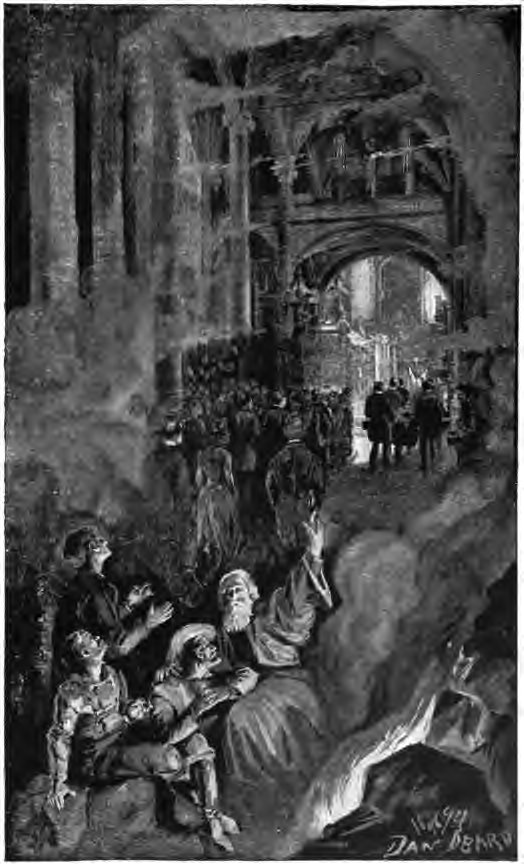 '
' A look into the future
"Oh, my faith!" cried Cortlandt, "I see my face within, yet it isbut a decomposing mass that I once described as I."
Then again did the minister's voice proclaim, "I am theresurrection and the life, saith the Lord; he that believeth inme, though he were dead, yet shall he live; and whosoever livethand believeth in me shall never die."
The bearers gently set down their burden; the minister read theever-impressive chapter of St. Paul to the Corinthians; a bishopsolemnly and silently sprinkled earth on the coffin; and thechoir sang the 398th hymn, beginning with the words, "Hark, harkmy soul! angelic songs are swelling," which had always beenCortlandt's favourite, and the service was at an end. The bearersagain shouldered all that was left of Henry Cortlandt, and hisrelatives accompanied this to the cemetery.
Then came a sweeping change of scene. A host of monuments andgravestones reflected the sunlight, while a broad river ebbed andflowed between high banks. A sexton and a watchman stood by agranite vault, the heavy door of which they had opened with alarge key. Hard by were some gardeners and labourers, and also acrowd of curiosity-seekers who had come to witness the last sadrites. Presently a funeral procession appeared. The hearsestopped near the open vault, over the door of which stood out thename of CORTLANDT, and the accompanying minister said a shortprayer, while all present uncovered their heads. After this thecoffin was borne within and set at rest upon a slab, among manygenerations of Cortlandts. In the hearts of the relatives andfriends was genuine sorrow, but the curiosity-seekers went theirway and gave little thought. "To-morrow will be like to-day,"they said, "and more great men will die."
Then came another change of scene, though it was comparativelyslight. The sun slowly sank beyond the farther bank of the broadriver, and the moon and stars shone softly on the gravestones andcrosses. Two gardeners smoked their short clay pipes on a benchbefore the Cortlandt vault, and talked in a slow manner.
"He was a great man," said one, "and if his soul blooms like theflowers on his grave, he must be in paradise, which we know is afiner park than this."
"He was expert for the Government when the earth's axis was setright," said the second gardener, "and he must have been ascholar, for his calculations have all come true. He was one ofthe first three men to visit the other planets, while theobituaries in the papers say his history will be read hereafterlike the books of Caesar. After burying all these great people,I sometimes wish I could do the same for myself, for the people Ibury seem to be remembered." After this they relapsed into theirmeditations, the silence being broken only by an occasionalmurmur from the river's steady flow.
Hereupon the voyagers found they were once more in the cave. Thefire had burned low, and the dawn was already in the east.Cortlandt wiped his forehead, shivered, and looked extremelypale.
"Thank Heaven," he cried, "we cannot ordinarily foresee our end;for but few would attain their predestined ending could they seeit in advance. May the veil not again be raised, lest I faintbefore it! I looked in vain for my soul," he continued, "butcould see it nowhere."
"The souls of those dying young," replied the spirit, "sometimeswish to hover near their ashes as if regretting an unfinishedlife, or the opportunities that have departed; but those dyingafter middle age are usually glad to be free from their bodies,and seldom think of them again."
"I shall append the lines now in my head to my history," saidCortlandt, "that where it goes they may go also. They canscarcely fail to be instructive as the conclusions of a man whohas seen beyond his grave." Whereupon he wrote a stanza in hisnote-book, and closed it without showing his companions what hehad written.
"May they do all the good you hope, and much more!" replied thespirit, "for the reward in the resurrection morning will vastlyexceed all your labours now.
"O, my friends," the spirit continued most earnestly, addressingthe three, "are you prepared for your death-beds? When your eyesglaze in their last sleep, and you lose that temporal world andwhat you perhaps considered all, as in a haze, your dim visionwill then be displaced by the true creation that will be eternal.Your unattained ambitions, your hopes, and your ideals will beswallowed in the grave. Your works will secure you a place inhistory, and many will remember your names until, in time,oblivion covers your memory as the grass conceals your tombs.Are you prepared for the time when your eyes become blind, andyour trusted senses fail? Your sorrowing friends will mourn, andthe flags of your clubs will fly at half-mast, but no earthlything can help you then. In what condition will the resurrectionmorning find you, when your sins of neglect and commission pleadfor vengeance, as Abel's blood from the ground? After that therecan be no change. The classification, as I have already toldyou, is now going on; it will then be finished."
"We are the most utterly wretched sinners!" cried Ayrault. "Showus how we can be saved."
"As an inhabitant of spirit-land, I will give you worldlycounsel," replied the bishop. "During my earthly administration,as I told you, people came from far to hear me preach. This wasbecause I had eloquence and earnestness, both gifts of God. ButI was a miserably weak sinner myself. That which I would, I didnot, and that which I would not that I did; and I often prayed mycongregation to follow my sermons rather than my ways. I seemedto do my followers good, and Daniel thus commends my way in hislast chapter: 'They that turn many to righteousness shall shineas the stars forever and ever,' and the explanation is clear.There is no surer way of learning than trying to teach. Inteaching my several flocks I was also improved myself. I wassown in weakness, but was raised in power, strength being madeperfect in weakness. Therefore improve your fellows, thoughyourself you cannot raise. The knowledge that you have sent manysouls to heaven, though you are yourself a castaway, will giveyou unspeakable joy, and place you in heaven wherever you may be.Yet remember this: none of us can win heaven; salvation is thegift of God. I have said as much now as you can remember.Farewell. Improve time while you can. Fear God and keep Hiscommandments. This is the whole duty of man."
So saying, the spirit vanished in a cloud that for atime emitted light."I am not surprised," said Bearwarden, "that people took longjourneys to hear him. I would do so myself."
"I have never had much fear of death," said Cortlandt, "but themere thought of it now makes my knees shake, and fills my heartwith dread. I thought I saw the most hateful forms about mycoffin, and imagined that they might be the personification ofdoubt, coldness, and my other shortcomings, which had comeperhaps from sympathy, in invisible form. I was almost afraid toask the spirit for the explanation."
"I saw them also," replied Bearwarden, "but took them to beswarms of microbes waiting to destroy your body, or perhapstrying in vain to penetrate your hermetically sealed coffin."Cortlandt seemed much upset, and spent the rest of the day inwriting out the facts and trying to assign a cause. Towardsevening Bearwarden, who had recovered his spirits, preparedsupper, after which they sat in the entrance to the cave.
Chapter X.Contents
AYRAULT.
As the night became darker they caught sight of the earth again,shining very faintly, and in his mind's eye Ayrault saw hissweetheart, and the old, old repining that, since reason and lovebegan, has been in men's minds, came upon him and almost crushedhim. Without saying anything to his companions, Ayrault left thecave, and, passing through the grove in which the spirit had paidthem his second visit, went slowly to the top of the hill abouthalf a mile off, that he might the more easily gaze at the faintstar on which he could picture Sylvia.
"Ah!" he said to himself, on reaching the summit, "I will stayhere till the earth rises higher, and when it is far above me Iwill gaze at it as at heaven."
Accordingly, he lay down with his head on a mound of sod, andwatched the familiar planet.
"We were born too soon," he soliloquized; "for had Sylvia and Ibut lived in the spiritual age foretold by the bishop, we mighthave held communion, while now our spirits, no matter how much inlove, are separated absolutely by a mere matter of distance. Itis a mockery to see Sylvia's dwelling-place, and feel that she isbeyond my vision. O that, in the absence of something better, mypoor imperfect eyes could be transformed into those of an eagle,but with a million times the power! for though I know that withthese senses I shall see the resurrection, and hear the lasttrump, that is but prospective, while now is the time I long forsight."
On the plain he had left he saw his friends' camp-fire, while onthe other side of his elevation was a valley in which the insectschirped sharply, and through which ran a stream. Feeling adesire for solitude and to be as far removed as possible, hearose and descended towards the water. Though the autumn, wherethey found themselves, was well advanced, this night was warm,and the rings formed a great arch above his head. Near thestream the frogs croaked happily, as if unmindful of the long,very long Saturnian winter; for though they were removed butabout ten degrees from the equator, the sun was so remote and theaxis of the planet so inclined that it was unlikely theseindividual frogs would see another summer, though they might liveagain, in a sense, in their descendants. The insects also wouldsoon be frozen and stiff, and the tall, graceful lilies thatstill clung to life would be withered and dead. The trees, as ifweeping at the evanescence of the life around them, shed theirleaves at the faintest breeze. These fluttered to the ground,or, falling into the tranquil stream, were carried away by it,and passed from sight. Ayrault stood musing and regretting thenecessity of such general death. "But," he thought, "I wouldrather die than lose my love; for then I should have had thetaste of bliss without its fulfilment, and should be worse offthan dead. Love gilds the commonplace, and deifies all ittouches. Love survives the winter, and in my present frame ofmind I should prefer earth and cold with it to heaven and spring.Oh, why is my soul so clogged by my body?"
A pillar of stone standing near him was suddenly shattered, andthe bishop stood where it had been. "Because," said the spirit, answering his thought, "it has notyet power to be free."
"Can a man's soul not rise till his body is dead?" asked Ayrault.
The spirit hesitated.
"Oh, tell me," pleaded Ayrault. "If I could see the girl to whomI am engaged, for but a moment, could be convinced that she lovesme still, my mind would be at rest. Free my soul or spirit, orwhatever it is, from this body, that I may traverse interveningspace and be with her."
"You will discover the way for yourself in time," said the spirit.
"I know I shall at the last day, in the resurrection, when I amno longer in the flesh. Then I shall have no need of your aid;for we know that in the resurrection they neither marry nor aregiven in marriage, but are like the angels of God in heaven. Itis while I am mortal, and love as mortals do, that I wish to seemy promised bride. A spirit may have other joys, and perhapshigher; but you who have lived in the world and loved, show methat which is now my heart's desire. You have shown us the tombin which Cortlandt will lie buried; now help me to go to one whois still alive.""I pray that God will grant you this," said the spirit, "and makeme His instrument, for I see the depth of your distress." Sayingwhich, he vanished, leaving no trace in his departure except thatthe pillar of stone returned to its place.With this rather vague hope, Ayrault set off to rejoin hiscompanions, for he felt the need of human sympathy. Saturn'srapid rotation had brought the earth almost to the zenith, thelittle point shining with the unmistakably steady ray of aplanet. Huge bats fluttered about him, and the greatcloud-masses swept across the sky, being part of Saturn'sceaseless whirl. He found he was in a hypnotic or spiritualisticstate, for it was not necessary for him to have his eyes open toknow where he was. In passing one of the pools they had noticed,he observed that the upper and previously invisible liquid hadthe bright colour of gold, and about it rested a group of figuresenveloped in light.
"Why do you look so sad?" they asked. "You are in that abode ofdeparted spirits known as paradise, and should be happy."
"I suppose I should be happy, were I here as you are, as thereward of merit," he replied. "But I am still in the flesh, andas such am subject to its cares."
"You are about to have an experience," said another speaker."This day your doubts will be at rest, for before another sunsetyou will know more of the woman you love."
The intensity of the spiritualistic influence here somewhatweakened, for he partially lost sight of the luminous figures,and could no longer hear what they said. His heart was in hismouth as he walked, and he felt like a man about to set out onhis honeymoon, or like a bride who knows not whether to laugh orto cry. An indescribable exhilaration was constantly present.
"I wonder," thought he, "if a caterpillar has these sensationsbefore becoming a butterfly? Though I return to the rock fromwhich I sprang, I believe I shall be with Sylvia to-day."
Footprints formed in the soft ground all around him, and the airwas filled with spots of phosphorescent light that coincided withthe relative positions of the brains, hearts, and eyes of humanbeings. These surrounded and often preceded him, as thoughleading him on, while the most heavenly anthems filled the airand the vault of the sky.
"I believe," he thought, with bounding heart, "that I shall beinitiated into the mysteries of space this night."
At times he could hear even the words of the choruses ringing inhis ears, though at others he thought the effect was altogetherin his mind.
"Oh, for a proof," he prayed, "that no sane man can doubt! Myfaith is implicit in the bishop and the vision, and I feel thatin some way I shall return to earth ere the close of another day,for I know I am awake, and that this is no dream."
A fire burned in the mouth of the cave, within which Bearwardenand Cortlandt lay sleeping. The specks of mica in the rocksreflected its light, but in addition to this a diffusedphosphorescence filled the place, and the large sod-coveredstones they used for pillows emitted purple and dark red flames.
"Is that you, Dick?" asked Bearwarden, awaking and groping about."We built up the fire so that you should find the camp, but itseems to have gone down." Saying which, he struck a match,whereupon Ayrault ceased to see the phosphorescence or bluishlight. At that moment a peal of thunder awakened Cortlandt, whosat up and rubbed his eyes.
"I think," said Ayrault, "I will go to the Callisto and get ourmackintoshes before the rain sets in." Whereupon he left hiscompanions, who were soon again fast asleep.
The sky had suddenly become filled with clouds, and Ayraulthastened towards the Callisto, intending to remain there, ifnecessary, until the storm was over. For about twenty minutes hehurried on through the growing darkness, stopping once on highground to make sure of his bearings, and he had covered more thanhalf the distance when the rain came on in a flood, accompaniedby brilliant lightning. Seeing the huge, hollow trunk of afallen tree near, and not wishing to be wet through, Ayraultfired several solid shots from his revolver into the cavity, todrive out any wild animals there might be inside, and thenhurriedly crawled in, feet first. He next drew in his head, andwas congratulating himself on his snug retreat, when the skybecame lurid with a flash of lightning, then his head droppedforward, and he was unconscious.
Chapter XI.Contents
DREAMLAND TO SHADOWLAND.
As Ayrault's consciousness returned, he fancied he heard music.Though distant, it was distinct, and seemed to ring from theether of space. Occasionally it sounded even more remote, but itwas rhythmical and continuous, inspiring and stirring him asnothing that he had ever heard before. Finally, it was overcomeby the more vivid impressions upon his other senses, and he foundhimself walking in the streets of his native city. It wasspring, and the trees were white with buds. The long shadows ofthe late afternoon stretched across the way, but the clear skygave indication of prolonged twilight, and the air was warm andbalmy. Nature was filled with life, and seemed to be proclaimingthat the cold was past.
As he moved along the street he met a funeral procession.
"What a pity," he thought, "a man should die, with summer so nearat hand!"
He was also surprised at the keenness of his sight; for, inclosedin each man's body, he saw the outline of his soul. But the deadman's body was empty, like a cage without a bird. He also readthe thoughts in their minds.
"Now," said a large man in the carriage next the hearse, "I maywin her, since she is a widow."
The widow herself kept thinking: "Would it had been I! His lifewas essential to the children, while I should scarcely have beenmissed. I wish I had no duties here, and might follow him now."
While pondering on these things, he reached Sylvia's house, andwent into the little room in which he had so often seen her. Thewarm southwesterly breeze blew through the open windows, and farbeyond Central Park the approaching sunset promised to bebeautiful. The table was covered with flowers, and though he hadoften seen that variety, he had never before noticed themarvellous combinations of colours, while the room was filledwith a thousand delicious perfumes. The thrush hanging in thewindow sang divinely, and in a silver frame he saw a likeness ofhimself.
"I have always loved this room," he thought, "but it seems to menow like heaven."
He sat down in an arm-chair from force of habit, to await hisfiancee.
"Oh, for a walk with Sylvia by twilight!" his thoughts ran on,"for she need not be at home again till after seven."
Presently he heard the soft rustle of her dress, and rose to meether. Though she looked in his direction, she did not seem to seehim, and walked past him to the window. She was the picture ofloveliness silhouetted against the sky. He went towards her, andgazed into her deep-sea eyes, which had a far-away expression.She turned, went gracefully to the mantelpiece, and took aphotograph of herself from behind the clock. On its back Ayraulthad scrawled a boyish verse composed by himself, which ran:
"My divine, most ideal Sylvia, O vision, with eyes so blue, 'Tis in the highest degree consequential, To my existence in fact essential, That I should be loved by you."
As she read and reread those lines, with his whole soul heyearned to have her look at him. He watched the colour come andgo in her clear, bright complexion, and was rejoiced to see inher the personification of activity and health. Beneath his owneffusion on the photograph he saw something written in pencil, inthe hand he knew so well:
"Did you but know how I love you, No more silly things would you ask. With my whole heart and soul I adore you-- Idiot! goose! bombast!"
And as she glanced at it, these thoughts crossed her mind: "Ishall never call you such names again. How much I shall have totell you! It is provoking that you stay away so long."
He came still nearer--so near, in fact, that he could hear thebeating of her heart--but she still seemed entirely unconsciousof his presence. Losing his reserve and self-control, heimpulsively grasped at her hands, then fell on his knees, andthen, dumfounded, struggled to his feet. Her hands seemed toslip through his; he was not able to touch her, and she was stillunaware of his presence.
Suddenly a whole flood of light and the truth burst upon him. Hehad passed painlessly and unconsciously from the dreamland ofSaturn to the shadowland of eternity. The mystery was solved.Like the dead bishop, he had become a free spirit. His prayerwas answered, and his body, struck by lightning, lay far away onthat great ringed planet. How he longed to take in his arms thegirl who had promised herself to him, and who, he now saw, lovedhim with her whole heart; but he was only an immaterial spirit,lighter even than the ether of space, and the unchangeable lawsof the universe seemed to him but the irony of fate. As aspirit, he was intangible and invisible to those in the flesh,and likewise they were beyond his control. The tragedy of lifethen dawned upon him, and the awful results of death madethemselves felt. He glanced at Sylvia. On coming in she hadlooked radiantly happy; now she seemed depressed, and even thebird stopped singing.
"Oh," he thought, "could I but return to life for one hour, totell her how incessantly she has been in my thoughts, and how Ilove her! Death, to the aged, is no loss--in fact, ablessing--but now!" and he sobbed mentally in the anguish of hissoul. If he could but communicate with her, he thought; but heremembered what the departed bishop had said, that it would takemost men centuries to do this, and that others could never learn.By that time she, too, would be dead, perhaps having been thewife of some one else, and he felt a sense of jealousy evenbeyond the grave. Throwing himself upon a rug on the floor, in aparoxysm of distress, he gazed at Sylvia.
"Oh, horrible mockery!" he thought, thinking of the spirit. "Hegave me worse than a stone when I asked for bread; for, in placeof freedom, he sent me death. Could I but be alive again for afew moments!" But, with a bitter smile, he again remembered thewords of the bishop, "What would a soul in hell not give for butone hour on earth?"
Sylvia had seated herself on a small sofa, on which, and next toher, he had so often sat. Her gentle eyes had a thoughtful look,while her face was the personification of intelligence andbeauty. She occasionally glanced at his photograph, which sheheld in her hand.
"Sylvia, Sylvia!" he suddenly cried, rising to his knees at herfeet. "I love, I adore you! It was my longing to be with youthat brought me here. I know you can neither see nor hear me,but cannot your soul commune with mine?"
"Is Dick here?" cried Sylvia, becoming deadly pale and gettingup, "or am I losing my reason?"
Seeing that she was distressed by the power of his mind, Ayraultonce more sank to the floor, burying his face in his hands.
Unable to endure this longer, and feeling as if his heart mustbreak, he rushed out into the street, wishing he might soothe hisanguish with a hypodermic injection of morphine, and that he hada body with which to divert and suppress his soul.
Night had fallen, and the electric lamps cast their white rays onthe ground, while the stars overhead shone in their eternalserenity and calm. Then was it once more brought home to himthat he was a spirit, for darkness and light were alike, and hefelt the beginning of that sense of prescience of which thebishop had spoken. Passing through the houses of some of theclubs to which he belonged, he saw his name still upon the listof members, and then he went to the places of amusement he knewso well. On all sides were familiar faces, but what interestedhim most was the great division incessantly going on. Here werejolly people enjoying life and playing cards, who, his foresightshowed him, would in less than a year be under ground--likeMercutio, in "Romeo and Juliet," to-day known as merry fellows,who to-morrow would be grave men.
While his eyes beheld the sun, he had imagined the air felt warmand balmy. He now saw that this had been a hallucination, for hewas chilled through and through. He also perceived that he castno shadow, and that no one observed his presence. He, on theother hand, saw not only the air as it entered and left hisfriends' lungs, but also the substance of their brains, and theseeds of disease and death, whose presence they themselves didnot even suspect, and the seventy-five per cent of water in theirbodies, making them appear like sacks of liquid. In some he sawthe germs of consumption; in others, affections of the heart. Inall, he saw the incessant struggle between the healthyblood-cells and the malignant, omnipresent bacilli that the cellswere trying to overcome. Many men and women he saw were in love,and he could tell what all were about to do. Oh, the secretsthat were revealed, while the motives for acts were now laid barethat till then he had misunderstood! He had often heard the oldsaying, that if every person in a ball-room could read thethoughts of the rest, the ball would seem a travesty onenjoyment, rather than real pleasure, and now he perceived itsforce. He also noticed that many were better than he hadsupposed, and were trying, in a blundering but persevering way,to obey their consciences. He saw some unselfish thoughts andacts. Many things that he had attributed to irresolution orinconsistency, he perceived were in reality self-sacrifice. Hewent on in frantic disquiet, distance no longer being ofconsequence, and in his roaming chanced to pass through thegraveyard in which many generations of his ancestors lay buried.Within the leaden coffins he saw the cold remains; some wellpreserved, others but handfuls of dust.
"Tell me, O my progenitors," he cried, "you whose blood till thismorning flowed in my veins, is there not some way by which I, asa spirit, can commune with the material world? I have alwaysadmired your judgment and wisdom, and you have all been inShadowland longer than I. Give me, I pray you, some ancestraladvice."
The only sound in answer was the hum of the insects that filledthe evening air. The moonlight shone softly, but in a ghastlyway, on the marble crosses of his vault and those around, and hefelt an unspeakable sadness within this abode of the dead. "Howmany unfinished lives," he thought, "have ended beneath thesesods! Unimproved talents here are buried in the ground.Unattained ambitions, and those who died before their time; thosewho tried, in a half-hearted way, to improve their opportunities,and accomplished something, and those who neglected them, and didstill less--all are together here, the just with the unjust,though it be for the last time. The grave absorbs their bodiesand ends their probationary record, from which there is noappeal."
Near by were some open graves, ready to receive their occupants,while a little farther on he recognized the Cortlandt mausoleum,looking exactly as when shown him, through his second sight, bythe spirit on the previous day.
From the graves filled recently, and from many others, rosethreads of coloured matter, in the form of gases, the forerunnersof miasma. He now perceived shadowy figures flitting about onthe ground and in the air, from whose eyes poured streams ofimmaterial tears. Their brains, hearts, and vertebral columnswere the parts most easily seen, and they were filled with aninextinguishable anguish and sorrow that from its very intensitymade itself seen as a blue flame. The ruffles and knickerbockersin which some of these were attired, evidently by the effects ofthe thoughts in their minds, doubtless from force of habit fromwhat they had worn on earth while alive, showed that they hadbeen dead at least two hundred years. Ayrault also now foundhimself in street clothes, although when in his clubs he had worna dress suit.
"Tell me, fellow-spirits," he said, addressing them, "how can Icommunicate with one that is still alive?"
They looked at him with moist eyes, but answered not a word.
"I attributed the misery in my heart," thought Ayrault, "entirelyto the distress at losing Sylvia, which God knows is enough; butthough I suspected it before, I now see, by my companions, that Iam in the depths of hell."
Chapter XII.Contents
SHEOL.
Failing to find words to convey his thoughts, he threw himselfinto an open grave, praying that the earth might hide his soul,as he had supposed it some day would hide his body. But theground was like crystal, and he saw the white bones in the gravesall around him. Unable to endure these surroundings longer, herushed back to his old haunts, where he knew he should find thefriends of his youth. He did not pause to go by the usual way,but passed, without stopping, through walls and buildings. Soonhe beheld the familiar scene, and heard his own name mentioned.But there was no comfort here, and what he had seen of old wasbut an incident to what he gazed on now. Praying with his wholeheart that he might make himself heard, he stepped upon afoot-stool, and cried:
"Your bodies are decaying before me. You are burying yourtalents in the ground. We must all stand for final sentence atthe last day, mortals and spirits alike--there is not a shadowof a shade of doubt. Your every thought will be known, and forevery evil deed and every idle word God will bring us intojudgment. The angel of death is among you and at work in yourvery midst. Are you prepared to receive him? He has alreadykilled my body, and now that I can never die I wish there was agrave for my soul. I was reassured by a vision that told me Iwas safe, but either it was a hallucination, or I have beenbetrayed by some spirit. Last night I still lived, and my bodyobeyed my will. Since then I have experienced death, and withthe resulting increased knowledge comes the loss of all hope,with keener pangs than I supposed could exist. Oh, that I hadnow their opportunities, that I might write a thesis that shouldlive forever, and save millions of souls from the anguish ofmine! Inoculate your mortal bodies with the germs of faith andmutual love, in a stronger degree than they dwelt in me, lest youlose the life above."
But no one heard him, and he preached in vain.
He again rushed forth, and, after a half-involuntary effort,found himself in the street before his loved one's home.Scarcely knowing why, except that it had become nature to wish tobe near her, he stood for a long time opposite her dwelling.
"O house!" he cried, "inanimate object that can yet enthral meso, I stand before your cold front as a suppliant from a verydistant realm; yet in my sadness I am colder than your stones,more alone than in a desolate place. She that dwells within youholds my love. I long for her shadow or the sound of her step.I am more wretchedly in love than ever--I, an impotent, invisiblespirit. Must I bear this sorrow in addition to my others, in myfruitless search for rest? My life will be a waking nightmare,most bitter irony of fate."The trees swayed above his head, and the moon, in its lastquarter, looked dreamily at him.
"Ah," thought Ayrault, "could I but sleep and be happy!Drowsiness and weariness, fatigue's grasp is on me; or maySylvia's nearness soothe, as her voice has brought me calm!Quiet I may some day enjoy, but slumber again, never! I see thatsouls in hades must ever have their misdeeds before them. Happyman in this world, the repentant's sins are forgiven! You loseyour care in sleep. Somnolence and drowsiness--balm of achinghearts, angels of mercy! Mortals, how blessed! until you die,God sends you this rest. When I recall summer evenings withSylvia, while gentle zephyrs fanned our brows, I would changePope's famous line to 'Man never is, but always HAS BEENblessed.'"
A clock in a church-steeple now struck three, the sound ringingthrough the still night air.
"It will soon be time for ghosts to go," thought Ayrault. "Imust not haunt her dwelling."
There was a light in Sylvia's study, and Ayrault remainedmeditatively gazing at it.
"Happy lamp," he thought, "to shed your light on one so fair!She can see you, and you shine, for her. You are better off thanI. Would that her soul might shine for me, as your light shinesfor her! The light of my life has departed. O that the darknesswere complete! I am dead," his thoughts ran on, and when theprivilege--bitter word!--that permits me to remain here hasexpired, I must doubtless return to Saturn, and there inpurgatory work out my probation. But what comfort is it that afew centuries hence I may be able to revisit my native earth?--
The flowers will bloom in the morning light, And the lark salute the sun, The earth will continue to roll through space, And I may be nearer my final grace, But Sylvia's life-thread will be spun.
"Even Sylvia's house will be a heap of ruins, or its place willbe taken by something else. If I had Sylvia, I should care fornothing; as I have lost her, even this sight, though sweet, mustalways bring regret. I wish, at all events, I might see Sylvia,if only with these spirit-eyes, since, as a mortal, she may nevergladden my sight again."
To his surprise, he now perceived that he could see,notwithstanding the drawn shades. Sylvia was at herwriting-desk, in a light-coloured wrapper. She sat there restingher head on her hand, looking thoughtful but worried. Though itwas so late, she had not retired. The thrush that Ayrault hadoften in life admired, and that she had for some reason broughtup-stairs, was silent and asleep.
"Happy bird!" he said, "you obtain rest and forgetfulness oncovering your head; but what wing can cover my soul? I used towish I might flutter towards heaven on natural wings like you,little thrush. Now I can, indeed, outfly you. But whatever I doI'm unhappy, and wherever I go I'm in hell. What is man in hishelpless, first spiritual state? He is but a flower, and witherssoon. Had I, like the bishop, been less blind, and obeyed myconscience clear, I might have returned to my native earth whileSylvia still sojourns here; and coming thus by virtue ofdevelopment, I should be able to commune with her.
"What is life?" he continued. "In the retrospect, nothing. Itseems to me already as but an infinitesimal point. Things thatengrossed me, and seemed of such moment, that overshadowed theduty of obeying my conscience--what were they, and where? Ah,where? They endured but a moment. Reality andevanescence--evanescence and reality."
The light in Sylvia's room was out now, and in the east he beheldthe dawn. The ubiquitous grey which he saw at night was invadedby streams of glorious crimson and blue that reached far up intothe sky. He gazed at the spectacle, and then once more at thathouse in which his love was centred.
"Would I might be her guardian angel, to guide her in the rightand keep her from all harm!
"Sleep on, Sylvia. Sweet one, sleep. Yon stars fade beside your eyes. Your thoughts and your soul are fairer far than the east in this day's sunrise."
I know what I have lost. Ah, desolating knowledge! for I have read Sylvia'sheart, and know I was loved as truly as I loved. When Bearwardenand Cortlandt break her the news--ah, God! will she live, and dothey yet know I am dead?"
Again came that spasm to shed spirit tears, and had he not knownit impossible he would have thought his heart must break.
The birds twittered, and the light grew, but Ayrault lay with hisface upon the ground. Finally the spirit of unrest drove him on.He passed the barred door of his own house, through which he hadentered so often. It was unchanged, but seemed deserted. Next,he went to the water-front, where he had left his yacht.Invisibly and sadly he stood upon her upper deck, and gazed atthe levers, in response to his touch on which the craft had cleftthe waves, reversed, or turned like a thing of life."'Twas a pretty toy," he mused, "and many hours of joy have I hadas I floated through life on board of her."
As he moped along he beheld two unkempt Italians having apiano-organ and a violin. The music was not fine, but it toucheda chord in Ayrault's breast, for he had waltzed with Sylvia tothat air, and it made his heart ache.
"Oh, the acuteness of my distress," he cried, "the utter depth ofmy sorrow! Can I have no peace in death, no oblivion in thegrave? I am reminded of my blighted, hopeless love in all kindsof unexpected ways, by unforeseen trifles. Oh, would I might,indeed, die! May obliteration be my deliverer!"
"Poor fellows," he continued, glancing at the Italians, for heperceived that neither of the players was happy; the pianist wasavaricious, while the violinist's natural and habitual jealousydestroyed his peace of mind.
"Unhappiness seems the common lot," thought Ayrault. "Earthcannot give that joy for which we sigh. Poor fellows! though yourack my ears and distress my heart, I cannot help you now."
Chapter XIII.Contents
THE PRIEST'S SERMON.
It being the first day of the week, the morning air was filledwith chimes from many steeples.
"Divine service always comforted in life," thought Ayrault,"perchance it may do so now, when I have reached the state forwhich it tried to prepare me."
Accordingly, he moved on with the throng, and soon was ascendingthe heights of Morningside Park, after which, he entered thecathedral. The priest whose voice had so often thrilled himstood at his post in his surplice, and the choir had finished theprocessional hymn. During the responses in the litany, andbetween the commandments, while the congregation and the choirsang, he heard their natural voices as of old ascending to thevaulted roof and arrested there. He now also heard theirspiritual voices resulting from the earnestness of their prayers.These were rung through the vaster vault of space, arousing aspiritual echo beyond the constellations and the nebulae. Theservice, which was that of the Protestant Episcopal Church,touched him as deeply as usual, after which the rector ascendedthe steps to the pulpit.
"The text, this morning," he began, "is from the eighth chapterof St. Paul's Epistle to the Romans, at the eighteenth verse:'For I reckon that the sufferings of this present time are notworthy to be compared to the glory that shall be revealed in us.'Let us suppose that you or I, brethren, should become a free anddisembodied spirit. A minute vein in the brain bursts, or a clotforms in the heart. It may be a mere trifle, some unexpectedthing, yet the career in the flesh is ended, the eternal life ofthe liberated spirit begun. The soul slips from earth's grasp,as air from our fingers, and finds itself in the frigid,boundless void of space. Yet, through some longing this soulmight rejoin us, and, though invisible, might hear thechurch-bells ring, and long to recall some one of the many brightSunday mornings spent here on earth. Has a direful misfortunebefallen this brother, or has a slave been set free? Let ussuppose for a moment that the first has occurred. 'Vanity ofvanities,' said the old preacher. 'Calamity of calamities,' saysthe new. That soul's probationary period is ended; his record,on which he must go, is forever made. He has been in the flesh,let us say, one, two, three or four score years; before him arethe countless æons of eternity. He may have had a reasonablysatisfactory life, from his point of view, and been fairlysuccessful in stilling conscience. That still, small voicedoubtless spoke pretty sharply at first, but after a while itrarely troubled him, and in the end it spoke not at all. He may,in a way, have enjoyed life and the beauties of nature. He hasseen the fresh leaves come and go, but he forgot the moral, thathe himself was but a leaf, and that, as they all dropped to earthto make more soil, his ashes must also return to the ground. Buthis soul, friends and brethren, what becomes of that? Ah! it isthe study of this question that moistens our eyes with tears. Noevil man is really happy here, and what must be his suffering inthe cold, cold land of spirits? No slumber or forgetfulness canease his lot in hades, and after his condemnation at the lastjudgment he must forever face the unsoftened realities ofeternity. No evil thing or thought can find lodgment in heaven.If it could, heaven would not be a happy place; neither can anyman improve in the abyss of hell. As the horizon graduallydarkens, and this soul recedes from God, the time spent in theflesh must come to seem the most infinitesimal moment, moreevanescent than the tick of a clock. It seems dreadful that forsuch short misdoings a soul should suffer so long, but no man canbe saved in spite of himself. He had the opportunities--and theknowledge of this must give a soul the most acute pang.
"In Revelation, xx, 6, we find these words, 'Blessed and holy ishe that hath part in the first resurrection: on such the seconddeath hath no power.' I have often asked myself, May not thismean that those with a bad record in the general resurrectionafter a time cease to exist, since all suffer one death at theclose of their period here?"This is somewhat suggested by Proverbs, xii, 28. 'In the wayof righteousness is life, and in the pathway thereof there is nodeath.' This might limit the everlasting damnation, so oftenrepeated elsewhere, to the lives of the condemned, since to them,in a sense, it would be everlasting.
"Let us now turn to the bright picture--the soul that hasweathered the storms of life and has reached the haven of rest.The struggles, temptations, and trials overcome, have done theirwork of refining with a rapidity that could not have beenequalled in any other way, and though, perhaps, very imperfectstill, the journey is ever on. The reward is tenfold, yet inproportion to what this soul has done, for we know that theservant who best used his ten talents was made ruler over tencities, while he that increased his five talents by five receivedfive; and the Saviour in whom he trusted, by whose aid he madehis fight, stands ready to receive him, saying, 'Enter thou intothe joy of thy Lord.'
"As the dark, earthly background recedes, the clouds break andthe glorious light appears, the contrast heightening theever-unfolding and increasing delights, which are as great as therecipients have power to enjoy, since these righteous soulsreceive their rewards in proportion to the weight of the crossesthat they have borne in the right spirit. These souls are a joyto their Creator, and are the heirs of Him in heaven. Theceaseless, sleepless activity that must obtain in both paradiseand hades, and that must make the hearts of the godless growfaint at the contemplation, is also a boundless promise to thosewho have Him who is all in all.
"Where is now thy Saviour? where is now thy God? the unjust manhas asked in his heart when he saw his just neighbour strugglingand unsuccessful. Both the righteous and the unrighteous man aredead. The one has found his Saviour, the other is yearly losingGod. What is the suffering of the present momentary time, easedas it is by God's mercy and presence, compared with the gloriesthat await us? What would it be if our lives here were filledwith nothing else, as ye know that your labour is not vain in theLord? Time and eternity--the finite and the infinite. Deathwas, indeed, a deliverer, and the sunset of the body is thesunrise of the soul."
The priest held himself erect as a soldier while delivering thissermon, making the great cathedral ring with his earnest andsolemn voice, while Ayrault, as a spirit, saw how absolutely hemeant and believed every word that he said.
Nearly all the members of the congregation were moved--some more,some less than they appeared. After the benediction they rapidlydispersed, carrying in their hearts the germs he had sown; butwhether these would bear fruit or wither, time alone could show.
Ayrault had noticed Sylvia's father and mother in church, butSylvia herself was not there, and he was distressed to think shemight be ill.
"Why," pondered Ayrault, "am I so unhappy? I was baptized,confirmed, and have taken the sacrament. I have always had anunshaken faith, and, though often unsuccessful, have striven toobey my conscience. The spirits also on Saturn kept saying Ishould be happy. Now, did this mean it was incumbent upon me torejoice, because of some blessing I already had, and did notappreciate, or did their prescience show them some prospectivehappiness I was to enjoy? The visions also of Violet, the angel,and the lily, which I believed, and still believe, were no mereempty fancies, should have given me the most unspeakable joy. Itmay be a mistake to apply earthly logic to heavenly things, butthe fundamental laws of science cannot change.
"Why am I so unhappy?" he continued, returning to his originalquestion. "The visions gave promise of special grace, perhapssome special favour. True, my prayer to see Sylvia was heard,but, considering the sacrifice, this has been no blessing. Therequest cannot have been wrong in itself, and as for the manner,there was no arrogance in my heart. I asked as a mortal, as aman of but finite understanding, for what concerned me most.Why, oh why, so wretched?"
Chapter XIV.Contents
HIC ILLE JACET.
At daybreak the thunder-shower passed off, but was followed by acold, drenching rain. Supposing Ayrault had remained in theCallisto, Bearwarden and Cortlandt did not feel anxious, and, notwishing to be wet through, remained in the cave, keeping up agood fire with the wood they had collected. Towards evening acold wind came up, and, thinking this might clear the air, theyventured out, but, finding the ground saturated, and that therain was again beginning to fall, they returned to shelter,prepared a dinner of canned meat, and made themselves ascomfortable as possible for the night.
"I am surprised," said Cortlandt, "that Dick did not try toreturn to us, since he had the mackintoshes."
"I dare say he did try," replied Bearwarden, "but finding thecourse inundated, and knowing we should not need the mackintoshesif we remained under cover, decided to put back. The Callistois, of course, as safe as a church."
"I hope," said Cortlandt, "no harm has come to him on the way.It will be a weight off my mind to see him safely with us."
"Should he not turn up in the morning," replied Bearwarden, "wemust begin a search for him bright and early."
Making up the fire as near the entrance of the cave as they couldfind a dry place, so that Ayrault should see it if he attemptedto return during the night, they piled on wood, and talked oftheir recent experiences.
"However unwilling I was," said Cortlandt, "to believe my senses,which I felt were misleading me, I can no longer doubt thereality of that spirit bishop, or the truth of what he says.When you look at the question dispassionately, it is what youmight logically expect. In my desire to disprove what is to ussupernatural, I tried to create mentally a system that would be asubstitute for the one he described, but could evolve nothingthat so perfectly filled the requirements, or that was so simple.Nothing seems more natural than that man, having been evolvedfrom stone, should continue his ascent till he discards materialaltogether. The metamorphism is more striking in the firstchange than in the second. Granted that the soul is immaterial,and that it leaves the body after death, what is there to keep iton earth? Gravitation cannot affect it. What is more likelythan that it is left behind by the earth in its orbit, or that itcontinues its forward motion, but in a straight line, till,reaching the paths of the greater planets, it is drawn to them bysome affinity or attraction that the earth does not possess, andthat the souls held in that manner remain here on probation,developing like young animals or children, till, by graduallyacquired power, resulting from their wills, they are able to riseagain into space, to revisit the earth, and in time to explorethe universe? It might easily come about that, by someexplainable sympathy, the infant good souls are drawn to thisplanet, while the condemned pass on to Cassandra, which holdsthem by some property peculiar to itself, until perhaps they,too, by virtue of their wills, acquire new power, unlessinvolution sets in and they lose what they have. The simplicityof the thing is what surprises me now, and that for agesphilosophers have been racking their brains with everyconceivable fancy, when, by simply extending and followingnatural laws, they could discern the whole."
"It is the old story," said Bearwarden, "of Columbus and the egg.Schopenhouer and his predecessors appear to have tried every ideabut the right one, and even Darwin and Huxley fell short in theirreasoning, because they tried to obtain more or less than four byputting two with two."
Thus they sat and talked while the night wore on. Neitherthought of sleeping, hoping all the while that Ayrault might walkin as he had the night before.
At last the dawn began to tint the east, and the growing lightshowed them that the storm had passed. The upper strata ofSaturn's atmosphere being filled with infinitesimal particles ofdust, as a result of its numerous volcanoes, the conditions werehighly favourable to beautiful sunrises and sunsets. Sooncoloured streaks extended far into the sky, and though they knewthat when the sun's disc appeared it would seem small, it filledthe almost boundless eastern horizon with the most variegated andgorgeous hues.
Turning away from the welcome sight--for their minds were ill atease--they found the light strong enough for their search tobegin. Writing on a sheet of paper, in a large hand, "Have goneto the Callisto to look for you; shall afterwards return here,"they pinned this in a conspicuous place and set out due west,keeping about a hundred yards apart. The ground was wet andslippery, but overhead all was clear, and the sun soon shonebrightly. Looking to right and left, and occasionally shoutingand discharging their revolvers, they went on for half an hour.
"I have his tracks," called Bearwarden, and Cortlandt hastened tojoin him.
In the soft ground, sure enough, they saw Ayrault's footprints,and, from the distance between them, concluded that he must havebeen running or walking very fast; but the rain had washed downthe edges of the incision. The trail ascended a gentle slope,where they lost it; but on reaching the summit they saw it againwith the feet together, as though Ayrault had paused, and aboutit were many other impressions with the feet turned in, as if thewalkers or standers had surrounded Ayrault, who was in thecentre.
"I hope," said Cortlandt, "these are nothing more than thefootprints we have seen formed about ourselves."
"See," said Bearwarden, "Dick's trail goes on, and the othersvanish. They cannot have been made by savages or Indians, forthey seem to have had weight only while standing."
They then resumed their march, firing a revolver shot atintervals of a minute. Suddenly they came upon a tall, straighttree, uprooted by the wind and lying diagonally across theirpath. Following with their eyes the direction in which it lay,they saw a large, hollow trunk, with the bark stripped off, andcharred as if struck by lightning. Obliged to pass near this bythe uprooted tree-whose thick trunk, upheld by the branches atthe head, lay raised about two feet from the ground--bothsearchers gave a start, and stood still as if petrified. Insidethe great trunk they saw a head, and, on looking more closely,descried Ayrault's body. Grasping it by the arms, they drew itout. The face was pale and the limbs were stiff. InstantlyCortlandt unfastened the collar, while Bearwarden applied a flaskto the lips. But they soon found that their efforts were vain.
"The spirit!" ejaculated Cortlandt. "Dick may be in a trance, inwhich case he can help us. Let us will hard and long."Accordingly, they threw themselves on their faces, closing theireyes, that nothing might distract their concentration. Minutes,which seemed like ages, passed, and there was no response.
"Now," said Bearwarden, "will together, hard."
Suddenly the stillness was broken by the spirit's voice, whichsaid:
"I felt more than one mind calling, but the effect was so slightI thought first I was mistaken. I will help you in what youwant, for the young man is not dead, neither is he injured."
Saying which, he stretched himself upon Ayrault, worked his lungsartificially, and willed with an intensity the observers couldfeel where they stood. Quickly the colour returned to Ayrault'scheeks, and with the spirit's assistance he sat up and leanedagainst the tree that had protected him from the storm.
"Your promise was realized," he said, addressing the spirit. "Ihave seen what I shall never forget, and lest the anguish--thevision of which I saw--come true, let us return to the earth, andnot leave it till I have tasted in reality the joys that in thespirit I seemed to have missed. I have often longed in this lifeto be in the spirit, but never knew what longing was, till Iexperienced it as a spirit, to be once more in the flesh."
"You see the mercy of God," said the spirit, "in not ordinarilyallowing the spirits of the departed to revisit earth until theyare prepared--that is, until they are sufficiently advanced to gothere unaided--by which time they have come to understand thewisdom of God's laws. In your case the limiting laws werepartially suspended, so that you were able to return at once,with many of the faculties and senses of spirits, but withouttheir accumulated experience. It speaks well for your state ofpreparation that, without having had those disguised blessings,illness or misfortune, you were not utterly crushed by what yousaw when temporarily released. While in the trance you were notin hell, but experienced the feelings that all mortals would ifallowed to return immediately. Thus no lover can return to earthtill his fiancee has joined him here, or till, perceiving thebenevolence of God's ways, he is not distressed at what he sees,and has the companionship of a host of kindred spirits.
"The spirits you saw in the cemetery were indeed in hell, but hadbecome sufficiently developed to revisit the earth, though doingso did not relieve their distress; for neither the development oftheir senses, which intensifies their capacity for remorse andregret, nor their investigations into God's boundless mercies,which they have deliberately thrown away, can comfort them.
"Some of your ancestors are on Cassandra, and others are inpurgatory here. Though a few faintly felt your prayer, none wereable to return and answer beside their graves. It was at yourrequest and prayer that He freed your spirit, but you see howunhappy it made you."
"I see," replied Ayrault, "that no man should wish to anticipatethe workings of the Almighty, although I have been unspeakablyblessed in that He made an exception--if I may so call it--in myfavour, since, in addition to revealing the responsibilities oflife, it has shown me the inestimable value and loyalty ofwoman's love. I fear, however, that my return to earth greatlydistressed the waterer of the flowers you showed me."
"She already sleeps," replied the spirit, "and I have comfortedher by a dream in which she sees that you are well.""When shall we start?" asked Bearwarden.
"As soon as you can get ready," replied Ayrault. "I would notrisk running short of enough current to generate the apergyneeded to get us back. I dare say when I have been on earth afew years, and have done something for the good of mysoul--which, as I take it, can be accomplished as well byadvancing science as in any other way--I shall pine for anotherjourney in space as I now do to return."
"How I wish I were engaged," said Bearwarden, glancing atCortlandt, and overjoyed at Ayrault's recovery.
Accordingly, they resumed their march in the direction in whichthey had been going when they found Ayrault, and were soon besidethe Callisto. Cortlandt worked the combination lock of the lowerentrance, through which they crawled. Going to the second story,they opened a large window and let down a ladder, on which thespirit ascended at their invitation.
Bearwarden and Ayrault immediately set about combining thechemicals that were to produce the force necessary to repel themfrom Saturn. Bubbles of hydrogen were given off from the leadand zinc plates, and the viscous primary batteries quickly hadthe wires passing through a vacuum at a white heat.
"I see you are nearly ready to start," said the spirit, "so Imust say farewell."
"Will you not come with us?" asked Ayrault.
"No," replied the spirit. "I do not wish to be away as long asit will take you to reach the earth. The Callisto's atmospherecould not absorb my body, so that, should I leave you before yourarrival, you would be burdened with a corpse. I may visit you inthe spirit, though the desire and effort for communion withspirits, to be of most good, must needs come from the earth. Erelong, my intuition tells me, we shall meet again.
"The vision of your own grave," he continued, addressingCortlandt, "may not come true for many years, but however longyour lives may be, according to earthly reckoning, remember thatwhen they are past they will seem to have been hardly more than amoment, for they are the personification of frailty andevanescence."
He held up his hands and blessed them; and then repeating,"Farewell and a happy return!" descended as he had come up.
The air was filled with misty shadows, and the pulsating hearts,luminous brains, and centres of spiritual activity quivered withmotion. They surrounded the incarnate spirit of the bishop andset up the soft, musical hum the travellers had heard so oftensince their arrival on Saturn.
"I now understand," thought Ayrault, "why the spirits I met keptrepeating that I should be happy. They perceived I was to betranslated, and though they doubtless knew what suffering itwould cause, they also knew I should be awakened to a sense ofgreat realities, of which I understood but little."
They drew up the ladder and turned on the current, and theCallisto slowly began to rise, while the three friends crowdedthe window.
"Good-bye!" called the spirit's pleasant voice, to which the menreplied in chorus.
The sun had set on the surface of the planet while they madetheir preparations; but as the Callisto rose higher, it seemed torise again, making the sides of their car shine like silver, and,carefully closing the two open windows, they watched thefast-receding world, so many times larger and more magnificentthan their own.
Chapter XV.Contents
MOTHER EARTH.
"There is something sad," said Cortlandt, "about the end ofeverything, but I am more sorry to leave Saturn than I have everbeen in taking leave of any other place."
When beyond the limits of the atmosphere they applied the fullcurrent, and were soon once more cleaving the ether at cometaryspeed, their motion towards the sun being aided by that greatbody itself.
They quickly passed beyond the outer edge of the vast silveryrings, and then crossed one after another the orbits of themoons, from the last of which, Iapetus, they obtained their finalcourse in the direction of the earth. They had an acute feelingof homesickness for the mysterious planet on which, while yetmortal, they had found paradise, and had communed with spirits asno modern men ever did.
Without deviating from their almost straight line, they passedwithin a million miles of Jupiter, which had gained in itssmaller orbit on Saturn, and a few days later crossed the trackof Mars.
As the earth had completed nearly half a revolution in its orbitsince their departure, they here turned somewhat to the right byattracting the ruddy planet, in order to avoid passing too nearthe sun.
"On some future expedition," said Ayrault, "and when we have asupply of blue glasses, we can take a trip to Venus, if we canfind a possible season in her year. Compared with this journey,it would be only like going round the block."
Two days later they had rounded the sun, and laid their course inpursuit of the earth.
That the astronomers in the dark hemisphere were at their postsand saw them, was evident; for a brilliant beam of light againflashed forth, this time from a point a little south of thearctic circle, and after shining one minute, telegraphed thismessage: "Rejoiced to see you again. Hope all are well."
Since they were not sufficiently near the moon's shadow, theydirected their light-beam into their own, which trailed off onone side, and answered: "All well, thank you. Have wonderfulthings to relate."
The men at the telescopes then, as before, read the message, andtelephoned the light this next question: "When are you comingdown, that we may notify the newspapers?"
"We wish one more sight of the earth from this height, bydaylight. We are now swinging to get between it and the sun."
"We have erected a monument in Van Cortlandt Park, and engravedupon it, 'At this place James Bearwarden, Henry ChelmsfordCortlandt, and Richard Rokeby Ayrault left earth, December 21, A.D. 2000, to visit Jupiter.'"
"Add to it, 'They returned on the 10th of the following June.'"
Soon the Callisto came nearly between the earth and the sun, whenthe astronomers could see it only through darkened glasses, andit appeared almost as a crescent. The sight the travellers thenbeheld was superb. It was about 11 A. M. in London, and Europewas spread before them like a map. All its peninsulas andislands, enclosed blue seas, and bays came out in clear relief.Gradually Russia, Germany, France, the British Isles, and Spainmoved towards the horizon, as in grand procession, and at thesame time the Western hemisphere appeared. The hour of day atthe longitude above which they hung was about the same as whenthey set out, but the sun shone far more directly upon theNorthern hemisphere than then, and instead of bleak December,this was the leafy month of June.
They were loath to end the lovely scene, and would fain haveremained where they were while the earth revolved again; but,remembering that their friends must by this time be waiting, theyshut off the repulsion from the earth.
"We need not apply the apergy to the earth until quite near,"said Ayrault, "since a great part of the top speed will be takenoff by the resistance of the atmosphere, especially as we go inbase first. We have only to keep a sufficiently strong repulsionon the dome to prevent our turning over, and to see that ourspeed is not great enough to heat the car."
When about fifty miles from the surface they felt the expectedcheck, and concluded they had reached the upper limits of theatmosphere. And this increased, notwithstanding the decrease intheir speed, showing how quickly the air became dense.
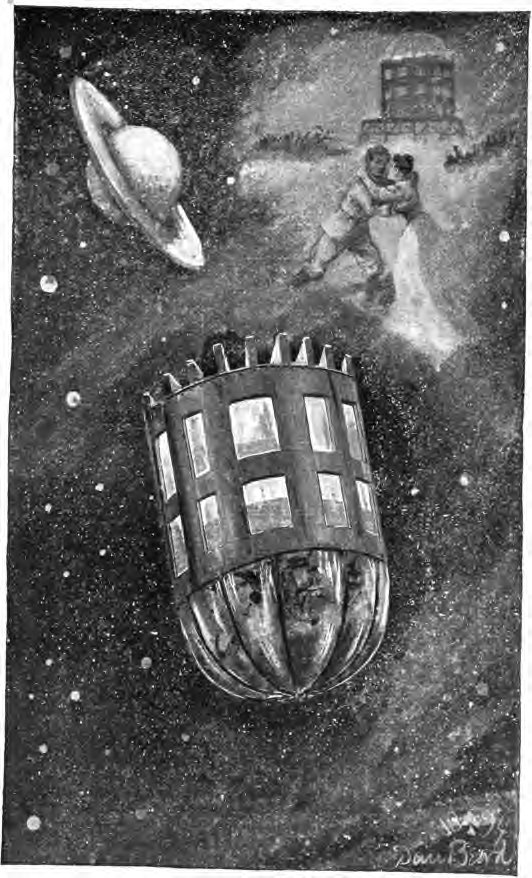 '
' The return
When about a mile from the earth they had the Callisto well inhand, and allowed it to descend slowly. The ground was alreadyblack with people, who, having learned where the Callisto was totouch, had hastened to Van Cortlandt Park.
"I am overjoyed to see you," said Sylvia, when she and Ayraultmet. "I had the most dreadful presentiment that something hadgone wrong with you. One afternoon and evening I was soperplexed, and during the night had a series of nightmares that Ishall never forget. I really believed you were near me, but yournature seemed to have changed, for, instead of its making mehappy, I was frightfully distressed. The next day I was veryill, and unable to get up; but during the morning I fell asleepand had another dream, which was intensely realistic and made mebelieve--yes, convinced me--that you were well. After that dreamI soon recovered; but oh, the anguish of the first!"
Ayrault did not tell her then that he had been near her, and ofhis unspeakable suffering, of which hers had been but the echo.
Three weeks later a clergyman tied the knot that was to unitethem forever.While Sylvia and Ayrault were standing up to receive thecongratulations of their friends, Bearwarden, in shaking hishand, said:
"Remember, we have been to neither Uranus, nor Neptune, norCassandra, which may be as interesting as anything we have seen.Should you want to take another trip, count me as your humbleservant." And Cortlandt, following behind him, said the samething.
Shortly after this, Sylvia went up-stairs to change her dress,and when she came down she and Ayrault set out on their journeytogether through life, amid a chorus of cheers and a shower ofrice.
Cortlandt then returned to his department at Washington, andBearwarden resumed his duties with the Terrestrial AxisStraightening Company, in the presidential chair.
 '
' Back cover
Contents
Top
(Editor: Reading Week)
- The Project Gutenberg eBook of The Divine Comedy, Paradise, by Dante Alighieri
- The Tapestried Chamber, by Sir Walter Scott
- The Tapestried Chamber, by Sir Walter Scott
- The Project Gutenberg eBook of Gorgias, by Plato
- The Nature Faker, by Richard Harding Davis
- The Project Gutenberg eBook of Gorgias, by Plato
- The Human Drift
- The Human Drift
- Tales of the Fish Patrol, by Jack London
- The Project Gutenberg eBook of Gorgias, by Plato
- The Human Drift
- The Tapestried Chamber, by Sir Walter Scott
- As You Like It
- The Tapestried Chamber, by Sir Walter Scott
- The Project Gutenberg eBook of Ethics — Part 5, by Benedictus de Spinoza
- The Human Drift
- The Tapestried Chamber, by Sir Walter Scott
- The Project Gutenberg eBook of Gorgias, by Plato
- The Cost of Kindness, by Jerome K. Jerome
- The Project Gutenberg eBook of Gorgias, by Plato
- The Wreck of the Golden Mary views+
- A Message from the Sea views+
- The Project Gutenberg eBook of Masterman Ready, by Frederick Marryat views+
- The Recruit, by Honore de Balzac views+
- Melmoth Reconciled, by Honore de Balzac views+
- The Jimmyjohn Boss and Other Stories, by Owen Wister views+
- The Seven Poor Travellers views+
- A Voyage to Abyssinia views+
- A New Philosophy: Henri Bergson, by Edouard Le Roy views+
- The Heritage of the Desert, by Zane Grey views+